
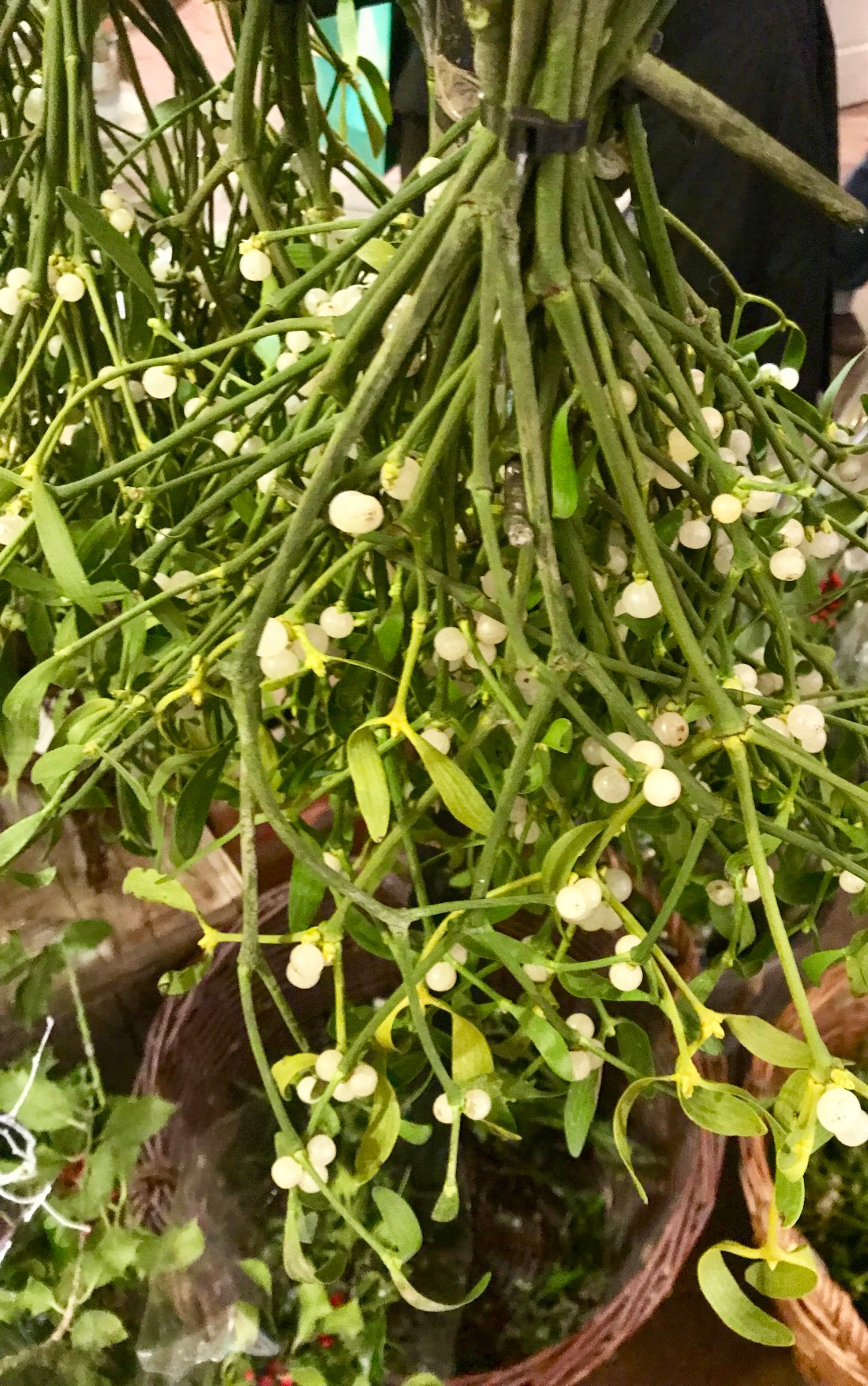
It is easy to understand why ancient peoples considered mistletoe magical. It seems to appear in trees all by itself and grows without roots. In truth, Viscum album, European mistletoe, is a hemiparasite spread by birds. Its evergreen leaves and stems contain chlorophyll and it does photosynthesise to a degree. The mature plant is entirely reliant on its host for water however, and for the majority of its nutrients. It achieves this by penetrating the bark of its host – a process that can take up to a year – and tapping into the connective tissue of xylem and phloem with a specialised growth known as a haustorium.
I gardened for many years in Herefordshire, which has taken mistletoe as its county flower. It is entirely appropriate. It thrives in the wet climate and seems especially fond of growing on apple trees of which Herefordshire has millions, being a cider-producing county. It was a constant battle to keep our orchards clear of it, and not one I was winning. A heavy infestation of mistletoe will weaken a tree, even to the point of death. The visible mistletoe can be cut and has a value in the weeks before Christmas, but it will regrow. To eradicate it from a tree, the wood which has been penetrated by the haustorium must be pruned out and sometimes not very much tree remains. I suspect, in the years to come, mistletoe will prove to be an indicator species for climate change. There is a clear line across the country, south of which mistletoe thrives.
The tradition of hanging mistletoe over doors has a very long history and was a feature of the Roman Saturnalia – a December festival involving feasting and the giving of gifts. For the Romans, it was a symbol of peace and understanding a meaning, oddly enough, which the later Vikings shared. In Viking mythology, Loki tricks the blind god Hodur into killing his otherwise invincible brother Baldr with an arrow or lance of mistletoe wood. When order is restored, mistletoe becomes a symbol of reconciliation. For the Greeks and the Celts, the white berries were symbols of divine male fertility and thus human male fertility by extension. These different strands of myth seem to have found a synthesis in the English practice of claiming kisses under a bunch of mistletoe at Christmas, removing a berry for each kiss exchanged.
It is best to leave the eating of the berries to the birds though, as all parts of the plant are toxic. One of the joys of winter in Herefordshire was seeing the orchards fill with mistle thrushes, feasting on the bounty and ensuring future bounties would be there for them in years to come, as they spread the seeds from tree to tree.

 thephilosophergardener
County flower or Herefordshire?! Oh my! It is the state flower of Oklahoma. That still seems odd to me.
LikeLike
It is a different species of course.
LikeLike
When I was brushing up on Viscum album, I saw that it had been introduced to California! That seems most odd to me. I love it though, that the associations of the plant have endured when their original mythological/religious frames have withered.
LikeLike
Yes, that is odd. There is too much mistletoe here to introduce another. If I remember correctly, there are only two native specie here.
LikeLike