
Ivy is a much maligned, but highly useful plant in the garden. Although it can be slow to establish and often sits still twiddling its thumbs for the first three years after planting, once it does start to grow in earnest, it soon scales whatever wall or structure has been provided for it. One of the most effective uses I have encountered in in the gardens of the Palais Royale in Paris. There, it grows through a chainlink fence and transforms a rather ugly feature into a visually solid, but narrow barrier – it must be 10cm/4″ thick at most. Its reputation for thuggery is due to the damage it can do to a poorly maintained wall. A recent ten year study by the University of Oxford on new walls, however, showed that the ivy-clad wall was in better condition than the bare wall at the finish. Like other climbers on walls, in provides insulation against sound and temperature. Being evergreen, it insulates the wall through the coldest months of the year, thus reducing frost shale on the bricks. And, although ivy does no harm when growing up the trunks of mature trees, it does conceal problems. I do cut my ivy from roadside trees, but those within the demesne are safe.
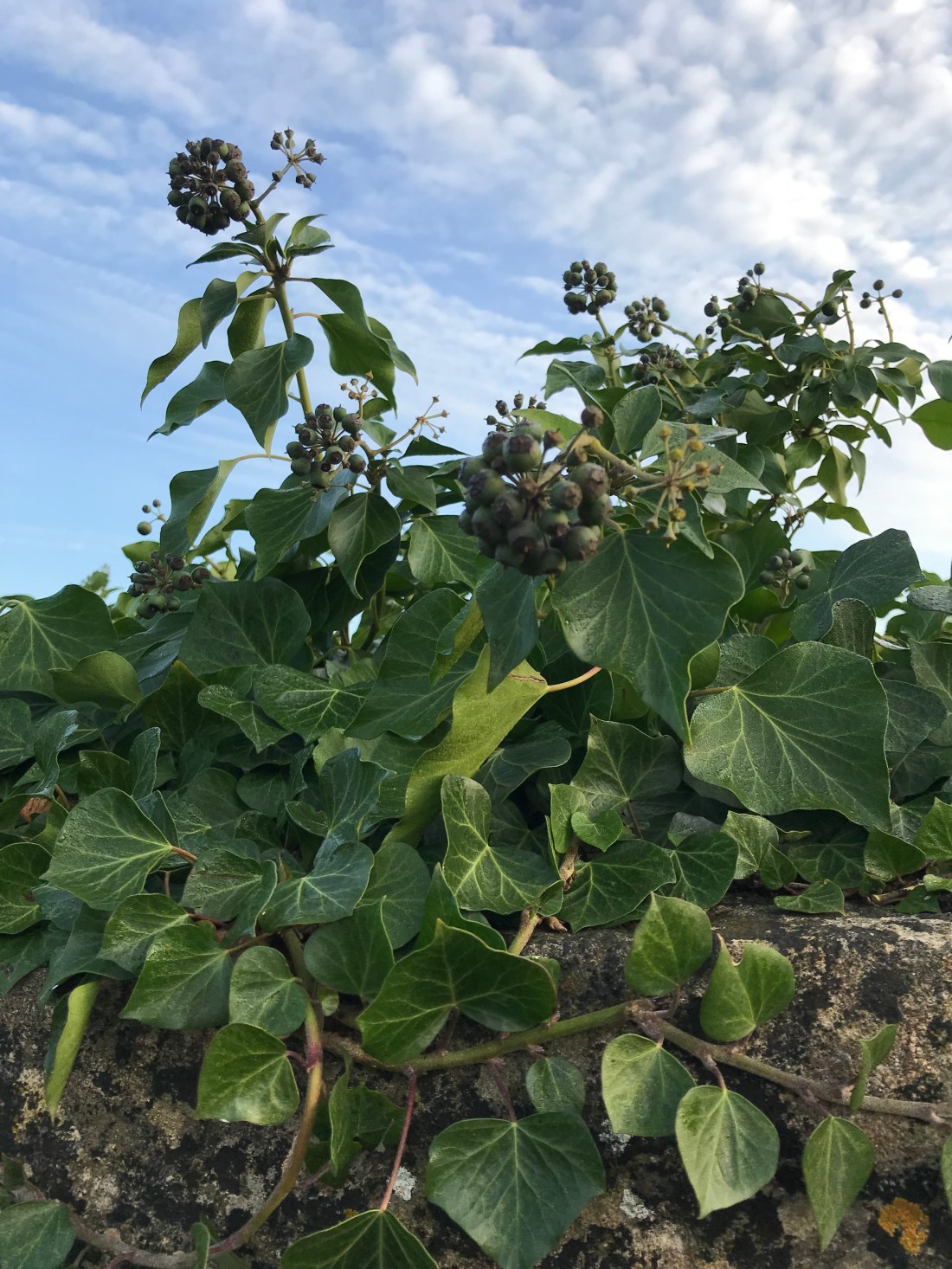
It is an amenable plant for the gardener. It can be pruned at any time of year so can be adapted to fit the demands of the wider garden. There are times I try to avoid, of course. Birds love to nest in it, so I tend to leave it alone between the months of March and August. The abundant green-yellow flowers attract clouds of flies and wasps, so it is safe from my secateurs then too. In time, these flowers set berries which ripen into pleasing clusters of round black buttons on which wood pigeons gorge. I was in Worcestershire at the weekend and a friend had cut an enviable bucketful of berried ivy for a Christmas wreath. I am only seventy miles south, but my ivy berries are resolutely green, as pictured, and will not be ripe in time.
Hedera helix is an unusual plant in that it has two very distinct phases of growth – the juvenile and the arborescent. As the latter adjective suggests, the stems thicken and become self-supporting to a greater extent, and the leaves become less indented. If cuttings are taken from ivy at the juvenile stage, the resultant plants will mature accordingly, but if cuttings are made at the arborescent stage, the plants remain arborescent. This has fallen from favour, but in the Victorian era, propagation by this method provided another texture for topiary plants, particularly in locations where other species could not grow, such as in deep, dry shade, or under the toxic drip of a Taxus baccata, the common yew.
Ivy composed the thryssos of Dionysos, oddly, I’ve always thought, as he was the god of wine, among other things and I’ve never understood why ivy grew entailed in his iconography. It is more commonly encountered these days in the English carol ‘The Holly and the Ivy’, which competes with ‘Jerusalem’ for the crown of ‘most pagan song sung in church’.

 thephilosophergardener
Oh my! That is a sore subject. I happen to like it for urban landscapes. It grew in my home garden in town. However, in the redwood forests, it is a serious problem. It climbs so high into the redwood trees that it would be impossible to get it down. It can get killed at the base, but remains ugly on the trunks of the grand redwoods.
LikeLike
Hedera helix isn’t a native to the U.S.A, is it? Like Scotch Broom, some exotics are more trouble than they are worth. In the UK we have a number of Victorian-era introductions which are now subject to legislative control.
LikeLiked by 1 person
Oh no! It is not native. However, it has naturalized in many regions. I contend with it regularly. To make matters worse, tree-huggers want to protect it because animals live in it.
LikeLike