
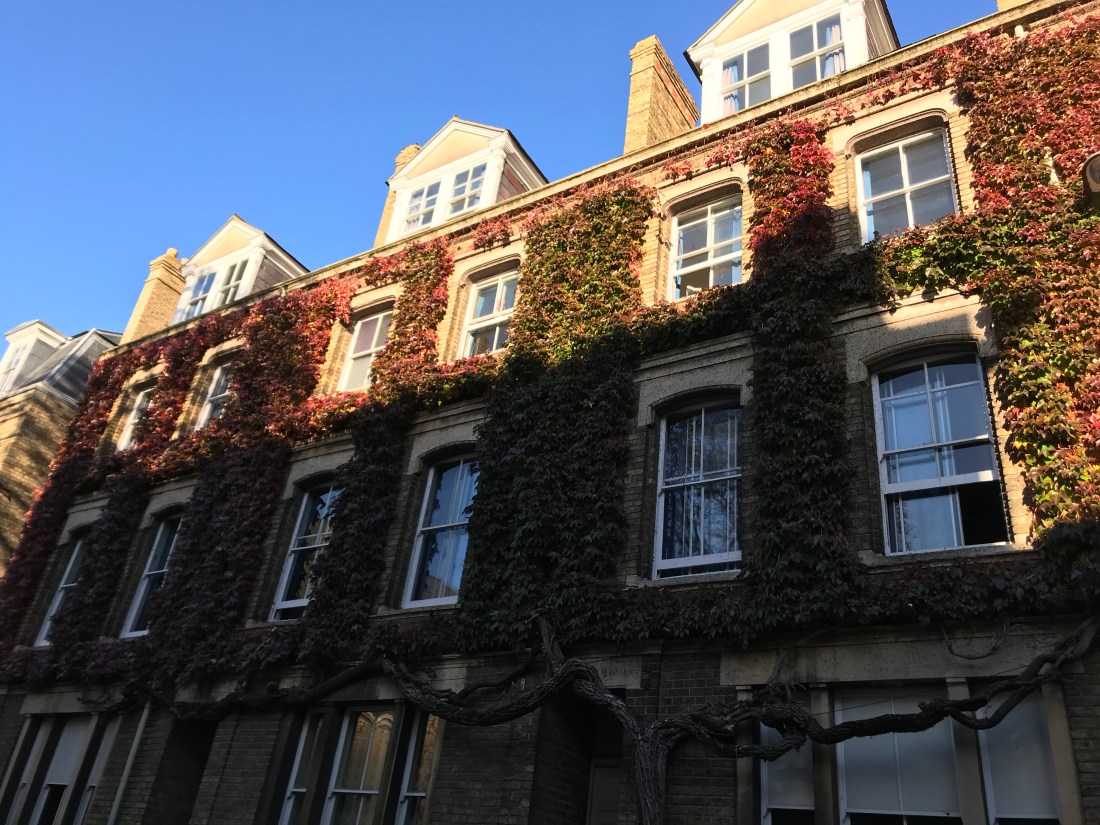
This week’s postcard is all about identity. Parthenocissus tricuspidata, Boston Ivy, is not what it seems. It is not from Boston on either side of the Atlantic ocean, nor is it ivy. It is a native of Japan, Korea, and parts of China. Given its ability to reach 30m/100′ in the UK, I expect it has spread widely in any similarly temperate climate. The tricuspidata, which describes the leaf shape, is the easiest part of its identity to pin down, meaning three – toothed. Except it isn’t, as Parthenocissus tricuspidata is highly variable in form. Some have five teeth, whilst remaining entire, whilst some have five, but are so indented (bitten) that they start to resemble its cousin, Parthenocissus quinquefolia, the Virginia Creeper. The Virginia Creeper is native to Virginia, but also to Canada in the north and Guatemala to the south. To further complicate matters, Parthenocissus refers to ‘virgin ivy’. As aforementioned, it isn’t ivy, unless ivy is taken to mean a generic identifier for any climbing plant as, I believe, Coca Cola has managed to achieve in parts of the world for any carbonated drink. I have not studied Greek, hence I do not know where to divide the compound. The Parthenon in Athens is the temple complex devoted to the virgin goddess Athena, though.
It is one of the most useful of climbing plants. It adheres to walls with little pads which bind by a method of secreting Calcium carbonate – the stuff of snails’ shells and pearls. It is a chemical bond, rather than a physical penetration, unlike ivy, Hedera helix. These pads do no harm to the wall and the presence of the plant only benefits the wall. We return to the realms of the umbrella-parasol, the cloister. In a hot climate, the presence of the climber on the wall significantly reduces cooling costs. Not only does it insulate the wall from direct sunlight and the ambient temperature, the evaporation of the transpiration stream – the flow of water from the roots out through the lenticels of the leaves – also causes cooling. In cold climates, the presence of the plant, even in its winter, un-leafed form insulates the wall and reduces heating costs. In both climates, and at all times of year, it provides aural insulation – it softens sound, making it invaluable in enclosed spaces of heavy traffic, pedestrian or otherwise.
Those of a delicate nature might not welcome it on their dwelling. It is rampant and needs to be kept in check routinely. Much of the fault lies with the human agent who plants it though, expecting it to stay content with a 5m/16′ x 4m/14′ wall, when it will climb to six times that. But, it also provides a home for insects and spiders, so confronts us with the reality that the superficial choices that we make determined on form, colour or affordability, have unforeseen consequences. The world is full of other lives and needs and we ignore them at our cost.

 thephilosophergardener
It helps to muffle sound and obscures graffiti on the sound walls of freeways around San Jose and Los Angeles. It does not need much chill to color spectacularly, even in Los Angeles!
LikeLike
Thanks Tony – graffiti hadn’t crossed my mind, but yes, of course! The colour is a joy at this time of year, particularly as the clocks went back here yesterday. The low afternoon sun is perfect for these rich reds. And, honestly, once the fogs of cloud of autumn start, any colour and light is welcome. The specimen I photographed is climbing a building on a fairly narrow street in Oxford. It was difficult to get a good picture.
LikeLike