
The garden is exhausted. I walk on paths strewn with yellow poplar leaves with their unique scent which I forget year to year. But, when I smell it afresh, it brings every autumn I can remember to mind. I find it re-assuring – it situates me in the passing of the seasons and the passing of my life. By the ponds, the large leaves of the Gunnera manicata – a Brazilian native – look ragged and tired, and soon will need to be put to bed for the winter. Under the beeches, squirrels forage franticly for the mast. Everything is as it should be.
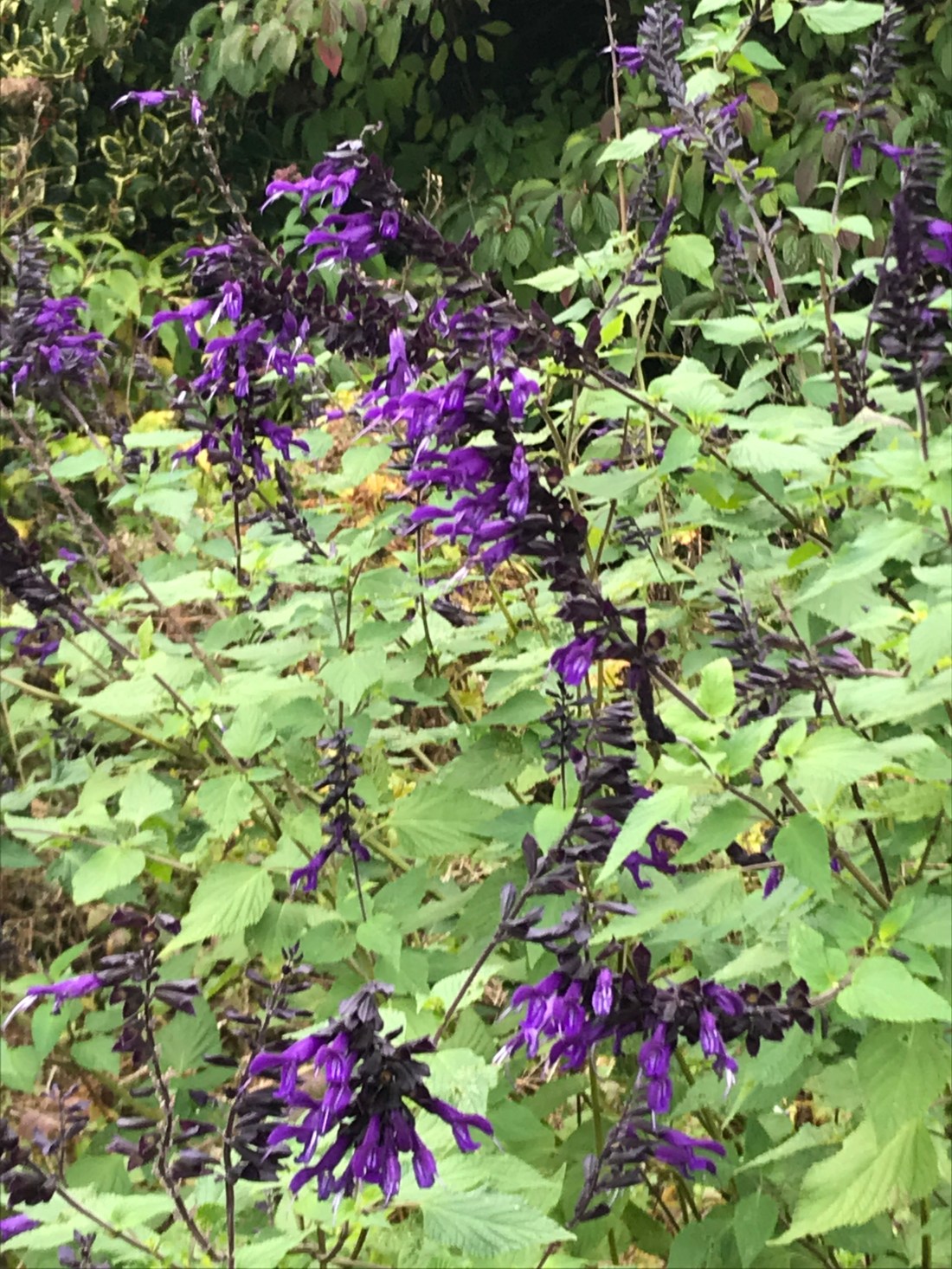
Then, rounding a corner, I come to a bed of Lobelia tupa (devil’s tobacco) and red and blue Salvias in full display, as if winter is just a fairytale to frighten children. It is a last shout of summer echoing into autumn carrying memories of a hot sun. The Salvia guaranitica catches my eye, especially. It is also known as the anise-scented sage, for the smell of the crushed leaves, and the hummingbird sage. What a sight it must be in its native Latin America, growing to its full height of 2.5m/8′, abuzz with the tiny birds sipping its nectar. The Salvias in my bed are a more modest 1.5m/5′, but still impressive. Salvia guaranitica has a running rootstock and spreads into drifts of colour. It is only hardy down to -5 Celsius though, so only a series of mild winters will allow the clump to develop any size. When I gardened in the far north of England, beyond Hadrian’s Wall, it was a plant which we kept alive from one year to the next by taking cuttings and over-wintering it in a heated glasshouse. We would plant it out with the other exotics towards the end of May or the beginning of June when the risk of hard frosts had passed. We had light frosts in September this year, just enough to blacken the leaves of the even more tender Dahlias and ruin their flowers, but the Salvias have endured them.
I am not sure which cultivar I have growing here. I think ‘Black and Blue’ is most probable. ‘Blue Enigma’ is a useful plant in the garden for those seeking that elusive true blue with no red in it. These tall sages are most effective when massed together informally with companions of similar habit. The Chilean Lobelia tupa, being more rigid provides a useful spine to the planting, whilst the Argentine Verbena bonariensis (syn. V. patagonica) brings a different flower form to the border.


We have several salvias at work. I do not care to identify all of them. They are pretty, and that is all I care about. Some are not easy to distinguish.
LikeLike