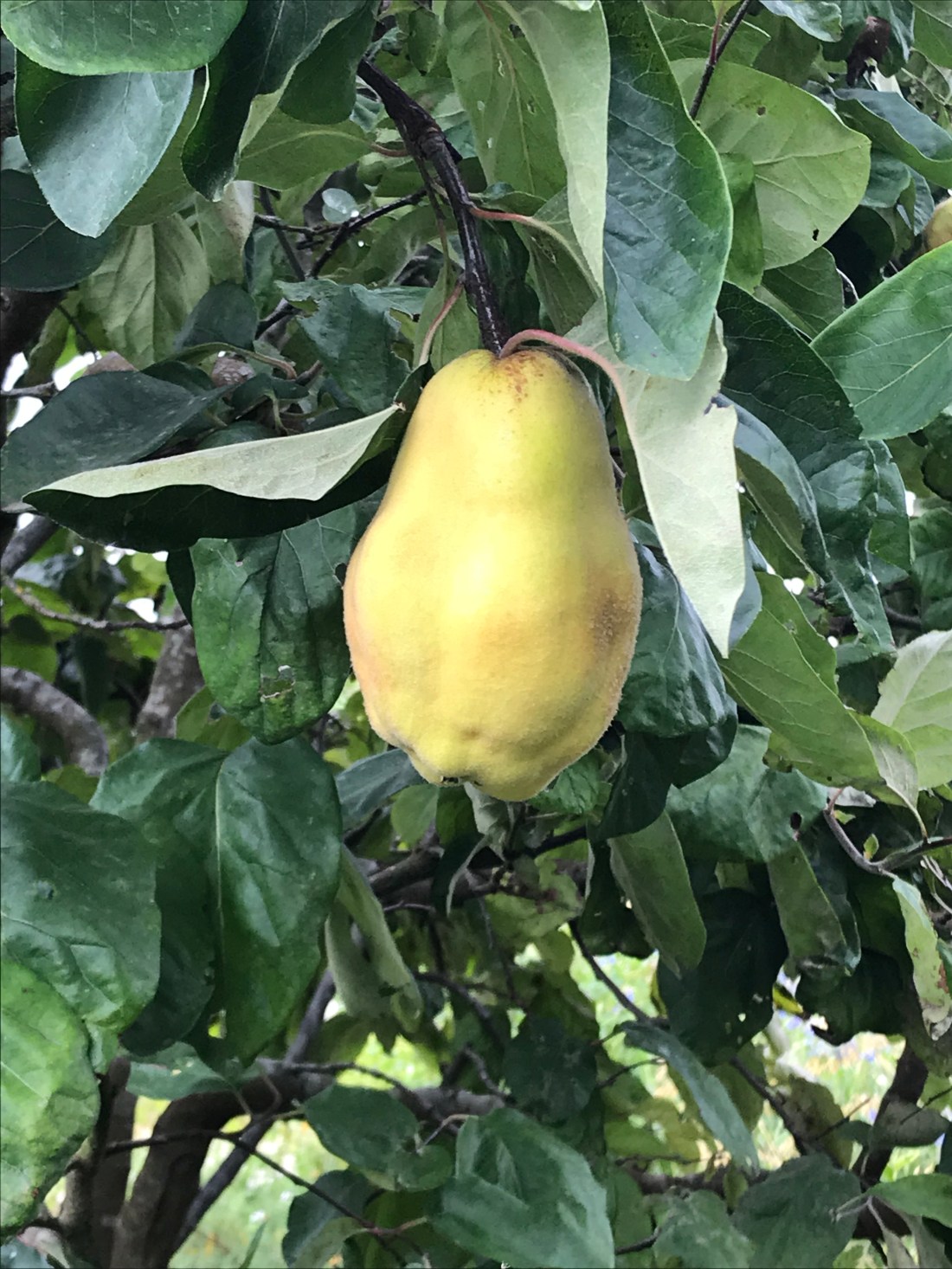
Cydonia oblonga

Quince is an unruly, untidy tree. It spreads outwards almost as much as it grows upwards and easily reaches 4m/14′ in both directions. Its branches crisscross and weave through each other in a most undisciplined manner. This time last year I was in the Potager du Roi at Versailles where I happened upon two quince trees which had been ‘trained’. The main trunk had been stopped at around 1m/3′ and four main branches had been directed outwards and upwards like a goblet, these in turn being stopped at 3m/10′ long. The bones of the structure were still visible, but tangled around them in a cloud of fury, the trees were growing as they pleased. Several golden pear-like fruit were hidden among the leaves. I leaned in close to smell them.

What is the smell of quince? It is green, fresh, cool, and constant at its base, then there is an elusive sweet intrigue which grows stronger as they ripen. Place some in a bowl and they scent a room pleasantly, whilst looking magnificent. It is this aromatic quality which makes quince so valuable for cooking. Constance Spry has an excellent recipe for ‘Partridges with Quince’ in her eponymous 1956 tome. Quinces are hard and bitter when raw, but transform into a soft, silky, delicately fragrant and delicately pink elixir when cooked. It is alleged that they can be bletted like medlars, but, as with medlars, I remain unconvinced.

The immature fruit are covered in a grey-ish fur which brushes off to reveal the golden skin beneath. Ancient texts are gloriously vague and at times contradictory, which leaves me free to claim that the fabled golden apples of the Hesperides were quinces. This was the prize which Aphrodite received in the divine beauty contest which sparked the Trojan War. The ancient Greeks thought the trees sprang up from her footsteps, and this association with love and fertility endures in the Balkan tradition of planting Cydonia to mark the birth of a baby.

Quince has previously enjoyed a higher cultural and culinary status in the UK than it does currently. It was an early introduction, recorded first in 1275AD when Edward I planted four at the Tower of London. It was a traditional planting in apple and pear orchards, a practice which was exported to the colonies of New England, but which fell from favour in old England. Its time may be returning given the fashion for Middle Eastern cookery and a broadening taste for exotic aromatics.

It is not a difficult tree to grow and tolerates a wide range of soils so long as they are not prone to water-logging. The simple white five-petalled flower (this is a member of the rose family), is borne early so can be prone to frost damage, and the fruit need a good summer to ripen fully, so a sheltered west or southwest aspect is probably best. The spreading habit of the quince makes it difficult to accommodate in small gardens, although there are more quinces growing in gardens than first meets the eye. Quince A and Quince B are the most common rootstocks for cultivated pears.
IMG_0635

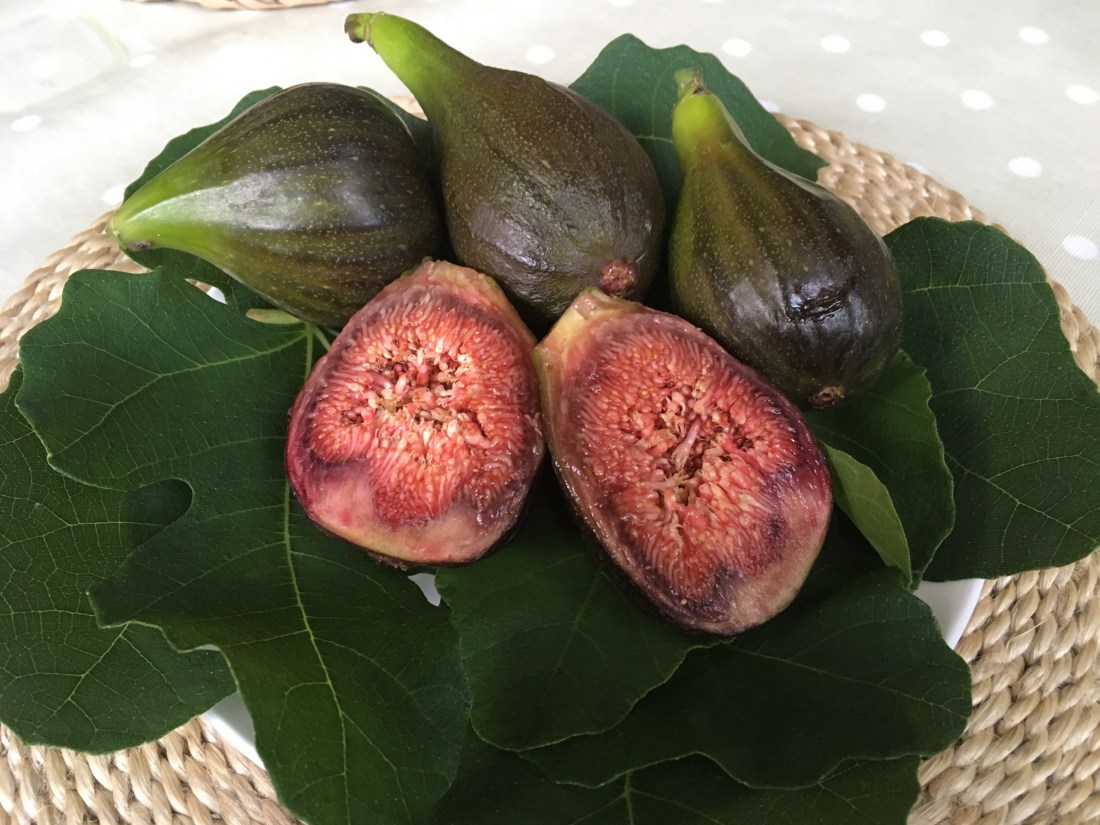
Ficus carica

In a house where I lived for too long – it was never my home – there is a fig growing in front of a south-facing wall. It is planted in a rough stone bank which holds the soil away from what becomes the cellar wall as the ground falls away. We used to find its fine fibrous roots growing across the brick of the cellar floor, having somehow found their way across the trench and through the outer wall. Each year we would talk about cutting it down and removing it completely, for the sake of the house, but each year it would carry such abundant fruit that we would say, Not yet. Let’s just wait until we have enjoyed the figs. So, each year, it was reprieved. We enjoyed them from mid-July onwards, blackbirds permitting. They are wonderful with a salty cheese like Pecorino or Roquefort, and a drizzle of chestnut honey. One year, the harvest was so abundant that we made chutney and so enjoyed figs with cheese in a very different way throughout the winter.

The fig I refer to is a reliable ‘Brown Turkey’ and produces large, dark figs with red, somewhat mammalian, interiors. I prefer the flavour of them to the gourmand’s ‘White Ischia’, which seems subtle to the point of blandness when compared to the meatiness of a ‘Brown Turkey’. Sometimes, I think certain plants become prized simply for their rarity or difficulty, rather than for any innate virtue. There is nothing rare or difficult about a ‘Brown Turkey’ – its vigour is almost indecent. Last September, I was at Versailles for research. I visited the Le Potager du Roi for personal interest and was deeply disappointed by its dilapidation. I wandered at leisure, being the only visitor, and nobody appeared to be working. I found a large fig tree in a southwest corner of the high walls. It had no label; it had had no care for decades. I picked a pale-skinned fig, broke it, and ate half. It tasted of honey. Perhaps it was sweeter for being stolen. Sadly, it was the only fruit within reach. I believe de La Quintinie, the garden’s first superintendent, would send 2000 figs a day to the kitchens at the palace. It was certainly one way to keep the wheels of state moving. I fantasised for an hour or perhaps a week, about having five good men, and five years, and possibly five Percheron, because the soil is terrible. What I could achieve there! Some dreams cost nothing, and can be a good way of exploring what is held and what can be let go.

Figs grow best when their roots are restricted and, in the UK, thrive when fan-trained against a wall, where they can be a handsome specimen, largely free of pests and diseases. Under glass, red spider mite can be a problem. Plant them in a box formed of paving slabs with rubble in the bottom of the hole. In Greece, on Aegina, twenty years ago, I met a fig tree growing on a south-facing slope of boulders, in conditions so arid, it must have been a desert. The tree was 10m/33′ across and abundantly figged. I picked one and broke it open. It was filled with the tiny black fig wasps which serve the fig as pollinators. The fig is a strange fruit. The skin is really an extension of the stem and the fingers within are individual flowers, each of which sets a seed. The wasps enter through the ostiole, the small orifice on the fig’s bottom. The figs and wasps have depended on each other for so long that there are almost as many thousands of species of one as of the other. I expect I may have unwittingly eaten as many wasps as I have figs, but neither I nor the fig are vegetarian. The fig excretes an enzyme, ficin, which dissolves any wasps which die inside it. The tree eats the wasps which serve its needs.

IMG_0268