
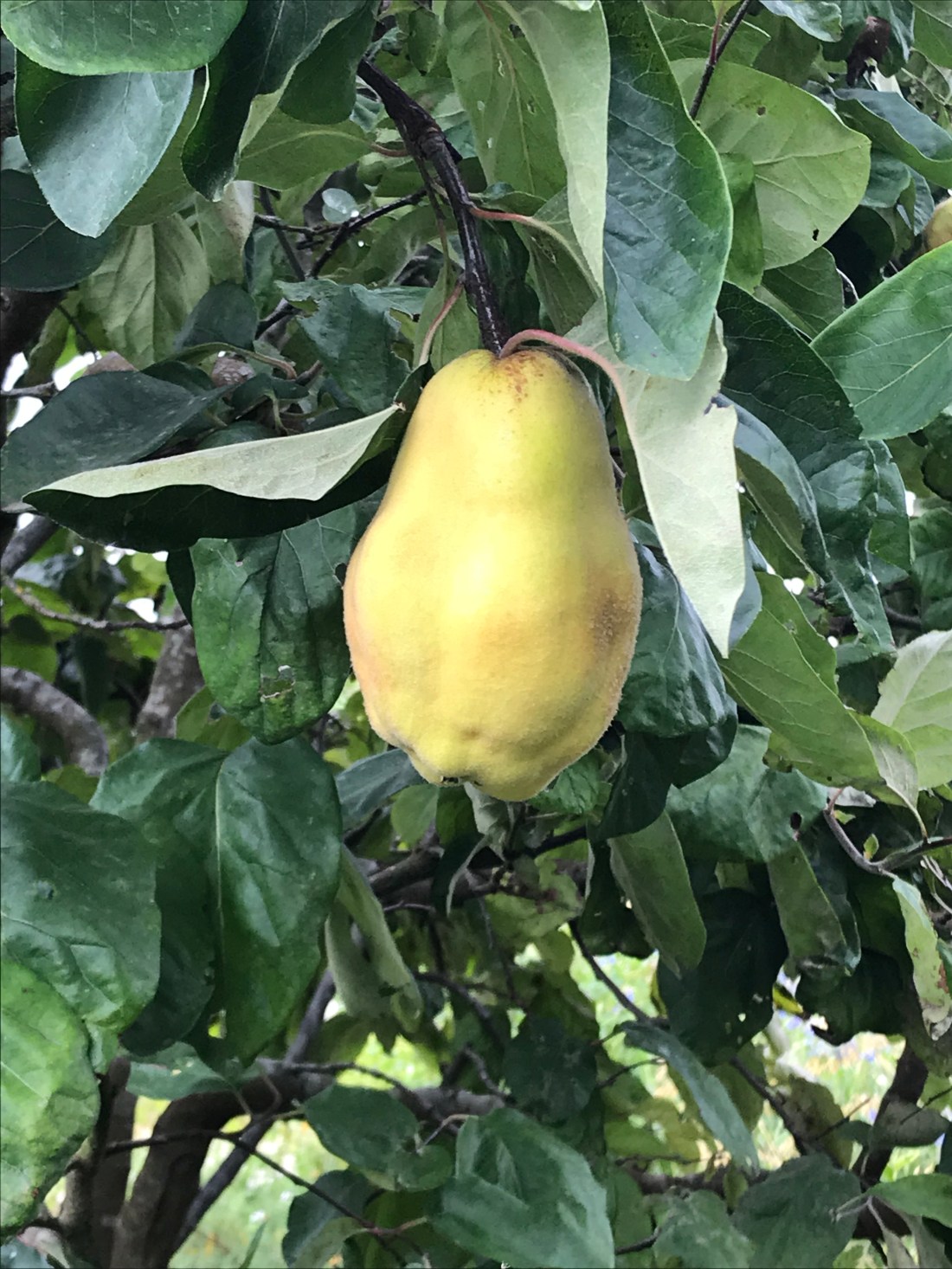
Quince is an unruly, untidy tree. It spreads outwards almost as much as it grows upwards and easily reaches 4m/14′ in both directions. Its branches crisscross and weave through each other in a most undisciplined manner. This time last year I was in the Potager du Roi at Versailles where I happened upon two quince trees which had been ‘trained’. The main trunk had been stopped at around 1m/3′ and four main branches had been directed outwards and upwards like a goblet, these in turn being stopped at 3m/10′ long. The bones of the structure were still visible, but tangled around them in a cloud of fury, the trees were growing as they pleased. Several golden pear-like fruit were hidden among the leaves. I leaned in close to smell them.
What is the smell of quince? It is green, fresh, cool, and constant at its base, then there is an elusive sweet intrigue which grows stronger as they ripen. Place some in a bowl and they scent a room pleasantly, whilst looking magnificent. It is this aromatic quality which makes quince so valuable for cooking. Constance Spry has an excellent recipe for ‘Partridges with Quince’ in her eponymous 1956 tome. Quinces are hard and bitter when raw, but transform into a soft, silky, delicately fragrant and delicately pink elixir when cooked. It is alleged that they can be bletted like medlars, but, as with medlars, I remain unconvinced.
The immature fruit are covered in a grey-ish fur which brushes off to reveal the golden skin beneath. Ancient texts are gloriously vague and at times contradictory, which leaves me free to claim that the fabled golden apples of the Hesperides were quinces. This was the prize which Aphrodite received in the divine beauty contest which sparked the Trojan War. The ancient Greeks thought the trees sprang up from her footsteps, and this association with love and fertility endures in the Balkan tradition of planting Cydonia to mark the birth of a baby.
Quince has previously enjoyed a higher cultural and culinary status in the UK than it does currently. It was an early introduction, recorded first in 1275AD when Edward I planted four at the Tower of London. It was a traditional planting in apple and pear orchards, a practice which was exported to the colonies of New England, but which fell from favour in old England. Its time may be returning given the fashion for Middle Eastern cookery and a broadening taste for exotic aromatics.
It is not a difficult tree to grow and tolerates a wide range of soils so long as they are not prone to water-logging. The simple white five-petalled flower (this is a member of the rose family), is borne early so can be prone to frost damage, and the fruit need a good summer to ripen fully, so a sheltered west or southwest aspect is probably best. The spreading habit of the quince makes it difficult to accommodate in small gardens, although there are more quinces growing in gardens than first meets the eye. Quince A and Quince B are the most common rootstocks for cultivated pears.

 thephilosophergardener