
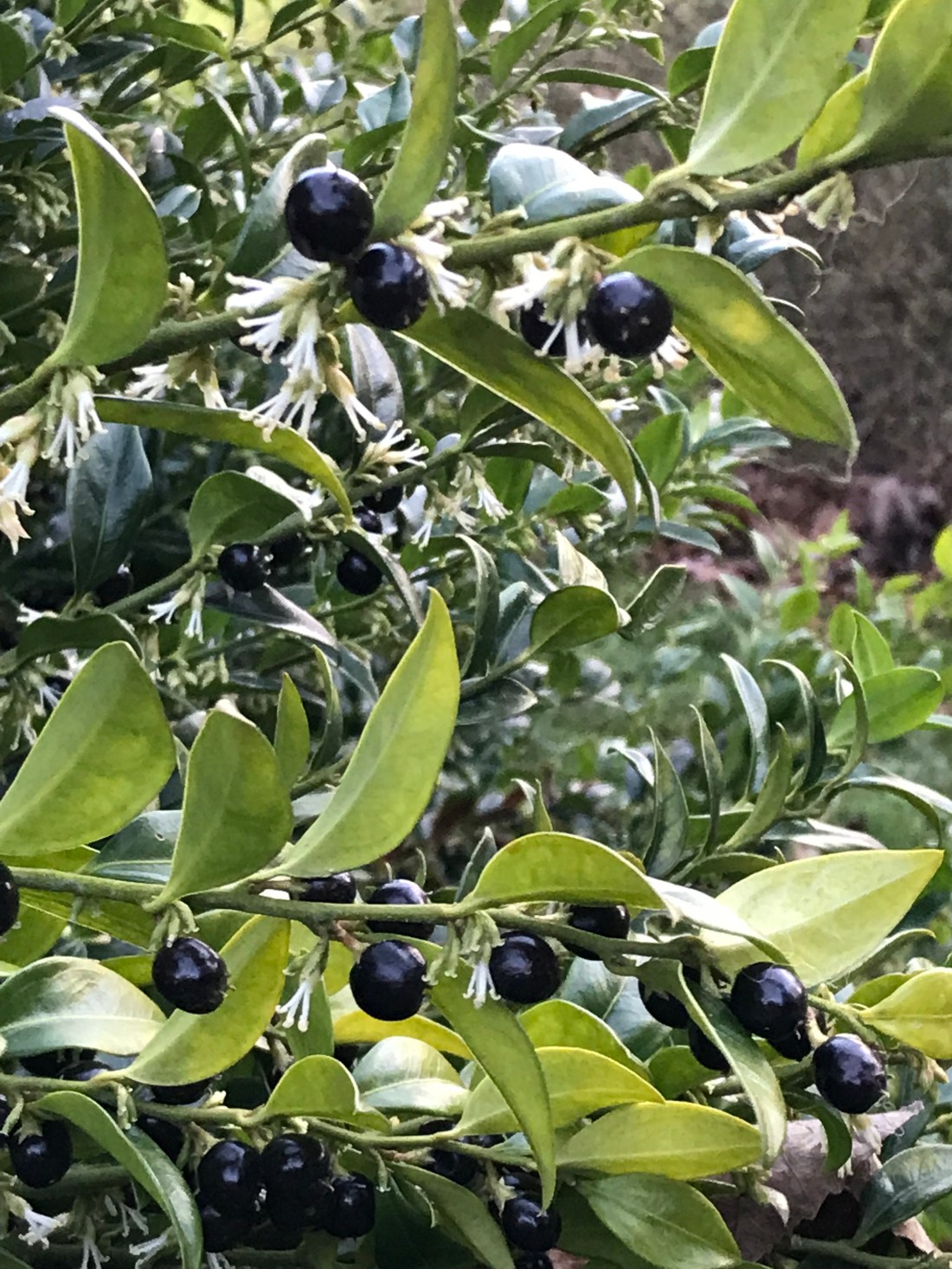
Sweet box is a viola in the garden: it may not be the most glamorous of the instruments in the orchestra, but its depth and tone would be sorely missed if it was absent. It fills that difficult middle-section of the border, where something reliable is needed to provide texture and contrast to the showier plants around it. And, undoubtedly, it has its own virtues too. First among these are the fragrant flowers which give it the sweet of its common name. Sarcococca flowers all winter and sets small glossy berries which range in colour from red to black. These are clearly not valued by British birds as food as they often endure into the following winter, so that flowers and berries are carried together. Although its leaf is shinier and more pointed than a true box, it is a member of the same family. Visually, it can be easily overlooked. I went to the University Parks in Oxford with the express intention of photographing a specimen and I walked straight by it – my eye was caught by a fine Poncirus trifoliata on the other side of the path. The powerful, sweet scent stopped me in my tracks though, and I returned to my prize. I like to think that if anything happened to my eyesight then I will be able to enjoy with my nose alone, a garden at all times of year so long as the plants have been chosen thoughtfully. I once worked in a garden which was a visually sophisticated composition, but it contained almost no scented plants. It was like watching a film with the soundtrack turned off. As scent is the handmaiden of memory, I have only to catch a note of Sarcococca in the air and my mind fills with pictures and associations of times and places.
Sarcococca is a victim of its other virtues, virtues which make it loved by amenity landscapers and parks and gardens departments. It is often found near public toilets. It tolerates all kinds of soil, although it prefers moist and well-drained loam. It grows in all growable pH ranges of acidity and alkalinity. It is hardy down to -15 Celsius, which makes it winter-proof throughout the British Isles. It prefers shadier conditions and will survive even in dry shade, which means it will grow where fussier plants will not. Indeed, I inherited one which had been planted in full sun by a firm of garden designers, and I had to transplant it: its leaves had turned an unpleasant shade of yellow. I am pleased to report that it recovered quickly once it was tucked against a north-facing wall. It suckers, which means that it spreads and within ten years can form a clump in the range of 1.5m/5′ to 2.5m/8′ across. As it suckers, it should be possible to lift and divide it if it grows beyond its bounds, but I have never done this. I have planted it as an under-storey beneath small, delicate trees such as Amelanchier canadensis, and it has always had as much space as it can fill. The dense, evergreen foliage provides a perfect foil to the gentle cloud of tree blossom above.


 thephilosophergardener