Laurus nobilis

I have been planting a bay hedge for a client. It has three immediate purposes. Firstly, it forms one boundary of a formal garden, the rest of which is in place. The straight run of dense, dark foliage is like a word at the end of a sentence, underscored for emphasis: the garden stops here. Secondly, it hides a large plastic tank which holds domestic heating oil. It excludes it from the formal garden whilst simultaneously carving off a useful area for rubbish bins, wheelbarrows, empty flowerpots, and all the other detritus with which we clutter our lives. Thirdly, a road lies beyond it. Large thick leaves such as bay’s have better sound-dampening properties than, for example, the needles of yew. Being evergreen, it will dampen sound the year round.

Next year, it will serve other purposes. In April, bay bears small, insignificant yellow flowers which are a valuable early pollen source for bees and other insects. Birds will nest in it, enjoying the protection and privacy of the dense foliage. My clients may pick leaves for use in the kitchen. I hope that on hot sunny days the dry, spicy fragrance of the foliage will mix with the sweeter scents of the flowers in the garden, enriching the olfactory experience.

The sun was shining when I delivered the bushes, and my client came out to see them. He broke into a smile – the smell of bay had conjured memories of his childhood in the Lebanon, ‘where bay is everywhere’, and of his grandmother adding stems of it to the laundry to scent it. Clever grandmother – the essential oils in the leaves can act as an insect repellent too.

Forests of Laurus nobilis once spread across the Mediterranean basin, only retreating when the climate became hotter and drier around ten thousand years ago. Pockets linger on in Portugal and Turkey, but I have never been fortunate enough to visit one. I am pleased to bring something from my client’s homeland to his home in this corner of England. I am sure it will thrive as he has done. Bay has a reputation for being unreliable in its hardiness, but I have known bushes survive successive nights of -10 Celsius without harm and I have no fear for this planting. It is remarkably tolerant of different soils too and can be grown in Herefordshire clay or the sandy loam of Norfolk. It dislikes cold, drying winds, but it is hardly alone in that.

Like yew, the dark evergreen foliage is the perfect backdrop for a statue. Unfortunately, my perfect statue is in the Galleria Borghese in Rome. How much better it would be if it were in a garden! It is an extraordinary marble by the extravagantly talented Bernini. It captures the metamorphoses of the nymph Daphne, her raised hands already changed into laurel leaves as the rapacious Apollo reaches to grasp her. Her leaves became his victor’s wreath, and the rest, as they say, is history.

IMG_0574

Cynara scolymus ‘Violetta Precoce’

Few plants sound so much like an incantation as Cynara scolymus ‘Violetta Precoce’. Portals to other worlds should open at the sound; portals to past worlds, possibly. Few garden plants have the long heritage of the globe artichoke. Pliny the Elder wrote about it in his Natural History (Book XIX), observing that, ‘it was in the highest state of cultivation, and Ravenna produces heads that weigh as much as three pounds even’. Carciofi alla Romana remains a typical dish of Roman springtime cuisine. Smaller heads than Pliny’s monsters are used, braised whole bar the choke, with a section of tasty stem still attached. Other cities have their own variants. In Venice, in March, a course of whole violet artichokes arrived at our table. The heads were somewhere between a hen’s and a duck’s egg in size, and they had been braised very simply in white wine, parsley and lemon juice. Our host described them as ‘the first cutting’ and the best of the year. He lamented the artichokes found in England, artichokes ‘the size of trees’. As we had walked through the restaurant to our table, however, I had spied a different dish of artichokes which I was keen to taste. It was made from the basal plates of large ‘tree-like’ artichokes, the basal plate from which the flower develops. It is firmer, denser, and more intensely artichoke flavoured than the bud-scales. The Italians also use artichokes to make a bitter digestivo Cynar, of which I am fond. It is allegedly good for the liver.

I have planted artichokes in the flower border as often as in the kitchen garden. They, like their close relative Cynara cardunculus, the cardoon, are among those plants which attract the lazy and often spurious epiphet ‘architectural’. They have strong form, certainly. Each leaf is carried on a rigid rib and has a jagged profile. The silver-green foliage pairs well with anything pale and interesting, and contrasts nicely with the softer, blousier textures of Geranium, Knautia, or Origanum. The cultivar ‘Violetta Precoce’ has two additional virtues to the species. Its purple buds are handsome and the ‘Precoce’ indicates that it is an early season maturer, which is useful in our northern isle where summer can arrive late and leave early.

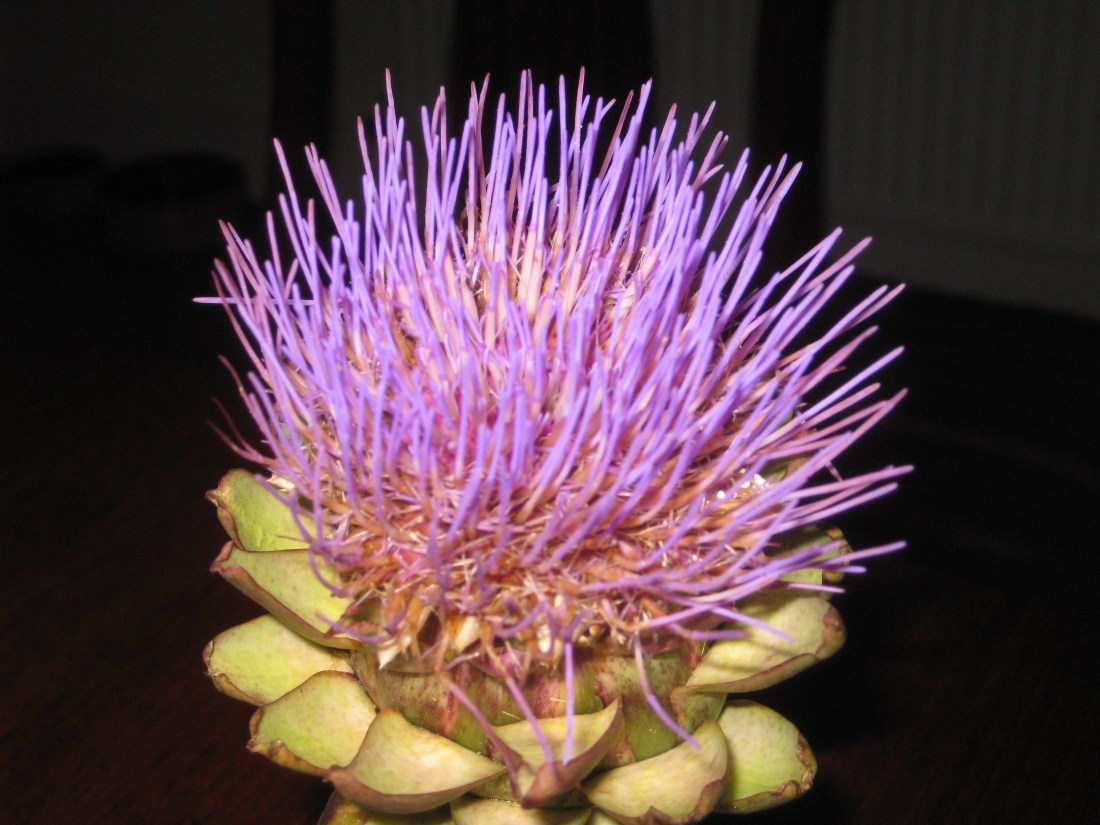
I have never found them the most predictable of plants. Of two close companions, one has died and the other thrived, and yet I can discern no difference in their situation. When they do thrive, they can be large plants, easily 1m/3′ across and 1.5m/5′ tall. I have never had the luxury of sufficient space to grow as many as I desire. I am always compromising therefore – a cardinal virtue in all successful gardening. I want to harvest buds for the table whilst they are still young and tender, and relatively choke-free, but I also want to leave some to develop into flowers. When left, the bud opens to reveal a saucer-sized cap of violet fingers. They seem to glow with their own light, and are mysterious presence in the border, like something from another world.

IMG_0412