
We have passed the autumn equinox. The year grows old and the light fails. In the garden, my eyes search out all sources of colour, of light, of warmth, of comfort. The autumn leaves are splendid this year; the trees being stressed from the drought, followed by some decent frosts to hone the colours. Their distress, physically expressed, is my comfort. But, I suppose my eyes are searching for signs of life, even so, not the senescent leaves of trees and shrubs falling into slumber. I am seeing the berries: the berries are alive. Within them, future lives are stored in seed. The berries give life to others also. As I walked across the demesne this morning, the first flight of Turdis pilaris, fieldfares, filled the sky. They will have flown in from Scandinavia or Russia to feast on the bounty of berries here. The first sighting is one of the mileposts of the year – it tells me, we are here and all is as it should be. I expect cold weather within the next month – they are the prophets of winter. It is a reminder too, that latitude is relational. The British Isles are south and temperate for millions of migrants every year. They come here to live. Political territories, borders, walls – these things are meaningless to them. Life is the imperative: and we are just fleas on the dog. A dog endures many generations of fleas.
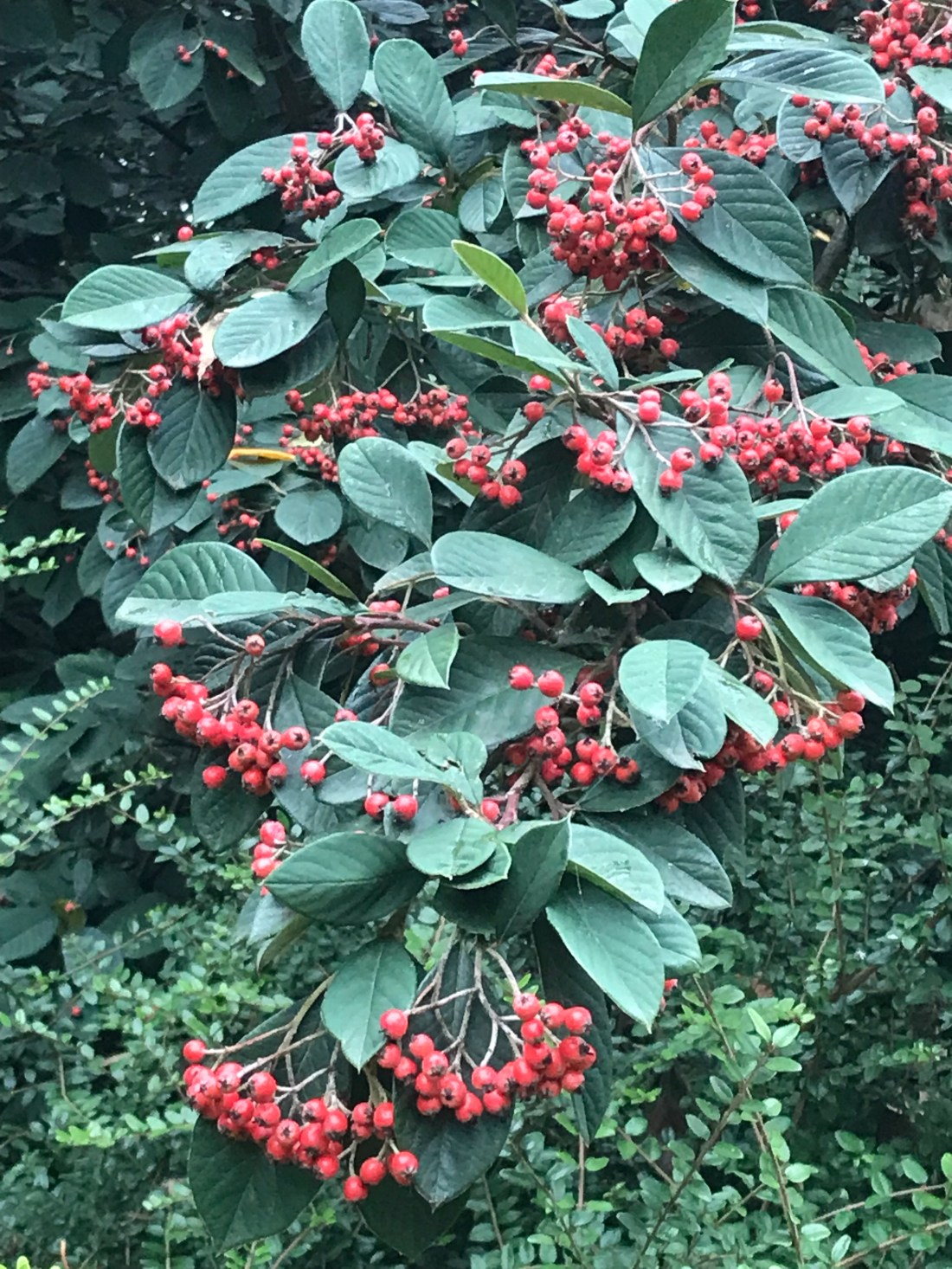
The berried plants catch my attention. I see the hedgerow Crataegus monogyna, hawthorn, with fresh eyes. The humble Ruscus aculeatus, butcher’s broom, is transformed from a filler-in to something commanding attention. But, my particular attention is caught by the titular subject, Cotoneaster x watereri. Like the Ruscus, it is the chorus to the garden for most of the year. It provides body and depth, seriousness, possibly. Yet, for most of the year, like the god of the German theologians, it is experienced as an absence more often than not.
Type ‘artificial shrub’ into a search engine and numerous sites selling plastic plants will be generated. Cotoneaster x watereri is classed as an artificial shrub. Its parents may never have met in the wild – indeed, the parentage is disputed, or undetermined, at least. But, I feel its existence challenges our terminology in the same way that calling anything unnatural does. Surely, only natural things can exist. I stand with Terence, as so often before: Homo sum, humani nihil a me alienum puto. My translation is free – I am a person, one of all of us, I recognise all of you. We are the same despite the differences.
I love Cotoneaster x watereri for its own virtues too. The arching branches are elegant. The ratio of leaf to berry is perfect to the eye, just beautifully balanced and proportioned, however complicated its breeding. The promise of the life in its berries gives me hope. A full life is a generous one.

 thephilosophergardener