Malus transitoria

Malus transitoria, the cut-leaf crabapple, is one of the tricksy members of the extended apple family. Like its sister, Malus triloba, its leaf looks more like a maple. Although the practice seems to be dying out, it used to be common for gardeners in the UK to be given a plant identification test when being interviewed for a job. This pair of crabapples were popular choices to winnow the wheat from the chaff; to test the depth of observation and knowledge. A malicious choice perhaps, designed to expose ignorance as much as strength. In common with maples, it has excellent autumn colour, and the leaves turn a very pleasing golden yellow. The picture below shows the trees in full blossom, blossom so dense that the branches are bars of white and most of the leaves are obscured. If fertilised, these flowers set into small golden fruits less than 10mm or 3/8″ across. Insignificant in size, but profuse and excellent in their abundance.

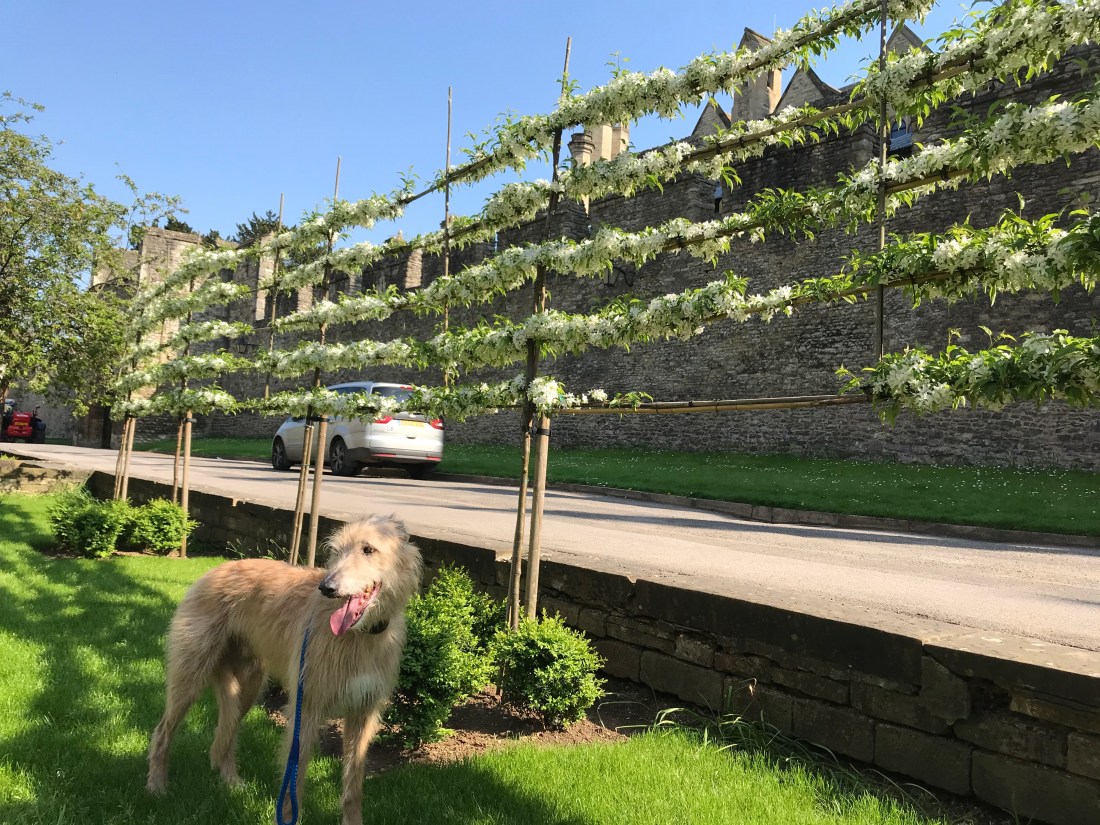
There is no etymological connection between Malus and malleability of which I am aware, but the crabapple, in common with many other members of ROSEACEAE can be formed or deformed with pressures, subtle of not. Although the Potager du Roi at Versailles has a derelict air, it still contains some magnificent examples of just how malleable apples and pears can be, and it is worth visiting  just to see these. Those pictured below in New College, Oxford, have lateral branches which have been trained out perpendicular to the trunk to a length of 2m/6′ each side and pruned so that the tree grows in a flattened plane. It raises an interesting question, I think. The tree, left alone, will find a shape determined by its nature and in response to its environment which, in the case of Malus transitoria is a fairly upright tree which all the same becomes as broad as it is tall with a range of 4-8m/14-26′. But, in the hands of a gardener, it can be shaped, and this adaptability is there in its nature also. Both possibilities are true to the nature of the tree, so long as we are considered part of the environment. The transitoria is a reference to the short-lived nature of the species, but it is a tree, and these things are relative.

The espaliered tree is highly useful when designing gardens. It provides a ‘light’ and visually permeable screen, whilst also providing a sense of enclosure. In some ways it is living equivalent of the tracery in a cloister’s arch (www.philosophergardener.com/snow), but the conceptual antithesis of the bars on a prison cell’s window. As below, it can be used to define an area – in this case a lawn – whilst not excluding a view of something desirable. The medieval city wall of Oxford can be seen through the branches. My hound and gravatar Floyd is indifferent to its virtues, but then, like all dogs, he is a cynic.
 

IMG_1530

Chimonanthus praecox

Wintersweet is one of winter’s compensations: a reminder that life does not stop in the dark, short days, it merely slows down, and for some species, it starts. In each flower, the next generation is conceived, and with the fertile seed, life begins. I first encountered Chimonanthus on a cold January evening in Oxford. I smelt it before I saw it, and followed my nose some 20m/60′ before finding the source, tucked against the old city wall. Even then I was confused as the scent hardly seemed stronger up close to the shrub than it had at some distance: it was equally diffuse throughout its range. The flowers are visually insignificant, and I concluded that whatever it was, it must be pollinated by moths, some species of which fly in even the coldest of the winter months. In fact, this Chinese native is pollinated by beetles, those industrious creatures which seem to have a nose for so many good things.

In China it has been cultivated for over one thousand years, being highly valued for its scent and its usefulness in traditional medicine. Its cultivation spread to Korea and Japan, and in the modern era to the USA and Britain. It was worth the wait.

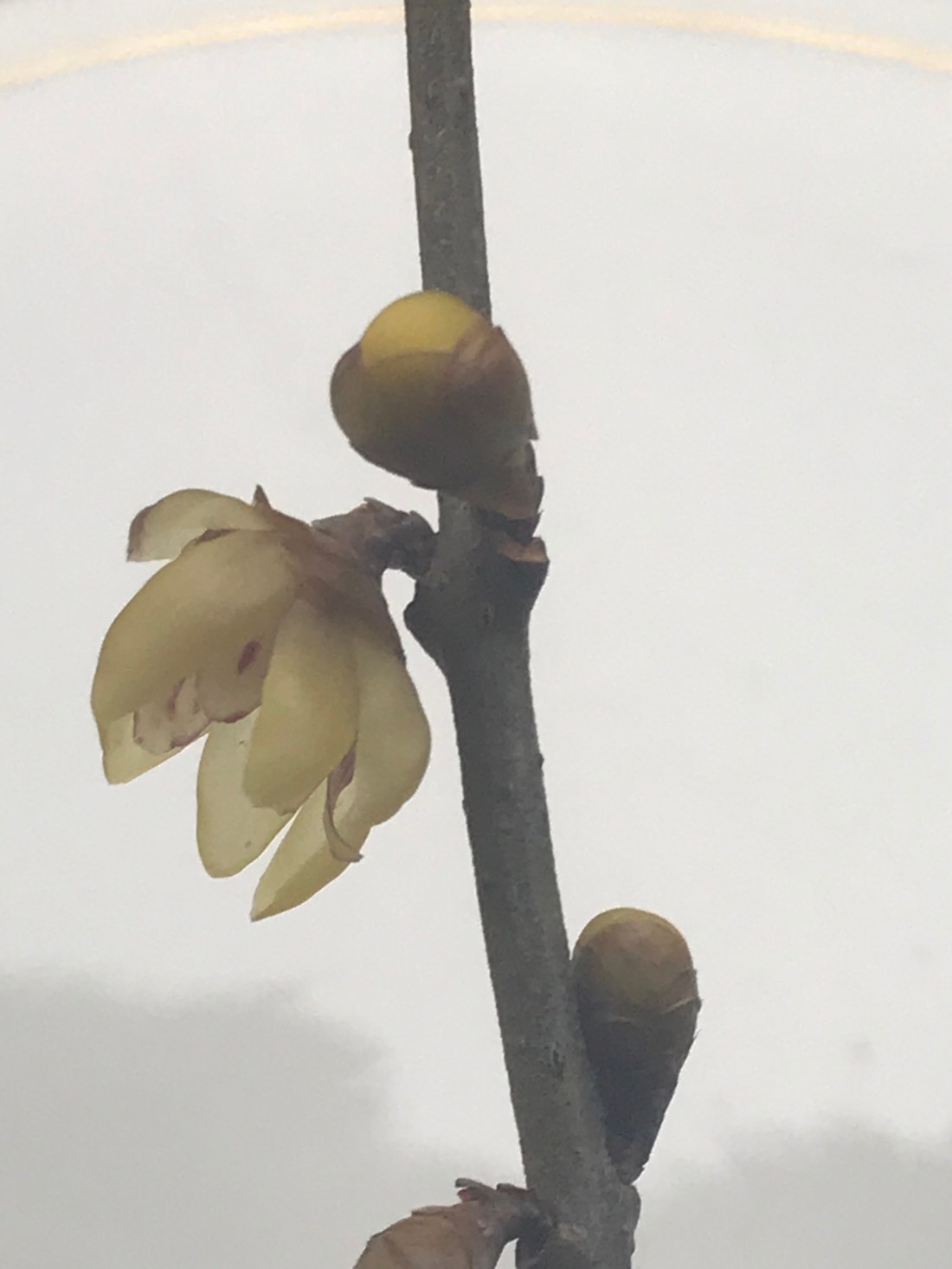
Wintersweet is praecox and the flowers are borne on bare twigs, although sometimes the last of the golden autumn leaves are still clinging on when it starts to bloom. The flower has waxy, translucent petals, the outer being pale yellow whilst the inner petals are pale yellow with dark red markings. They are a little more than a centimetre across and hang their heads like a shy child. Only the scent catches the attention. The scent is sweet enough to warrant the name, certainly, and slightly fizzy, like sherbet.

In Oxford it was growing in a shady spot against an east-facing stone wall and it was rather untidy. In our garden here there is a mature shrub, growing freely. It has reached 4m/14′ in all directions and has a round, fairly open-branched habit. In leaf it is not that decorative, and it is better suited to a larger garden than ours where the burden of putting on a show can be shared by many plants. Or perhaps the edge of a woodland garden where I would plant it with other winter-flowering shrubs such as Oemleria and Hamamelis. Hamamelis, witch hazel, has spidery flowers which likewise are borne on bare twigs, whilst Oemleria tends to flower just as the bright green leaves are breaking bud. All three share scent characteristics, being light, diffuse, and clean-smelling. The scents harmonise, creating a pleasingly intriguing cocktail. Visually, all three are modest, which makes their companionship easy. In the garden here our wintersweet is planted next to an equally mature Viburnum bodnantense ‘Dawn’. It too flowers in winter, but the marriage is not a happy one. The Viburnum’s scent is heavier and sweeter, almost cloying, and it overwhelms the delicate wintersweet.

IMG_4421

Buxus sempervirens

In winter, a garden is stripped back to its bones. Its structure is laid bare with all its strengths and weaknesses revealed. Much of the form of the garden which is visible in winter comes from the hard elements – the walls and the paths. But, the evergreens are an essential part of the composition. This may be the one appropriate use of the term ‘architectural plant’: hedges are green walls; topiary can be columns and sculptures. I like the idea that the columns of temples were inspired by tree trunks and trees can be used to mimic columns.

Buxus sempervirens, Box ever-living, is a winter star. Box hedges define parterres and their lines are clearer in winter. I love them even more when they are frosted, or better still, frosted having first been draped in silk by industrious spiders. The hoar frost clings to the strands in jagged crystals and melts to nothing with the first sun. The hedges provide shelter which can leave the ground at their bases free from frost. They cast shadows which prolong the frost within them, creating clear lines of bare dark soil and white crystals. The pattern plays out during the day, a visible testimony to the passage of time.

In summer, Box has that smell. It is the smell of itself, certainly, but a self which belongs to a family of scents which includes Ruta graveolens, Rue, and Ficus carica, Fig. They are at once green, woody, and dry-spicy. They are complex, enticing, intriguing, and possibly toxic. The danger is part of the experience. It is this depth of character which keeps me returning to it, nosing it in and trying to understand it fully. I love it on a hot day; the scent seems to intensify the heat. I run my fingers over it, enjoying the sensory dissonance. The leaves are oval and look soft, but the dryness of the foliage and its stiffness mean that my hand conflicts my eye. Even the sound of it under my fingers is a dry, stiff rustling. It is the sound and scent of a summer holiday in Italy, with golden gravel crunching underfoot. And light everywhere.

Pliny the Elder considered topiary to be akin to abortion. He was a great man, but mistaken in many things. My reading is that he considered it a frustration of the true course of nature, and that that was an expression of the vice hubris. Although the Romans brought their world, animal and human, to die for their entertainment in arenas across the empire, their most reflective thinkers considered that there were appropriate limits to this exploitation and manipulation of nature.

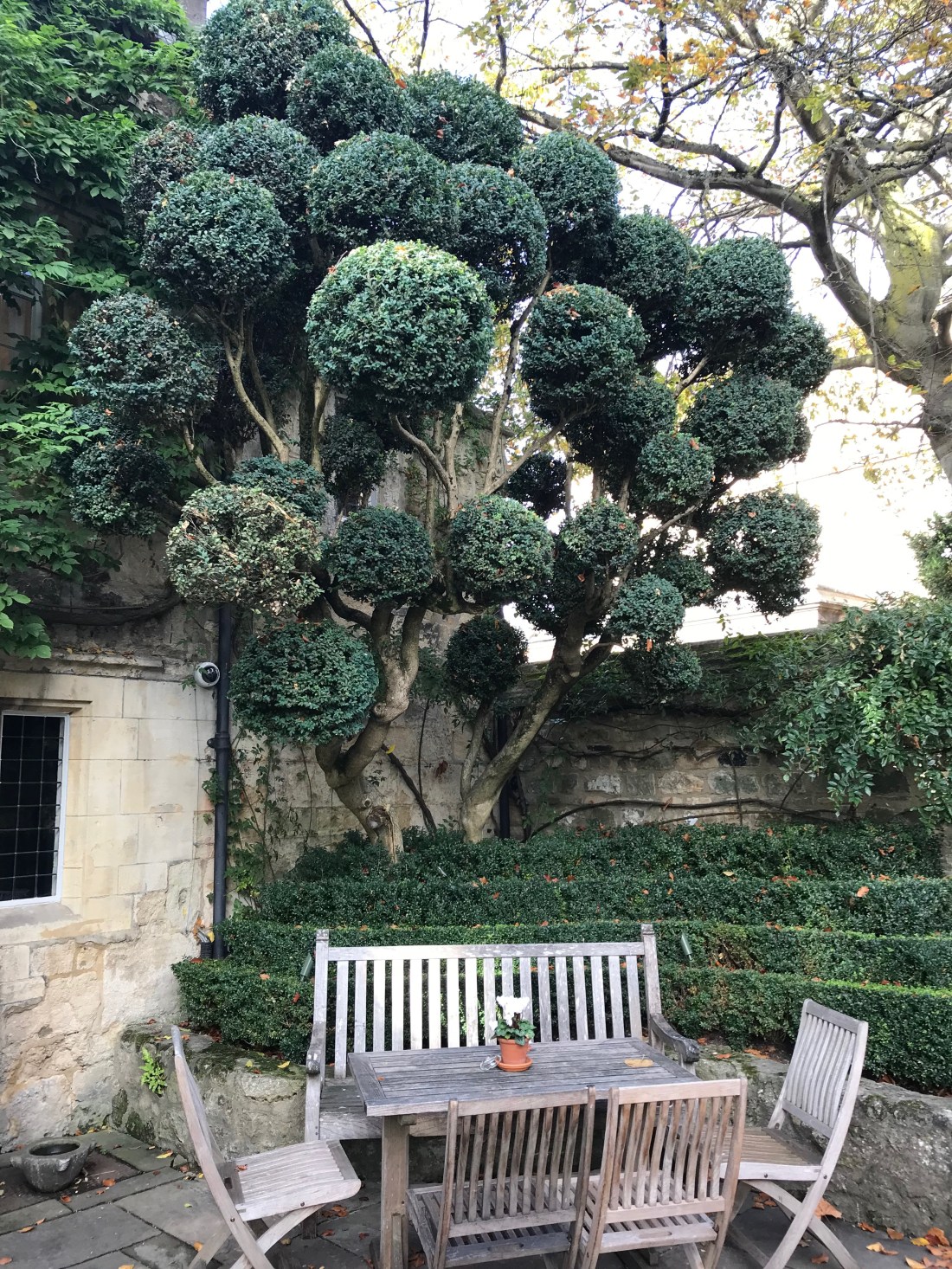
My favourite Buxus sempervirens grows in the garden of The Old Parsonage Hotel in Oxford (www.oldparsonage-hotel.co.uk). It is pictured below. I expect one ‘got away’ by accident, and grew to its natural height of 5m/15′ or so. It has been pruned back to a cloud structure of exposed trunks and balls of foliage. It is context-perfect. The garden is relatively small and rectilinear; it is enclosed by a wall on three sides and the house on the fourth. It is not a space for meandering paths and water in the middle distance. It is a place for order and precision.

Version 2