
The fine lawn grass species are the most common evergreens in the garden and yet are often overlooked and taken for granted, which is a pity as lawns are probably the hardest working feature of all. Herbaceous borders are not required to be beautiful and suitable for ball games or sitting on, but that is what we expect from a garden lawn.
Laying turf is one of the most enjoyable projects in a garden. As ever, soil cultivation and ground preparation are the most important parts of the process and take far longer than the turfing itself. I like my clients to go out on the day I lay the turf. They leave an area of bare level earth and come back ta-da! to a lawn. Because, if the preparation is done well, and the turf is good quality, it goes down like carpet.
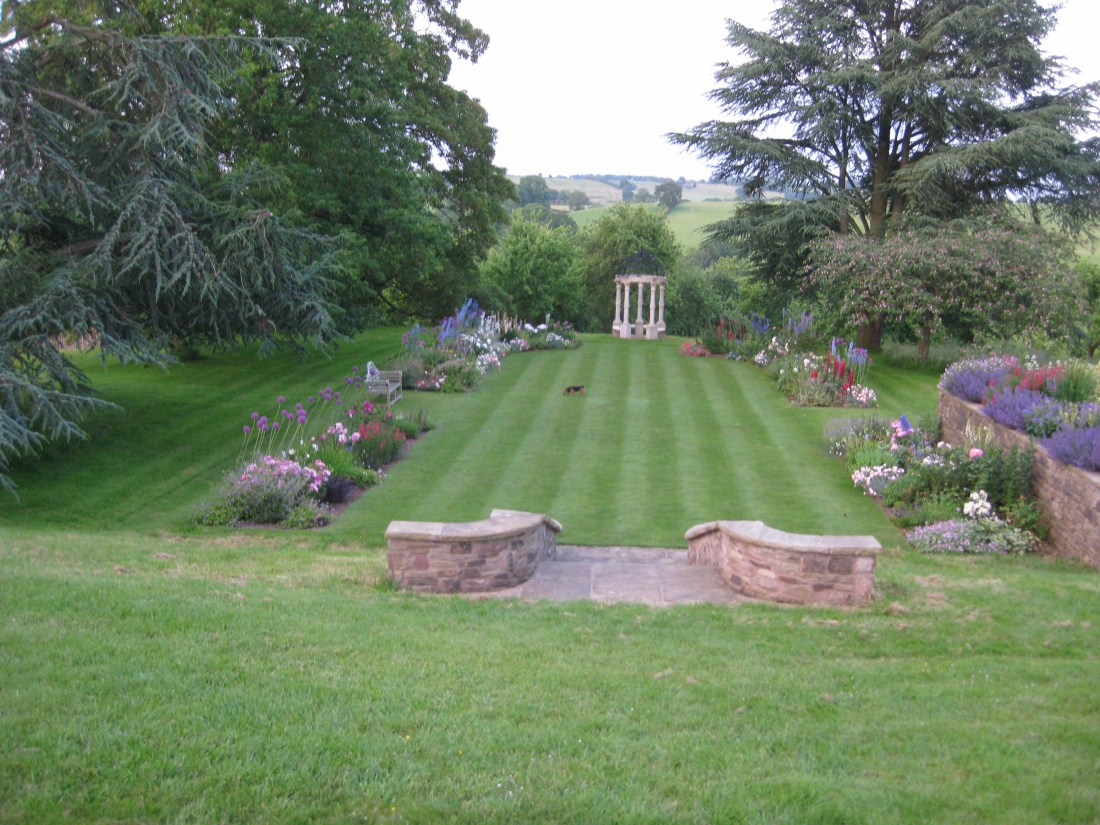
The green expanse of a lawn is a useful fore-grounding to the colourful display of the flower borders and the sward can both frame the other feature and help to calm the colours down, to buffer them. But lawns are things of beauty in their own right. Mowing at different heights creates contrasting textures which can be used to guide the eyes or create patterns. Parallel stripes are the simplest of patterns, but mowing the area a second time on the perpendicular creates a chequerboard. The stripes are created by the roller of the mower laying the blades of the grass down in the direction of its passage, which causes the light to reflect differently. Like rainbows, which exist uniquely to each viewer, the stripes of the grass reverse depending on which direction they are viewed from. Each stripe is both dark and light. More complicated patterns are possible, limited only by the area available, the width of the mower, and the dedication of the person mowing.
A finer cut, and a better finish, is achieved with a cylinder mower rather than a rotary one. The rotary mower is, in essence, a scythe, but the cylinder mower is a pair of scissors. A freshly sharpened and correctly adjusted cylinder mower is a thing of joy. It will cleanly cut a single piece of paper inserted between its fixed plate and the moving blades, indeed, that is how to test it.
Lawns are often recommended as a low-maintenance solution, but only if the garden owner is happy with unkempt grass. To keep fine turf in top condition is time-consuming. In a previous garden, I had an acre of it under my charge. Grass grows at temperatures above 6 degrees Celsius and during the growing season, generally March to November, it was mown every three or four days, edged weekly (1km/0.6miles of edging) and fed monthly. In September every year it was scarified to remove moss and thatch, hollow-tined to improve aeration and drainage, and top-dressed with sharp sand; six tonnes of sharp sand. During periods of drought, it was irrigated carefully. This kept the lawns looking like a billiard table, albeit a very stripy one.

 thephilosophergardener