
Few plants sound so much like an incantation as Cynara scolymus ‘Violetta Precoce’. Portals to other worlds should open at the sound; portals to past worlds, possibly. Few garden plants have the long heritage of the globe artichoke. Pliny the Elder wrote about it in his Natural History (Book XIX), observing that, ‘it was in the highest state of cultivation, and Ravenna produces heads that weigh as much as three pounds even’. Carciofi alla Romana remains a typical dish of Roman springtime cuisine. Smaller heads than Pliny’s monsters are used, braised whole bar the choke, with a section of tasty stem still attached. Other cities have their own variants. In Venice, in March, a course of whole violet artichokes arrived at our table. The heads were somewhere between a hen’s and a duck’s egg in size, and they had been braised very simply in white wine, parsley and lemon juice. Our host described them as ‘the first cutting’ and the best of the year. He lamented the artichokes found in England, artichokes ‘the size of trees’. As we had walked through the restaurant to our table, however, I had spied a different dish of artichokes which I was keen to taste. It was made from the basal plates of large ‘tree-like’ artichokes, the basal plate from which the flower develops. It is firmer, denser, and more intensely artichoke flavoured than the bud-scales. The Italians also use artichokes to make a bitter digestivo Cynar, of which I am fond. It is allegedly good for the liver.
I have planted artichokes in the flower border as often as in the kitchen garden. They, like their close relative Cynara cardunculus, the cardoon, are among those plants which attract the lazy and often spurious epiphet ‘architectural’. They have strong form, certainly. Each leaf is carried on a rigid rib and has a jagged profile. The silver-green foliage pairs well with anything pale and interesting, and contrasts nicely with the softer, blousier textures of Geranium, Knautia, or Origanum. The cultivar ‘Violetta Precoce’ has two additional virtues to the species. Its purple buds are handsome and the ‘Precoce’ indicates that it is an early season maturer, which is useful in our northern isle where summer can arrive late and leave early.
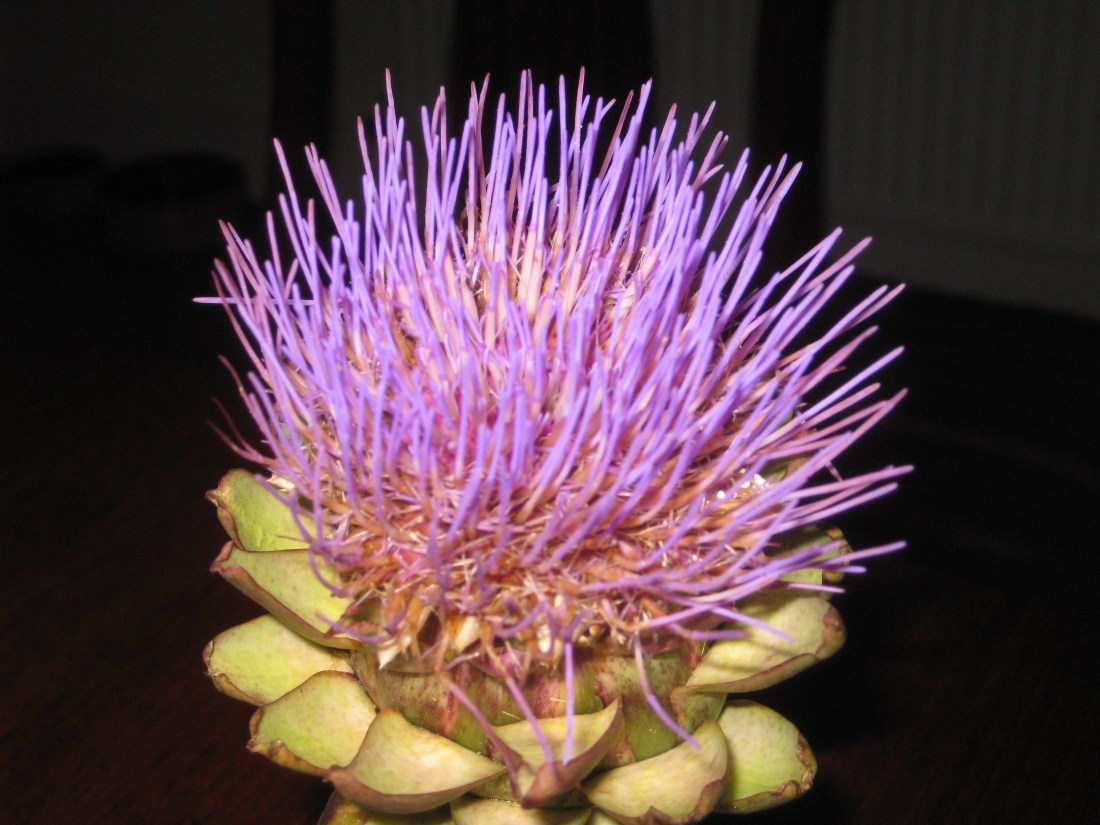
I have never found them the most predictable of plants. Of two close companions, one has died and the other thrived, and yet I can discern no difference in their situation. When they do thrive, they can be large plants, easily 1m/3′ across and 1.5m/5′ tall. I have never had the luxury of sufficient space to grow as many as I desire. I am always compromising therefore – a cardinal virtue in all successful gardening. I want to harvest buds for the table whilst they are still young and tender, and relatively choke-free, but I also want to leave some to develop into flowers. When left, the bud opens to reveal a saucer-sized cap of violet fingers. They seem to glow with their own light, and are mysterious presence in the border, like something from another world.


 thephilosophergardener