Salvia guaranitica

The garden is exhausted. I walk on paths strewn with yellow poplar leaves with their unique scent which I forget year to year. But, when I smell it afresh, it brings every autumn I can remember to mind. I find it re-assuring – it situates me in the passing of the seasons and the passing of my life. By the ponds, the large leaves of the Gunnera manicata – a Brazilian native – look ragged and tired, and soon will need to be put to bed for the winter. Under the beeches, squirrels forage franticly for the mast. Everything is as it should be.

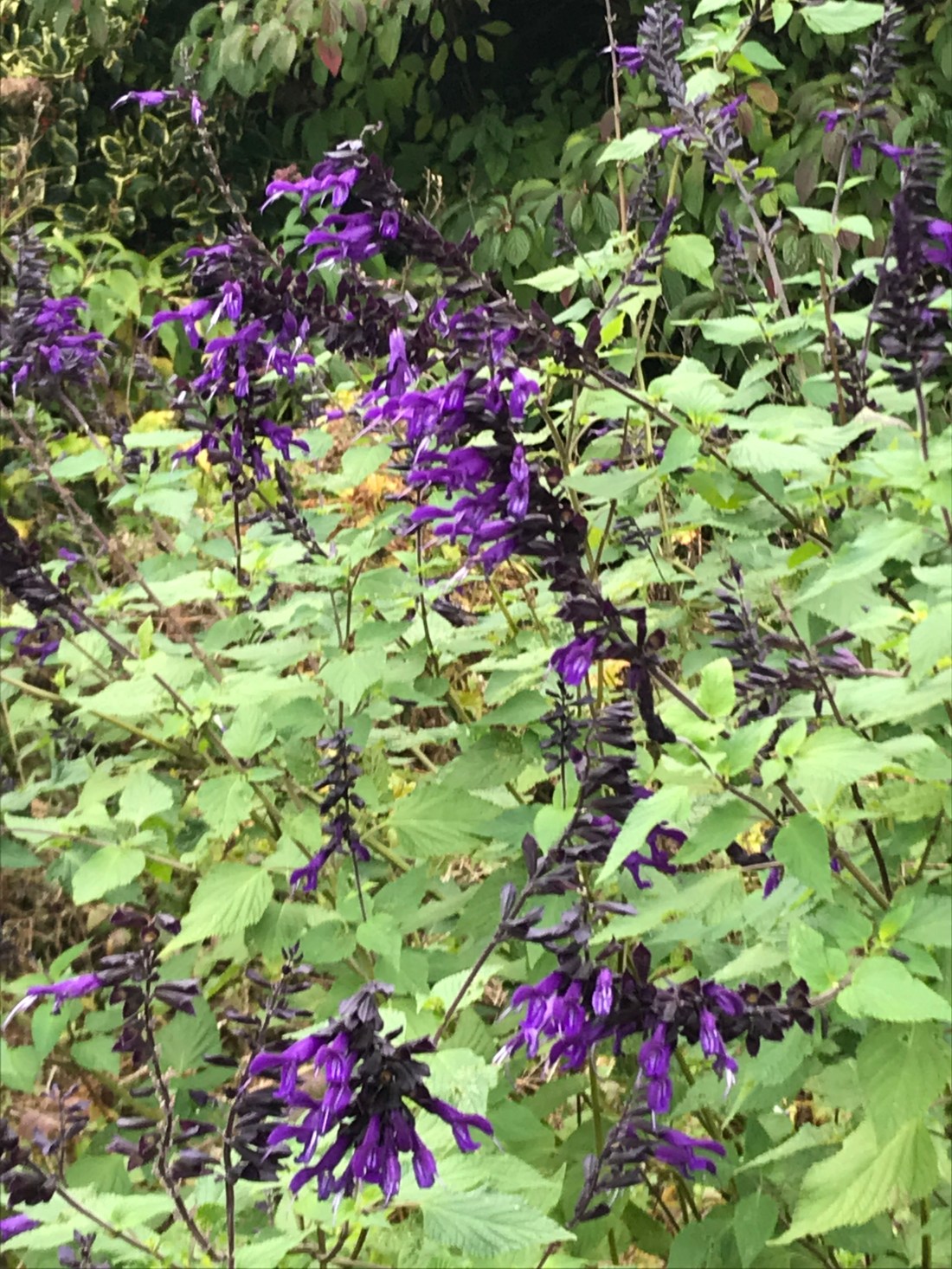
Then, rounding a corner, I come to a bed of Lobelia tupa (devil’s tobacco) and red and blue Salvias in full display, as if winter is just a fairytale to frighten children. It is a last shout of summer echoing into autumn carrying memories of a hot sun. The Salvia guaranitica catches my eye, especially. It is also known as the anise-scented sage, for the smell of the crushed leaves, and the hummingbird sage. What a sight it must be in its native Latin America, growing to its full height of 2.5m/8′, abuzz with the tiny birds sipping its nectar. The Salvias in my bed are a more modest 1.5m/5′, but still impressive. Salvia guaranitica has a running rootstock and spreads into drifts of colour. It is only hardy down to -5 Celsius though, so only a series of mild winters will allow the clump to develop any size. When I gardened in the far north of England, beyond Hadrian’s Wall, it was a plant which we kept alive from one year to the next by taking cuttings and over-wintering it in a heated glasshouse. We would plant it out with the other exotics towards the end of May or the beginning of June when the risk of hard frosts had passed. We had light frosts in September this year, just enough to blacken the leaves of the even more tender Dahlias and ruin their flowers, but the Salvias have endured them.

I am not sure which cultivar I have growing here. I think ‘Black and Blue’ is most probable. ‘Blue Enigma’ is a useful plant in the garden for those seeking that elusive true blue with no red in it. These tall sages are most effective when massed together informally with companions of similar habit. The Chilean Lobelia tupa, being more rigid provides a useful spine to the planting, whilst the Argentine Verbena bonariensis (syn. V. patagonica) brings a different flower form to the border.
IMG_0668

Crataegus coccinea

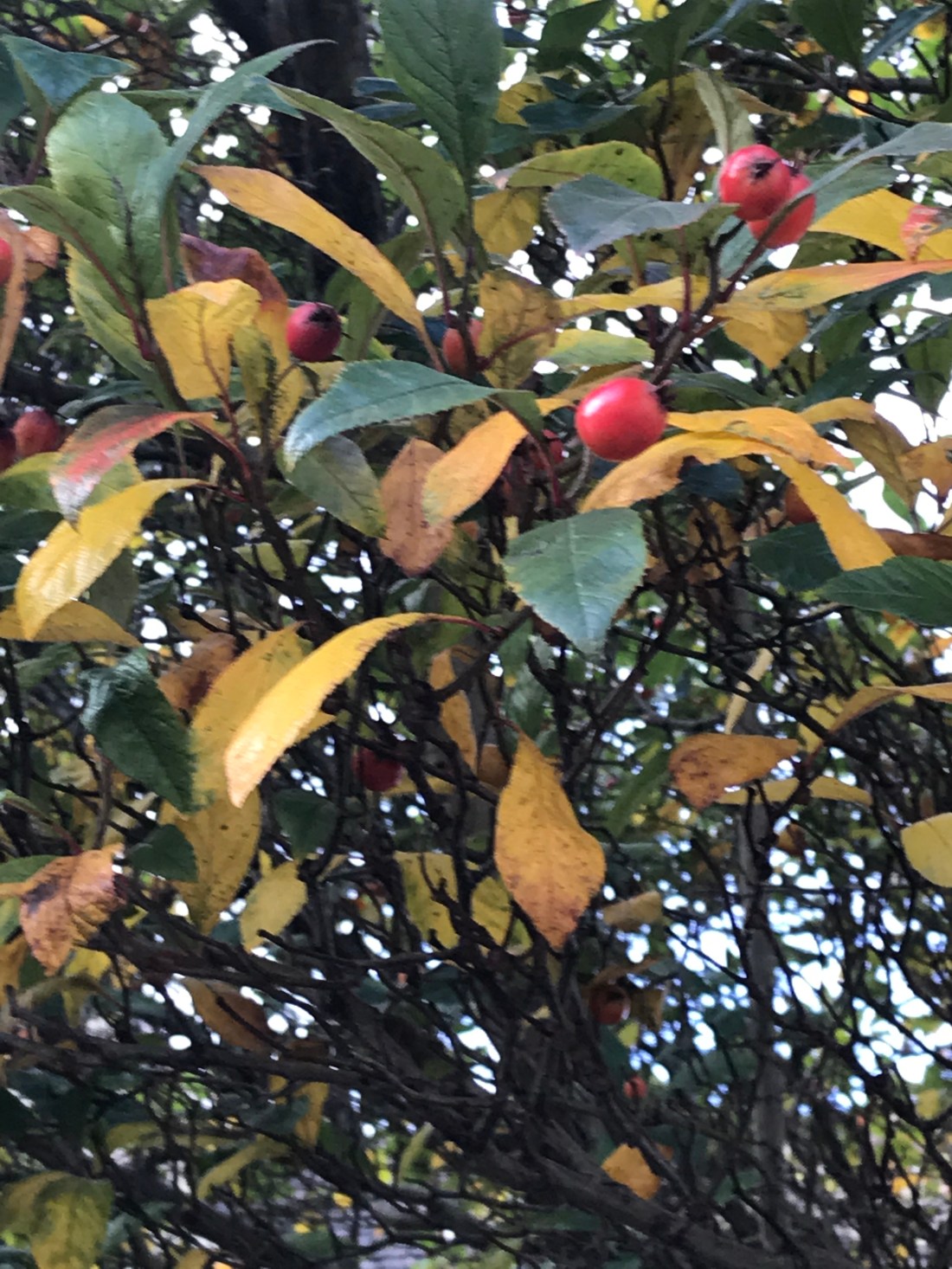
The scarlet hawthorn sits in the garden like the timpani of an orchestra. For much of the year, all the action, all the noise and excitement seems to be provided by showier plants – floriferous roses, or the herbaceous perennials which rise from nothing to fill the garden with colour and scent throughout summer. But, just as the garden is exhausted and it is time to cut the other plants down to their crowns, or to prune the roses severely, there is the scarlet hawthorn in its autumn dress, all flaming gold and abundant large red berries. There are few more pleasing sights on a bright, frosty day with the low sun illuminating the tree’s crown. On a dull, overcast or rainy day, the scarlet hawthorn and other deciduous heroes seem to be the only sources of colour and light to lift the spirits.

Crataegus coccinea is a useful tree in the garden. It is genuinely small, as opposed to being small for the first ten years before turning into a monster like so many other ‘small trees’ of the catalogues. When mature, it reaches 7.5m/25 feet tall and, in truth, it is its round-headed nature which is more likely to cause a problem in a city garden as it will grow as broad as it does tall. I enjoy plants which give and give again at different times of year; the scarlet hawthorn is generous. In spring it is covered with white, slightly sour-scented blossom which is loved by the insect pollinators. In summer, it settles down to a reliable green – the sort of background noise in a garden which is only noticed when it is absent. In autumn, the leaves turn gold before they fall. I believe that in their native New England, the deeper cold turns the leaves to red and even to purple. The berries are a valuable food for birds, birds which may have nested in its crown, protected by its 5cm/2″ thorns. Even in winter, the scarlet haw continues to give, to us and to other creatures. I find the fissured bark visually pleasing. Ladybirds and other hibernating insects find it homely, which in turn brings tits and numerous insectivorous birds in search of a meal. I have spent many a happy coffee time, wrapped against the cold, watching the sharp-eyed birds flitting from twig to twig, picking the crevices for food. Like other hawthorns, the bark of the previous year’s growth ripens through the cold months, gaining a deep red lustre. Slowly, in the cold chemistry of the tree’s stored energy, the buds ripen and swell with the promise of life. These changes, expressed by the tree, are fundamental to the timbre of the garden as a living space as, indeed, are its movements, and the movements of the creatures which are drawn to it.

When first I encountered Crataegus coccinea, it was by a different name, C. pedicellata. The two former species have been shown to be one species. Coccinea, being the older name, takes precedence. It is a more accurate description of the plant, and I should be less reluctant about this change than I am.

6OHjKZKNSGqSwP7Hgus3BA

Solanum lycopersicum ‘Crimean Black’

I believe it is the finest tomato I have ever grown. At 370g/13oz it is not the largest, that honour goes to a ‘Marmande’, but it is the largest ‘Crimean Black’. It is not black, of course, just a dark red of a shade which looks particularly fine when mixed with golden and scarlet varieties in a tomato salad. The depth of the colour intensifies with temperature, but even in this exceptional year, I have grown this outdoor variety under glass.

What a story the ‘Crimean Black’ has to tell! It is unknown when the tomato crossed the Atlantic for the first time, but if it wasn’t with Columbus then it was probably with Cortes, sometime after AD1521. Tomatoes were being eaten in Italy by AD1544 when Mattioli describes them in his herbal, but it was slow to catch on – the first cookbook to make use of it dates from AD1692. The clue to why is recorded in the second part of its botanical name lycopersicum or ‘wolf-apple’, the German name for the nightshade berry, by which occultists could transform into werewolves. The people of Europe were divided as to the toxicity of the tomato, recognising its relationship to a known danger. The SOLANACEAE family is a curious one, containing many useful foods such as aubergines and potatoes, and many highly poisonous species too. At some point, the tomato made it to the Crimean peninsula where local ‘black’ strains developed which were suited to the hot summers. After the eponymous war, these journeyed back across Europe in the pockets of homeward-bound soldiers, eventually re-crossing the Atlantic where they grow successfully in the favourable climate of the southern United States.

The tomatoes first appeal, like that of another American import the runner bean, was as a decorative rather than a culinary plant. The runner bean too was considered toxic. Tomatoes were prized in the flower garden and as a table decoration. It wasn’t re-branded as a ‘golden apple’ until AD1554 and as pomo d’oro it spread into Polish and Russian. An almost obsolete German word paradeisapfel connects the pomo d’oro to the Garden of the Hesperides as mush as to Eden. Tomatoes have travelled far and wide, geographically and figuratively.

I’m going to send my ‘Crimean Black’ on one final, alimentary journey. Years ago, in Turkey, I ate a simple but perfect salad which was served with my grilled lamb kebabs. As I remember it, cucumber and tomato had been diced finely, there was chopped onion and green chilli, olive oil and parsley. It was at once heating and cooling, and utterly delicious. I have cucumbers and chillies from the glasshouse and parsley from a pot by the back door. I have some Muntjac for the kebabs. A Mesoamerican-Crimean tomato, an Asian deer, an Indian-Germanic cucumber – all local. Fusion cuisine at its finest.

IMG_5973

Urtica dioica

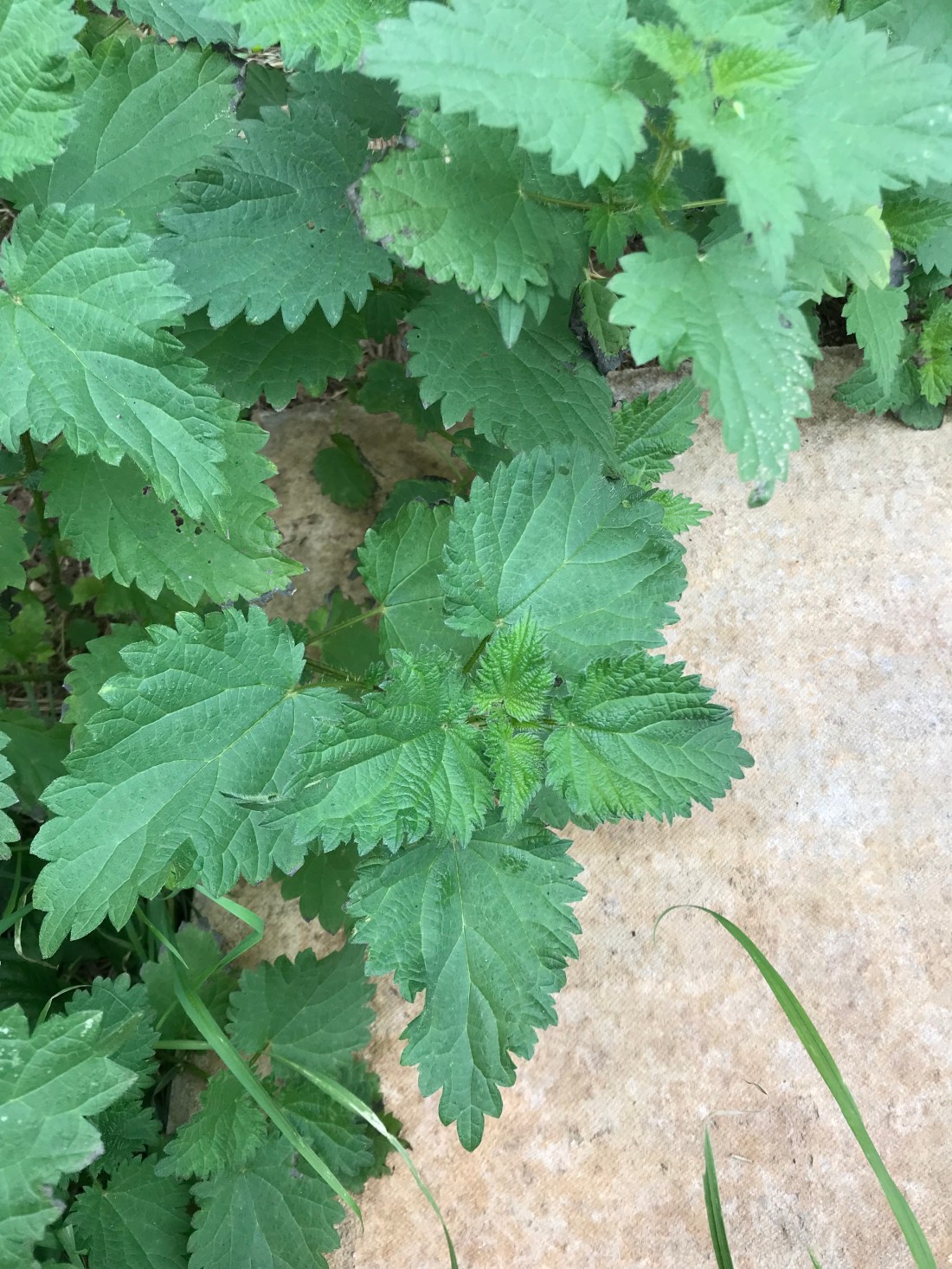
When Attila the Hun was besieging Milan, the city council opened the gates to him after he declared he was the Flagellum Dei. The city was thus subjected to the customary three days of pillage etc.. Urtica dioica, stinging nettle, is my scourge. It lurks within the crowns of other plants and punishes me for my lack of observance. The fingers of my left hand are tingling now from one I encountered earlier. I am not overly interested in the narrative of sin, however, with its infantilising blame – I have always been more interested in responsibility, and adulthood: Nietzsche, for all his faults, did have a point.

I prefer to think of the presence of nettles in the garden – and the presence of its friends – those that we call weeds, but which are really just plants which do not suit us – as the stone I must push to the brow of the hill, only to do it again tomorrow. Unlike Sisyphus, I do not consider it a punishment. I mean, what is the alternative to work – the interminable boredom and purposelessness of effortless pleasure? I’ve witnessed that firsthand and it isn’t attractive. I am happy to see weeds, including nettles, in the garden as then I know I have something to do tomorrow. And, when the day’s work is done, I can pour myself a glass of whiskey and find comfort in the memory of the work completed and the thought of tomorrow’s labour, sleeping sweetly with anticipation.

At school I was told that the Romans introduced nettles to Britain and the soldiers used to flagellate themselves or each other – it was never explained clearly – in order to stimulate their circulation in the cold climate. This seemed improbable to my eight year-old self. I was also taught that the Roman Empire fell in 410AD and that was never true. I would have thought that nettles more probably arrived in a shipment of hay for the cavalry horses. However the nettles arrived, they remain a sign of the presence of human activity. Nettles love nitrogen. They thrive on old middens, along fence lines where stock have been corralled, or next to walls where builders have been working. And they seem to invite nitrogen. My hound cannot pass a clump without blessing it.

I try to find a place for nettles in a garden. I don’t pick them to make into beer, tea or soup, although they are high in calcium, iron, and Vitamin K. I avoid consuming them on the grounds of the previously observed benediction. I take no pleasure from the stings, unlike the eccentric Sir Charles V. Boys, the author of Weeds, Weeds, Weeds [Wightman and Co., London, 1937]. No, I leave nettles their own space in a garden, as opposed to the places they usurp, for the many creatures which benefit from them. One of the greatest pleasures of summer is to see Red Admiral butterflies on the buddleias. But first Red Admiral caterpillars must engorge on Urtica dioica. They are the poets of the garden, metamorphosing pain to beauty.

IMG_0656


Cucurbita pepo

I have picked the last of this summer’s courgettes and pulled up the plants. Although the plants are still flowering gamely, the shortening days and dropping temperatures ensure that little will come of them. Besides, as the growing season wears on, courgettes always seem to suffer from mildew and the once handsome palmate leaves are now mottled, grey, and tattered.

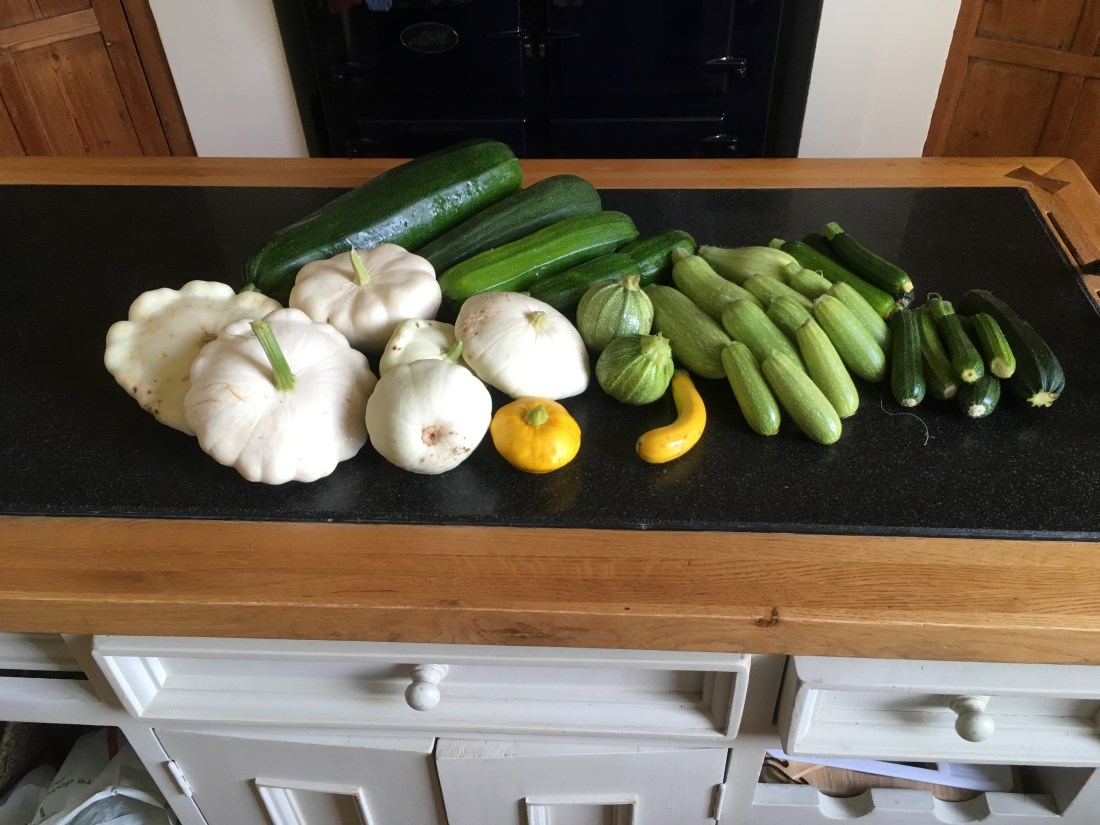
I bought a packet of seed which contained six different varieties – three were the ‘traditional’ baton type, one was round, and two were patty pans. As courgettes are very reliable germinators, I soon had more plants than ground in which to grow them, and as each plant can reach over 1m/3′ across, it is very easy to run out of space. I gave away as many plants as I could, then resorted to planting the spares in the flowerbeds. If life is willing, it seems wrong not to help it thrive. I chose my packet of seed for the varieties of colour and form, but my understanding was slight. Each type matured at a different rate and fruited with variable generosity. ‘Ronde de Nice’ fruited quickly and abundantly, but ended before the others. ‘Yellow Scallop’ was slow and shy and clearly needed an earlier start, more heat, or a balmier autumn. In another season with different conditions, the varieties might perform differently, but that is the virtue of diversity – there will be a harvest.

The abundance of plants quickly turned into a glut of berries, which is what courgettes are, botanically speaking. The ‘pepo’ in the name refers to a berry formed from the swollen ovary of the flower. In the kitchen, I settle all fruit-vegetable distinctions by the Yorkshire method: fruit can be eaten with custard. Courgettes became a twice-daily feature of my diet and I scoured my recipe books for new ways of preparing them. A favourite has been from the Moro cookbook and involves sautéing them with onion, pine nuts, and raisins – simple yet delicious. Still, the supply outstripped demand and I have adapted chutney recipes to include more courgettes. The freezer is filled with variations on ratatouille which will bring memories of summer sun through the dark, cold days of winter. I even became a courgette pest, badgering friends, neighbours, tradesmen who came to work at the house to take courgettes away with them, and still there have been too many.

And yet, this week or next week, when I have eaten or processed this final picking of courgettes, I will miss them. Cucurbita pepo, courgettes, zucchini, originate in the Americas, as do tomatoes, potatoes and chillies, and although exotic, they have become such an essential part of my diet and of my English vegetable garden, that summer would not be the same without them.

IMG_0463

Cydonia oblonga

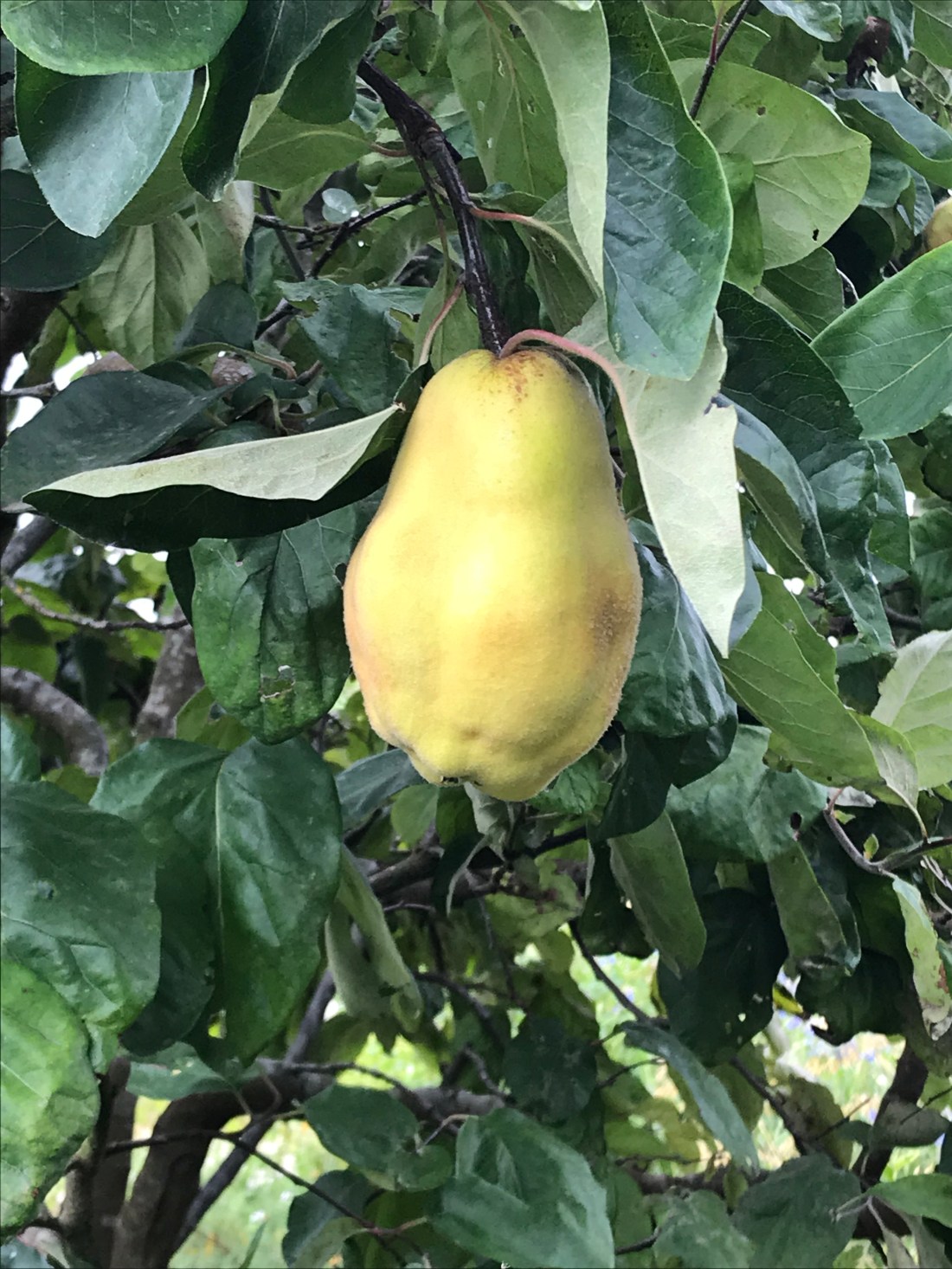
Quince is an unruly, untidy tree. It spreads outwards almost as much as it grows upwards and easily reaches 4m/14′ in both directions. Its branches crisscross and weave through each other in a most undisciplined manner. This time last year I was in the Potager du Roi at Versailles where I happened upon two quince trees which had been ‘trained’. The main trunk had been stopped at around 1m/3′ and four main branches had been directed outwards and upwards like a goblet, these in turn being stopped at 3m/10′ long. The bones of the structure were still visible, but tangled around them in a cloud of fury, the trees were growing as they pleased. Several golden pear-like fruit were hidden among the leaves. I leaned in close to smell them.

What is the smell of quince? It is green, fresh, cool, and constant at its base, then there is an elusive sweet intrigue which grows stronger as they ripen. Place some in a bowl and they scent a room pleasantly, whilst looking magnificent. It is this aromatic quality which makes quince so valuable for cooking. Constance Spry has an excellent recipe for ‘Partridges with Quince’ in her eponymous 1956 tome. Quinces are hard and bitter when raw, but transform into a soft, silky, delicately fragrant and delicately pink elixir when cooked. It is alleged that they can be bletted like medlars, but, as with medlars, I remain unconvinced.

The immature fruit are covered in a grey-ish fur which brushes off to reveal the golden skin beneath. Ancient texts are gloriously vague and at times contradictory, which leaves me free to claim that the fabled golden apples of the Hesperides were quinces. This was the prize which Aphrodite received in the divine beauty contest which sparked the Trojan War. The ancient Greeks thought the trees sprang up from her footsteps, and this association with love and fertility endures in the Balkan tradition of planting Cydonia to mark the birth of a baby.

Quince has previously enjoyed a higher cultural and culinary status in the UK than it does currently. It was an early introduction, recorded first in 1275AD when Edward I planted four at the Tower of London. It was a traditional planting in apple and pear orchards, a practice which was exported to the colonies of New England, but which fell from favour in old England. Its time may be returning given the fashion for Middle Eastern cookery and a broadening taste for exotic aromatics.

It is not a difficult tree to grow and tolerates a wide range of soils so long as they are not prone to water-logging. The simple white five-petalled flower (this is a member of the rose family), is borne early so can be prone to frost damage, and the fruit need a good summer to ripen fully, so a sheltered west or southwest aspect is probably best. The spreading habit of the quince makes it difficult to accommodate in small gardens, although there are more quinces growing in gardens than first meets the eye. Quince A and Quince B are the most common rootstocks for cultivated pears.

IMG_0635

Oenothera lindheimeri

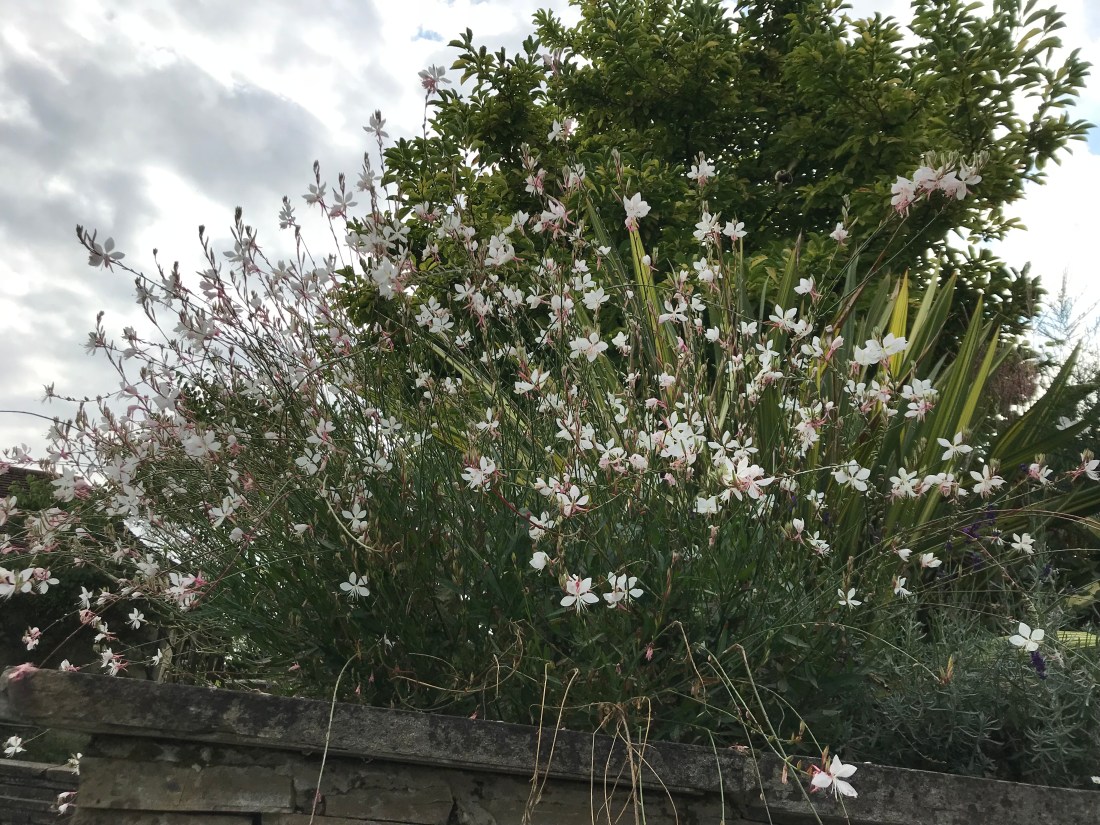
Beans may run or climb, Thymus serpyllum creeps, but Oenothera lindheimeri dances. She has been waving her long slender arms for months now and will continue to do so into October. There has been a significant drought this year, yet our heroine has flourished. In fact, I think she has excelled. She drifts through the borders, carrying her white butterfly flowers along her stems. The cultivar here is ‘Whirling Butterflies’ and the name fits. She stands at 1.2m/4′ tall, but all that growing has been since April. There was snow in April and frost throughout May and I had little hope that she would endure it: I checked her crown every few days, looking for life and not finding it. Yet here she is, beautiful and defiant. I expect, like so many other arid natives, it is not the cold which kills, but the damp island maritime winters of the British Isles.

In the English garden, this native of southern Louisiana and Texas is a natural friend with Verbena bonariensis which is common throughout South America. Their flowering period coincides and they have a similar lightness to their touch. The Verbena’s stems are also slender, but, unlike the Oenothera’s, quite rigid, so it is a useful plant which can provide support by stealth to its airier companions in the border. Aster x frikartii ‘Monch’ is another companion. Again, the fairly stiff stems help to provide support, whilst the lesser height and greater size of the flower introduces contrast. Its colouring is harmonious. ‘Monch’ will flower from mid-August until the end of the season.

When I was training, Oenothera lindheimeri was called Gaura lindheimeri. I have a strong affection for her old name, Gaura, from the Greek, meaning ‘superb’. I find Oenothera difficult to say, but it is more than that (the ‘O’ is silent and the ‘e’ is short and hard). I realise that I remember her name, in part at least, because of the rhythm of the syllables. The old rhythm has stuck, the pattern is formed, and it is difficult to break. I have the same problem with Datura which is now Brugmansia, and Crataegus pedicellata which is now C. coccinea. When I meet these old friends whilst out walking, I greet them with the name by which I first knew them and then correct myself. It is as if the world is shaped differently to how I remember it and I wonder if this is how dementia feels. Or parenthood, perhaps, as the child matures. I guess time may tell, but I expect I will have forgotten by then. And, finally, when I was training, Oenothera was, and still is, Evening Primrose, a course-foliaged plant with a hard and harsh yellow flower. Or, in other words, the antithesis of my delicate dancer.

IMG_0625

Jasminum officinale

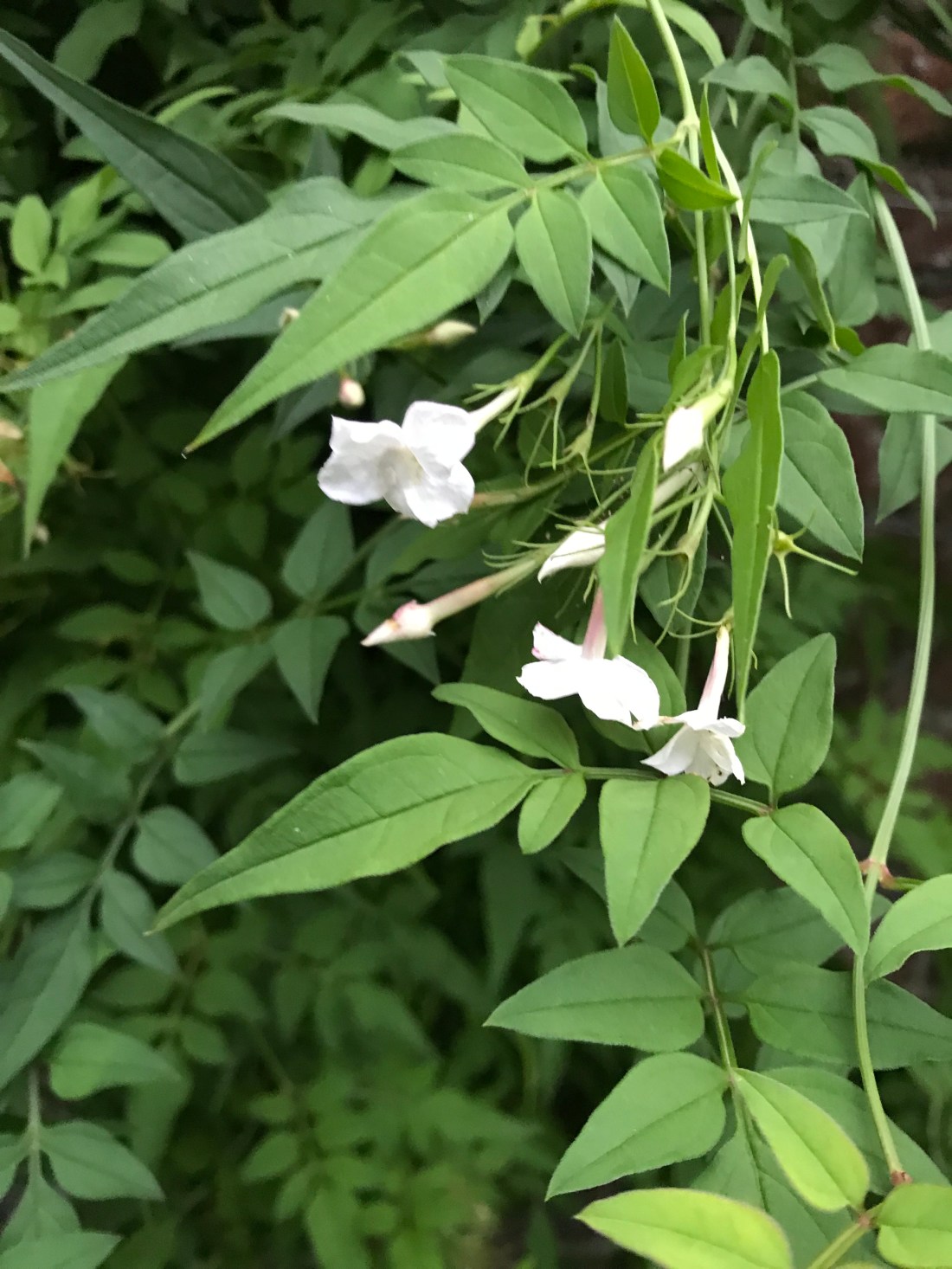
The sun was setting as I strolled around the garden one final time this evening. Beneath a west-facing wall, the Nicotiana alata ‘Grandiflora’ which I grew from seed at the start of the year and planted out in a swathe in May, was releasing its scent in waves on the cooling air. I smiled to myself – it is satisfying when a planting succeeds. The wall is covered in jasmine and the dark green foliage is the perfect foil for the large white stars of the tobacco. It is the perfect foil too for the jasmine’s smaller, more delicate white stars and my smile was in recognition that yet again, a jasmine has out-foxed me. This one has grown to the height of the wall and beyond, and it bears its flowers amidst the twining mass of stems which tumble over onto the eastern face; an aspect jasmines allegedly do not favour. Its full beauty is enjoyed outside the garden. I wandered out through the gate and found a flowering tendril within reach. I drew it down to my nose and breathed it in. Jasmine, like the tobacco, like many other white-flowered plants, releases its scent in the evening and through the night. White gardens should be planted by people who sit out late on summer’s evenings, talking into the darkness. At dusk and afterwards, the white blossoms shine, and fill the air with their musky fragrance.

Jasmine officinale has been in cultivation for so long and has become so widely naturalised that its place of origin is lost. Its name derives from Farsi though, and the old territories of Persia are a fitting place for it. It might also help to explain its early presence both in China and Byzantium. Today it can be found growing wild in the Iberian peninsula whilst also being the national flower of Pakistan. Jasmine, true jasmine, the poet’s jasmine, has a long association with love and is a reputed aphrodisiac. With no sense of contradiction, it is also recommended as a calmative remedy which quietens and soothes. As I write tonight, I am sipping from a glass of green jasmine tea and dreaming of a good night’s sleep.

Although it has found medical uses, notably as a liver tonic, its primary use beyond the garden wall has been in perfumery. Its oil, known as Jasmine Absolute, cannot be produced by steam distillation, so must instead be captured by a solvent from which it is then extracted. In the dark recesses of my memory, I have images of flowers pressed into grease between panes of glass. The volatile oils were transferred to the grease and then the grease was processed to liberate the oils. But that was a long time ago. Jasmine Absolute currently retails for around £10/ml which is expensive, but it is not the most expensive botanical. That crown is still held by saffron, a crocus with a remarkably similar geographical distribution to jasmine and with an even older recorded history of cultivation. The best saffron can cost £70/g, which is roughly three times the current price of gold.

IMG_0608

Putto with Perovskia atriplicifolia ‘Blue Spire’

Statues are such a familiar feature in a garden, that it is easy to stop asking why they are there or how they are effective. It is not simply that they are beautiful – some are brutal or Brutalist; they may have a spatial harmony, but they are disruptive and uneasy to the eye. Others, like Bernini’s Apollo and Daphne are exquisite in composition and execution, but the myth represented is one of violence and violation. The subject is as ugly as the object is beautiful. A good friend used to say, “Don’t look for hidden depths, I have only hidden shallows.” We studied philosophy together many years ago, (If presented with a choice of being a gruntled pig or a disgruntled philosopher, she always chose to be the hog). I suppose I am grasping towards the difference between figurative and abstract sculptures. Take our chubby, winged friend pictured below. Putti are highly ambiguous, at once attendees of Bacchic rites and representations of the omniscient creator; a companion of Venus-Aprodite and a messenger of divine wisdom. But, figurative sculptures do have meanings, albeit tricksy, plural, at times contradictory meanings. Their meanings have a history too, an etymology, a traceable lineage and an identity in the present. The danger with abstract sculptures is that they are only form – profound shallows signifying nothing. The British sculptor Henry Moore’s work is the most numerous in public spaces across the globe, I believe.  All statues though, even the abstract, are an external and objective condensation of energies; intellectual, cultural, physical, and chemical, perhaps even tectonic. Their presence in a garden is often ‘tonal’ – it sets a mood. The putto pictured on his ball, squeezing grapes into a goblet, is next to a swimming pool. It is a place of leisure, and licence, perhaps.

Whilst pale stone statues work well against a contrasting, darker background such as yew or bay, they can disappear in open space. Lead pieces, on the other hand, are at their best against a clear sky, or the plant substitute for such, an open-structured, blue-flowered plant such as the Russian sage. As Mary Keen observed, ‘blue is the colour of distance’. A blue-toned planting scheme is always restful and airy, whilst the hot yellows and reds are intense and enclosing. Perovskia’s common name is a good indicator of its hardiness and it is fine down to -15Celsius. It will take as much heat as the British summer can muster too, as befits its native habitat of the Steppes. In general though, silver-foliaged plants do not like too much water at any time of year, and it is often not the cold of the British winter which kills these hardy plants, just the incessant wet: their roots rot in the ground. I enjoy Perovskia for itself – like English lavender or Gaura, it moves, giving the breeze substance, making it visible. Perovskia, Lavandula, Gaura, all three would serve as backdrop to the putto – the movement and airiness is the perfect foil to its leaden density.

IMG_0576

Laurus nobilis

I have been planting a bay hedge for a client. It has three immediate purposes. Firstly, it forms one boundary of a formal garden, the rest of which is in place. The straight run of dense, dark foliage is like a word at the end of a sentence, underscored for emphasis: the garden stops here. Secondly, it hides a large plastic tank which holds domestic heating oil. It excludes it from the formal garden whilst simultaneously carving off a useful area for rubbish bins, wheelbarrows, empty flowerpots, and all the other detritus with which we clutter our lives. Thirdly, a road lies beyond it. Large thick leaves such as bay’s have better sound-dampening properties than, for example, the needles of yew. Being evergreen, it will dampen sound the year round.

Next year, it will serve other purposes. In April, bay bears small, insignificant yellow flowers which are a valuable early pollen source for bees and other insects. Birds will nest in it, enjoying the protection and privacy of the dense foliage. My clients may pick leaves for use in the kitchen. I hope that on hot sunny days the dry, spicy fragrance of the foliage will mix with the sweeter scents of the flowers in the garden, enriching the olfactory experience.

The sun was shining when I delivered the bushes, and my client came out to see them. He broke into a smile – the smell of bay had conjured memories of his childhood in the Lebanon, ‘where bay is everywhere’, and of his grandmother adding stems of it to the laundry to scent it. Clever grandmother – the essential oils in the leaves can act as an insect repellent too.

Forests of Laurus nobilis once spread across the Mediterranean basin, only retreating when the climate became hotter and drier around ten thousand years ago. Pockets linger on in Portugal and Turkey, but I have never been fortunate enough to visit one. I am pleased to bring something from my client’s homeland to his home in this corner of England. I am sure it will thrive as he has done. Bay has a reputation for being unreliable in its hardiness, but I have known bushes survive successive nights of -10 Celsius without harm and I have no fear for this planting. It is remarkably tolerant of different soils too and can be grown in Herefordshire clay or the sandy loam of Norfolk. It dislikes cold, drying winds, but it is hardly alone in that.

Like yew, the dark evergreen foliage is the perfect backdrop for a statue. Unfortunately, my perfect statue is in the Galleria Borghese in Rome. How much better it would be if it were in a garden! It is an extraordinary marble by the extravagantly talented Bernini. It captures the metamorphoses of the nymph Daphne, her raised hands already changed into laurel leaves as the rapacious Apollo reaches to grasp her. Her leaves became his victor’s wreath, and the rest, as they say, is history.

IMG_0574