Sarcococca hookeriana

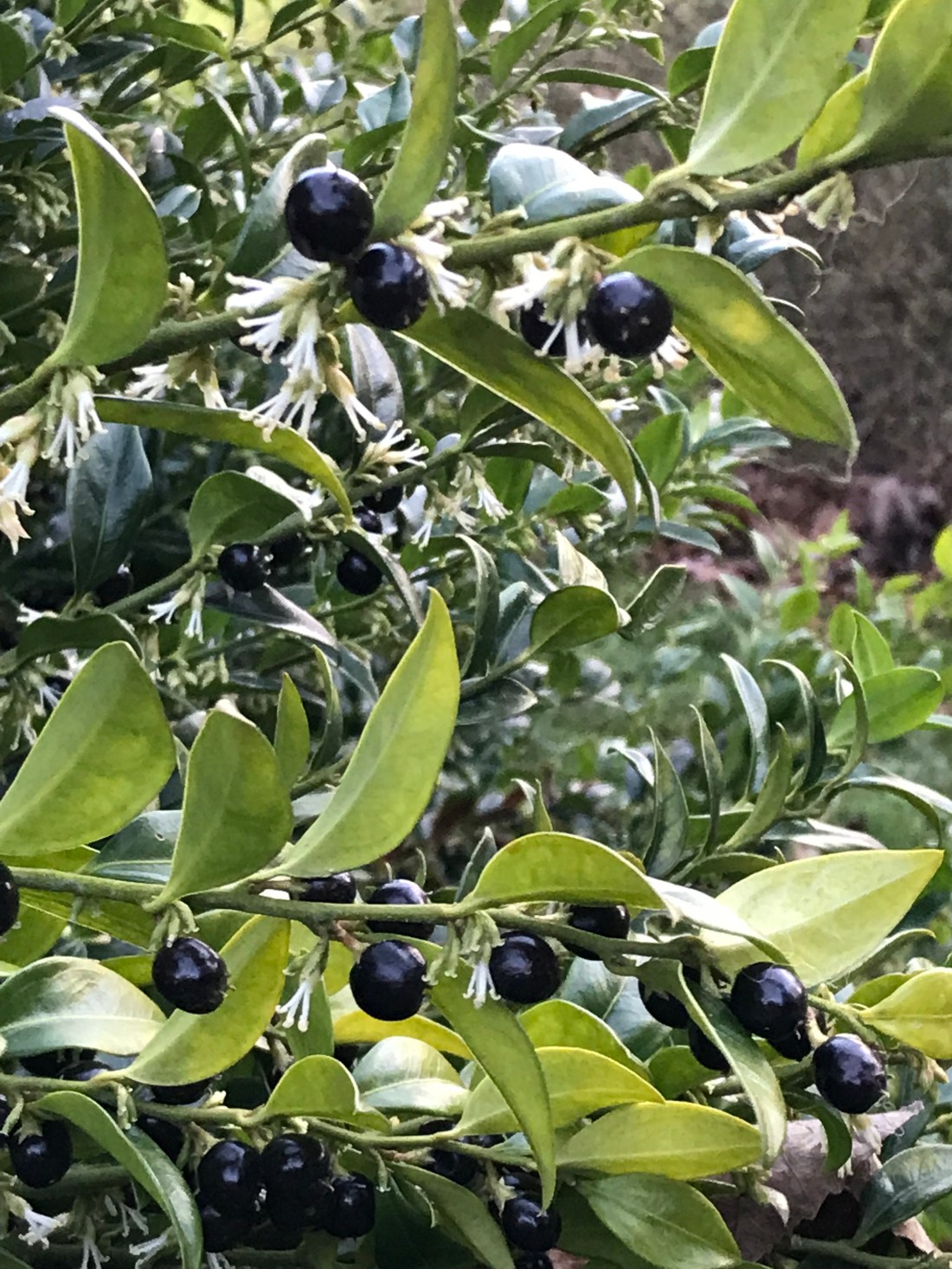
Sweet box is a viola in the garden: it may not be the most glamorous of the instruments in the orchestra, but its depth and tone would be sorely missed if it was absent. It fills that difficult middle-section of the border, where something reliable is needed to provide texture and contrast to the showier plants around it. And, undoubtedly, it has its own virtues too. First among these are the fragrant flowers which give it the sweet of its common name. Sarcococca flowers all winter and sets small glossy berries which range in colour from red to black. These are clearly not valued by British birds as food as they often endure into the following winter, so that flowers and berries are carried together. Although its leaf is shinier and more pointed than a true box, it is a member of the same family. Visually, it can be easily overlooked. I went to the University Parks in Oxford with the express intention of photographing a specimen and I walked straight by it – my eye was caught by a fine Poncirus trifoliata on the other side of the path. The powerful, sweet scent stopped me in my tracks though, and I returned to my prize. I like to think that if anything happened to my eyesight then I will be able to enjoy with my nose alone, a garden at all times of year so long as the plants have been chosen thoughtfully. I once worked in a garden which was a visually sophisticated composition, but it contained almost no scented plants. It was like watching a film with the soundtrack turned off. As scent is the handmaiden of memory, I have only to catch a note of Sarcococca in the air and my mind fills with pictures and associations of times and places.

Sarcococca is a victim of its other virtues, virtues which make it loved by amenity landscapers and parks and gardens departments. It is often found near public toilets. It tolerates all kinds of soil, although it prefers moist and well-drained loam. It grows in all growable pH ranges of acidity and alkalinity. It is hardy down to -15 Celsius, which makes it winter-proof throughout the British Isles. It prefers shadier conditions and will survive even in dry shade, which means it will grow where fussier plants will not. Indeed, I inherited one which had been planted in full sun by a firm of garden designers, and I had to transplant it: its leaves had turned an unpleasant shade of yellow. I am pleased to report that it recovered quickly once it was tucked against a north-facing wall. It suckers, which means that it spreads and within ten years can form a clump in the range of 1.5m/5′ to 2.5m/8′ across. As it suckers, it should be possible to lift and divide it if it grows beyond its bounds, but I have never done this. I have planted it as an under-storey beneath small, delicate trees such as Amelanchier canadensis, and it has always had as much space as it can fill. The dense, evergreen foliage provides a perfect foil to the gentle cloud of tree blossom above.
IMG_5919

Helleborus niger

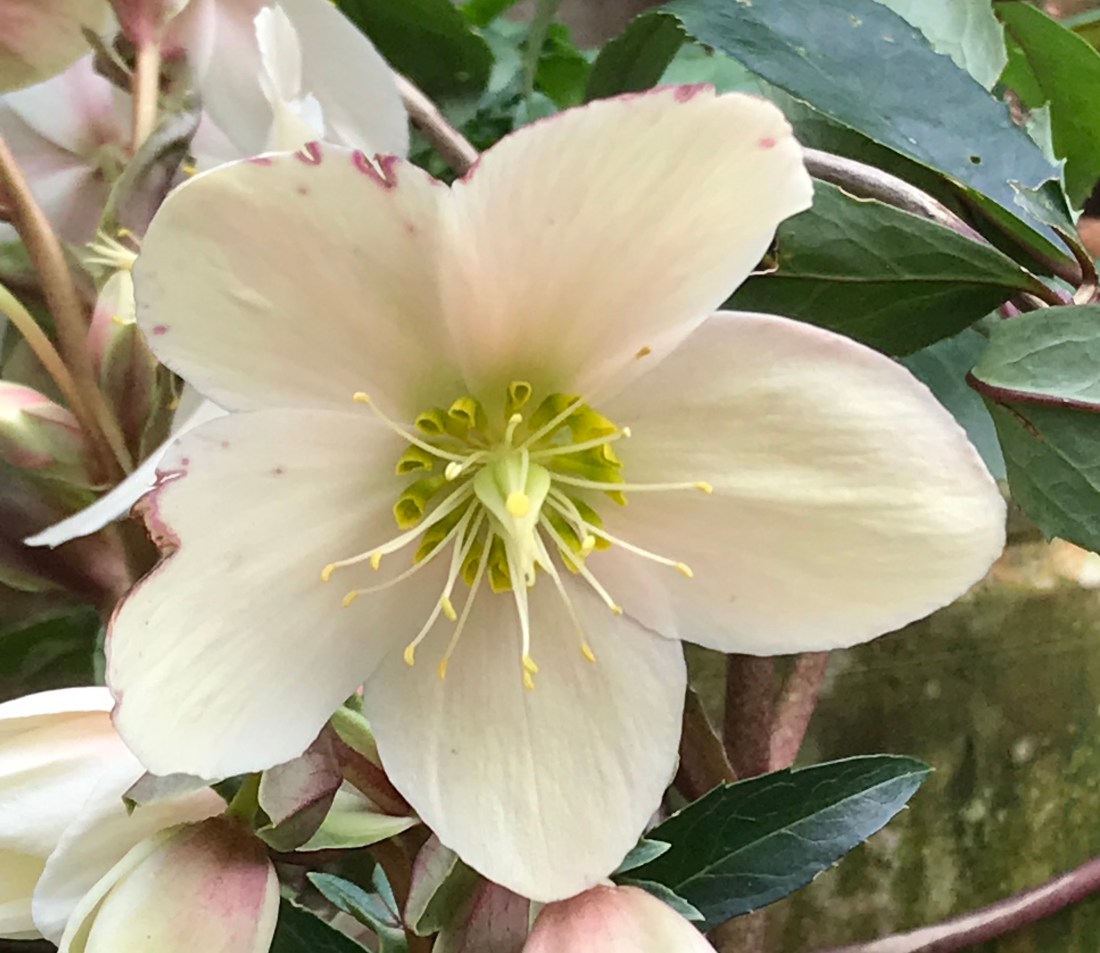
The Christmas rose Helleborus niger is a plant of the old dispensation: it favours the Julian calendar and is usually flowering more splendidly in the first week of January than in December. Although it is semi-evergreen, I find it is good to cut the year-old leaves down to ground level once the flowers begin to show. Then the flowering stems can grow and be seen without the rather tatty foliage spoiling the effect. By the time the flowering has finished, the fresh new leaves have come through and they, in turn, look splendid once the seed heads have been removed. Hellebores grow to around 40cm/15″ tall and provide interest and colour all year round. The leathery, palmate leaf is handsome, and the predominantly white flower can reach 8cm/4″ across. It flowers for weeks, through the darkest months of the year.

I found it highly valuable in Herefordshire where I grew it at the front of shady shrub borders. It liked the moist alkaline soil and its annual dressing of composted mulch. Within a couple of years, the plants had doubled in size. After four years, the clumps were ready to be lifted and divided. I prefer to do this in spring rather than autumn, as the plant has longer to recover from the trauma before the physiologically expensive flowering begins. The daughter plants can be used to populate the garden as hellebores are more beautiful in swathes. Or, better still, to give to friends. It seems right to share with others the gift which the world has given freely. Memories of friendship are planted and the roots grow deeper, year on year. It is one of the consolations of ageing.

The simple, open flower resembles a wild rose, but it is in fact a member of the buttercup family, RANUNCULACEAE, and all parts of it are toxic. It was used by the Greeks in 585BC  during the First Sacred War to poison the water supply of the city of Kirrha and thus weaken the defenders. It is a potent plant: hellebore, along with nightshade, hemlock, and aconite comprise the four classic botanical poisons. Despite, or because, of this it has a long history of medical use, often as an abortifacient or purgative of excessive humours. The legendary Mylampus of Pylos used it to cure the daughters of King Proteus of Argos from a madness induced by Dionysius – a story which raises interesting questions about the causes and nature of insanity. More recently, the magnificent polymath Theophrastus noted its sedative effects, whilst Dioscorides made extensive use of it in his first century De Materia medica. I think it is a finer plant in the garden than in the pharmacy.

Helleborus niger

Chimonanthus praecox

Wintersweet is one of winter’s compensations: a reminder that life does not stop in the dark, short days, it merely slows down, and for some species, it starts. In each flower, the next generation is conceived, and with the fertile seed, life begins. I first encountered Chimonanthus on a cold January evening in Oxford. I smelt it before I saw it, and followed my nose some 20m/60′ before finding the source, tucked against the old city wall. Even then I was confused as the scent hardly seemed stronger up close to the shrub than it had at some distance: it was equally diffuse throughout its range. The flowers are visually insignificant, and I concluded that whatever it was, it must be pollinated by moths, some species of which fly in even the coldest of the winter months. In fact, this Chinese native is pollinated by beetles, those industrious creatures which seem to have a nose for so many good things.

In China it has been cultivated for over one thousand years, being highly valued for its scent and its usefulness in traditional medicine. Its cultivation spread to Korea and Japan, and in the modern era to the USA and Britain. It was worth the wait.

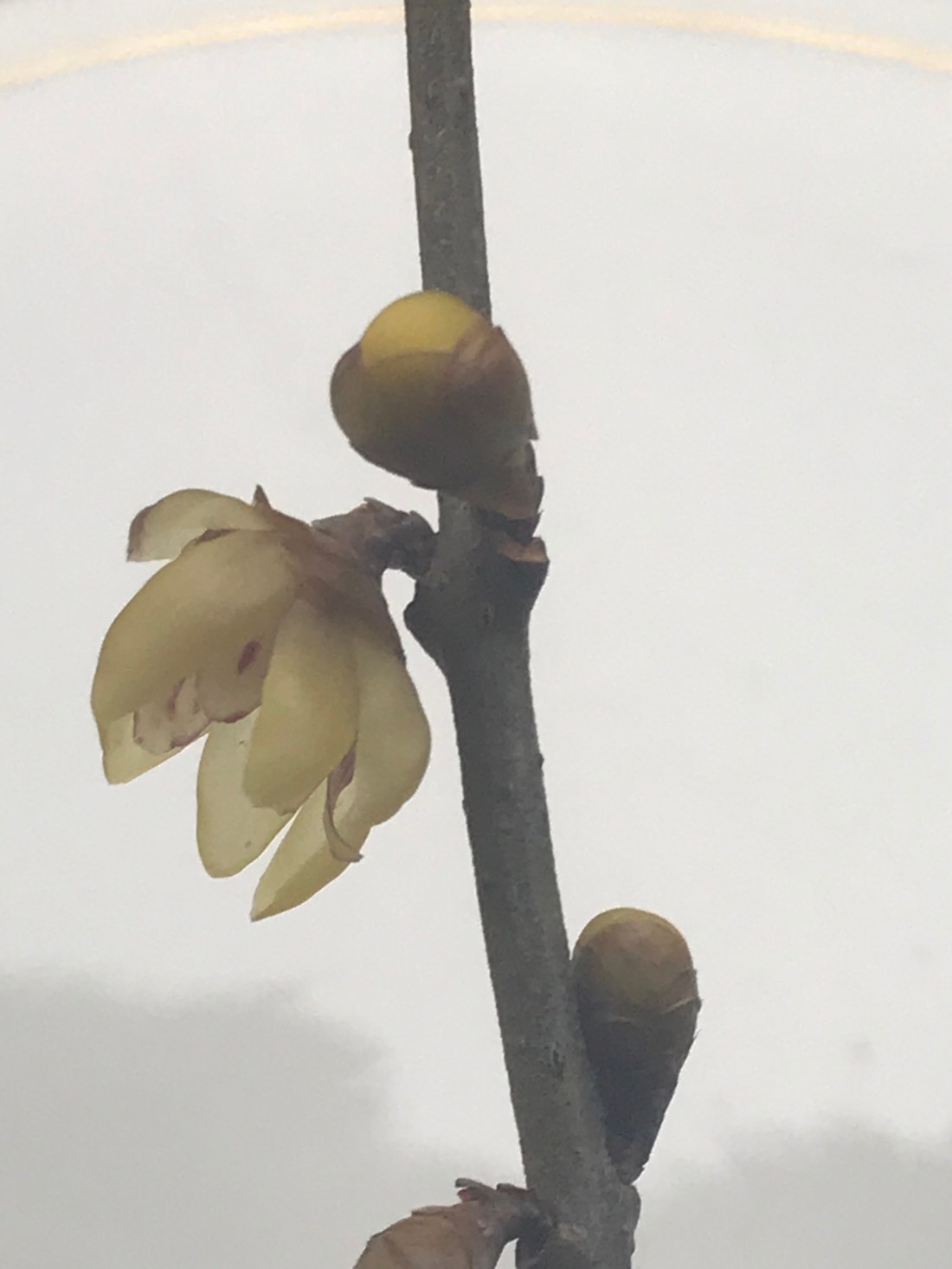
Wintersweet is praecox and the flowers are borne on bare twigs, although sometimes the last of the golden autumn leaves are still clinging on when it starts to bloom. The flower has waxy, translucent petals, the outer being pale yellow whilst the inner petals are pale yellow with dark red markings. They are a little more than a centimetre across and hang their heads like a shy child. Only the scent catches the attention. The scent is sweet enough to warrant the name, certainly, and slightly fizzy, like sherbet.

In Oxford it was growing in a shady spot against an east-facing stone wall and it was rather untidy. In our garden here there is a mature shrub, growing freely. It has reached 4m/14′ in all directions and has a round, fairly open-branched habit. In leaf it is not that decorative, and it is better suited to a larger garden than ours where the burden of putting on a show can be shared by many plants. Or perhaps the edge of a woodland garden where I would plant it with other winter-flowering shrubs such as Oemleria and Hamamelis. Hamamelis, witch hazel, has spidery flowers which likewise are borne on bare twigs, whilst Oemleria tends to flower just as the bright green leaves are breaking bud. All three share scent characteristics, being light, diffuse, and clean-smelling. The scents harmonise, creating a pleasingly intriguing cocktail. Visually, all three are modest, which makes their companionship easy. In the garden here our wintersweet is planted next to an equally mature Viburnum bodnantense ‘Dawn’. It too flowers in winter, but the marriage is not a happy one. The Viburnum’s scent is heavier and sweeter, almost cloying, and it overwhelms the delicate wintersweet.

IMG_4421

Buxus sempervirens

In winter, a garden is stripped back to its bones. Its structure is laid bare with all its strengths and weaknesses revealed. Much of the form of the garden which is visible in winter comes from the hard elements – the walls and the paths. But, the evergreens are an essential part of the composition. This may be the one appropriate use of the term ‘architectural plant’: hedges are green walls; topiary can be columns and sculptures. I like the idea that the columns of temples were inspired by tree trunks and trees can be used to mimic columns.

Buxus sempervirens, Box ever-living, is a winter star. Box hedges define parterres and their lines are clearer in winter. I love them even more when they are frosted, or better still, frosted having first been draped in silk by industrious spiders. The hoar frost clings to the strands in jagged crystals and melts to nothing with the first sun. The hedges provide shelter which can leave the ground at their bases free from frost. They cast shadows which prolong the frost within them, creating clear lines of bare dark soil and white crystals. The pattern plays out during the day, a visible testimony to the passage of time.

In summer, Box has that smell. It is the smell of itself, certainly, but a self which belongs to a family of scents which includes Ruta graveolens, Rue, and Ficus carica, Fig. They are at once green, woody, and dry-spicy. They are complex, enticing, intriguing, and possibly toxic. The danger is part of the experience. It is this depth of character which keeps me returning to it, nosing it in and trying to understand it fully. I love it on a hot day; the scent seems to intensify the heat. I run my fingers over it, enjoying the sensory dissonance. The leaves are oval and look soft, but the dryness of the foliage and its stiffness mean that my hand conflicts my eye. Even the sound of it under my fingers is a dry, stiff rustling. It is the sound and scent of a summer holiday in Italy, with golden gravel crunching underfoot. And light everywhere.

Pliny the Elder considered topiary to be akin to abortion. He was a great man, but mistaken in many things. My reading is that he considered it a frustration of the true course of nature, and that that was an expression of the vice hubris. Although the Romans brought their world, animal and human, to die for their entertainment in arenas across the empire, their most reflective thinkers considered that there were appropriate limits to this exploitation and manipulation of nature.

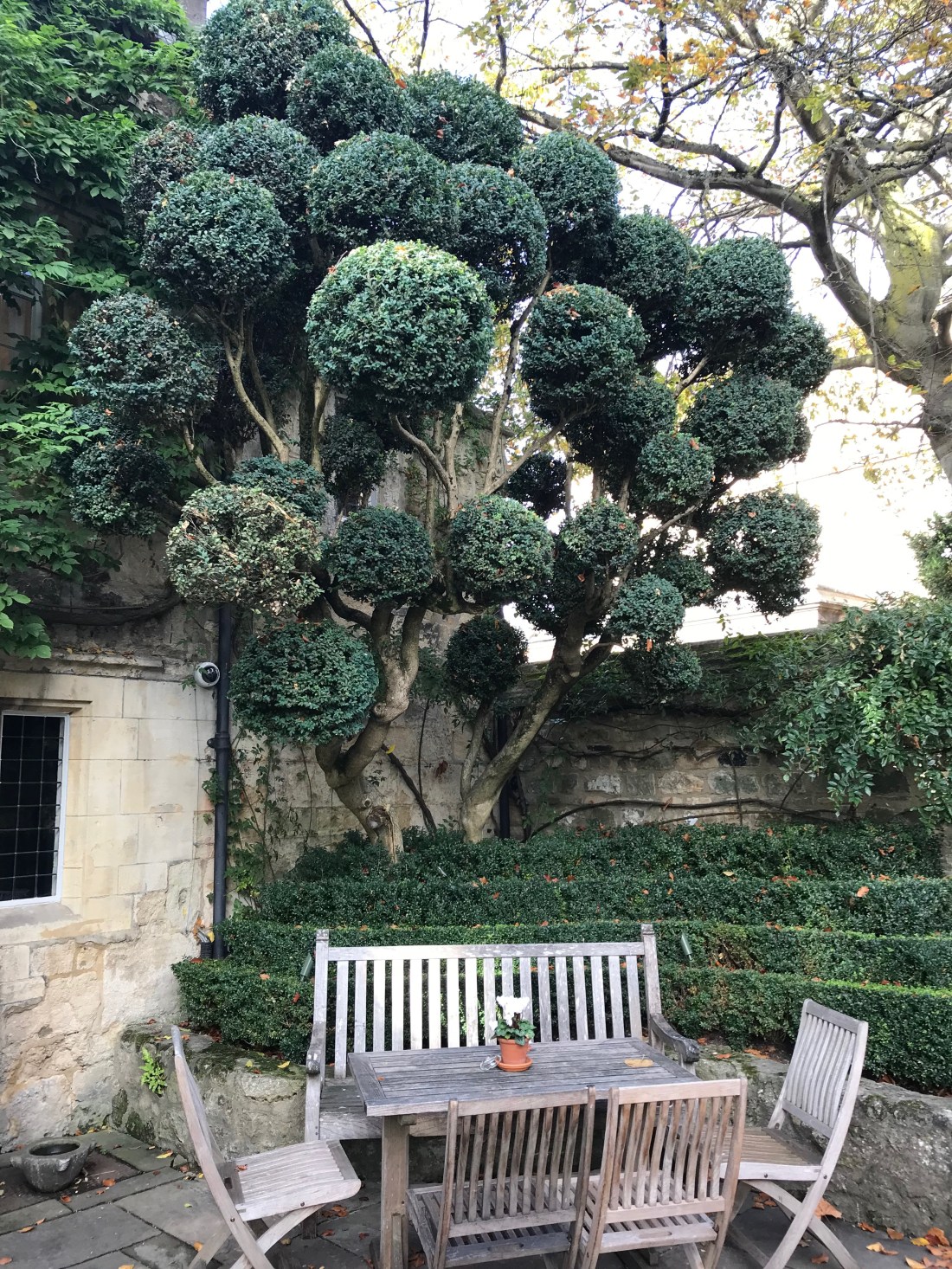
My favourite Buxus sempervirens grows in the garden of The Old Parsonage Hotel in Oxford (www.oldparsonage-hotel.co.uk). It is pictured below. I expect one ‘got away’ by accident, and grew to its natural height of 5m/15′ or so. It has been pruned back to a cloud structure of exposed trunks and balls of foliage. It is context-perfect. The garden is relatively small and rectilinear; it is enclosed by a wall on three sides and the house on the fourth. It is not a space for meandering paths and water in the middle distance. It is a place for order and precision.

Version 2