Cucurbita pepo

I have picked the last of this summer’s courgettes and pulled up the plants. Although the plants are still flowering gamely, the shortening days and dropping temperatures ensure that little will come of them. Besides, as the growing season wears on, courgettes always seem to suffer from mildew and the once handsome palmate leaves are now mottled, grey, and tattered.

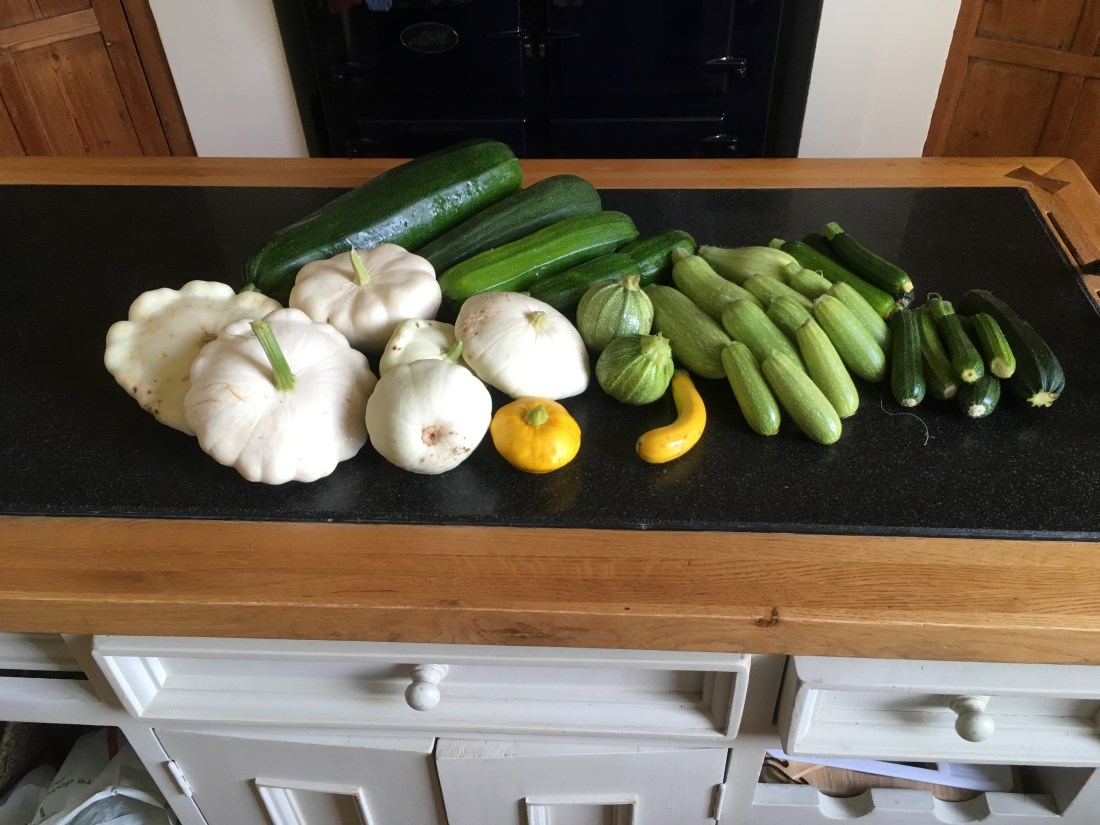
I bought a packet of seed which contained six different varieties – three were the ‘traditional’ baton type, one was round, and two were patty pans. As courgettes are very reliable germinators, I soon had more plants than ground in which to grow them, and as each plant can reach over 1m/3′ across, it is very easy to run out of space. I gave away as many plants as I could, then resorted to planting the spares in the flowerbeds. If life is willing, it seems wrong not to help it thrive. I chose my packet of seed for the varieties of colour and form, but my understanding was slight. Each type matured at a different rate and fruited with variable generosity. ‘Ronde de Nice’ fruited quickly and abundantly, but ended before the others. ‘Yellow Scallop’ was slow and shy and clearly needed an earlier start, more heat, or a balmier autumn. In another season with different conditions, the varieties might perform differently, but that is the virtue of diversity – there will be a harvest.

The abundance of plants quickly turned into a glut of berries, which is what courgettes are, botanically speaking. The ‘pepo’ in the name refers to a berry formed from the swollen ovary of the flower. In the kitchen, I settle all fruit-vegetable distinctions by the Yorkshire method: fruit can be eaten with custard. Courgettes became a twice-daily feature of my diet and I scoured my recipe books for new ways of preparing them. A favourite has been from the Moro cookbook and involves sautéing them with onion, pine nuts, and raisins – simple yet delicious. Still, the supply outstripped demand and I have adapted chutney recipes to include more courgettes. The freezer is filled with variations on ratatouille which will bring memories of summer sun through the dark, cold days of winter. I even became a courgette pest, badgering friends, neighbours, tradesmen who came to work at the house to take courgettes away with them, and still there have been too many.

And yet, this week or next week, when I have eaten or processed this final picking of courgettes, I will miss them. Cucurbita pepo, courgettes, zucchini, originate in the Americas, as do tomatoes, potatoes and chillies, and although exotic, they have become such an essential part of my diet and of my English vegetable garden, that summer would not be the same without them.
IMG_0463

Cydonia oblonga

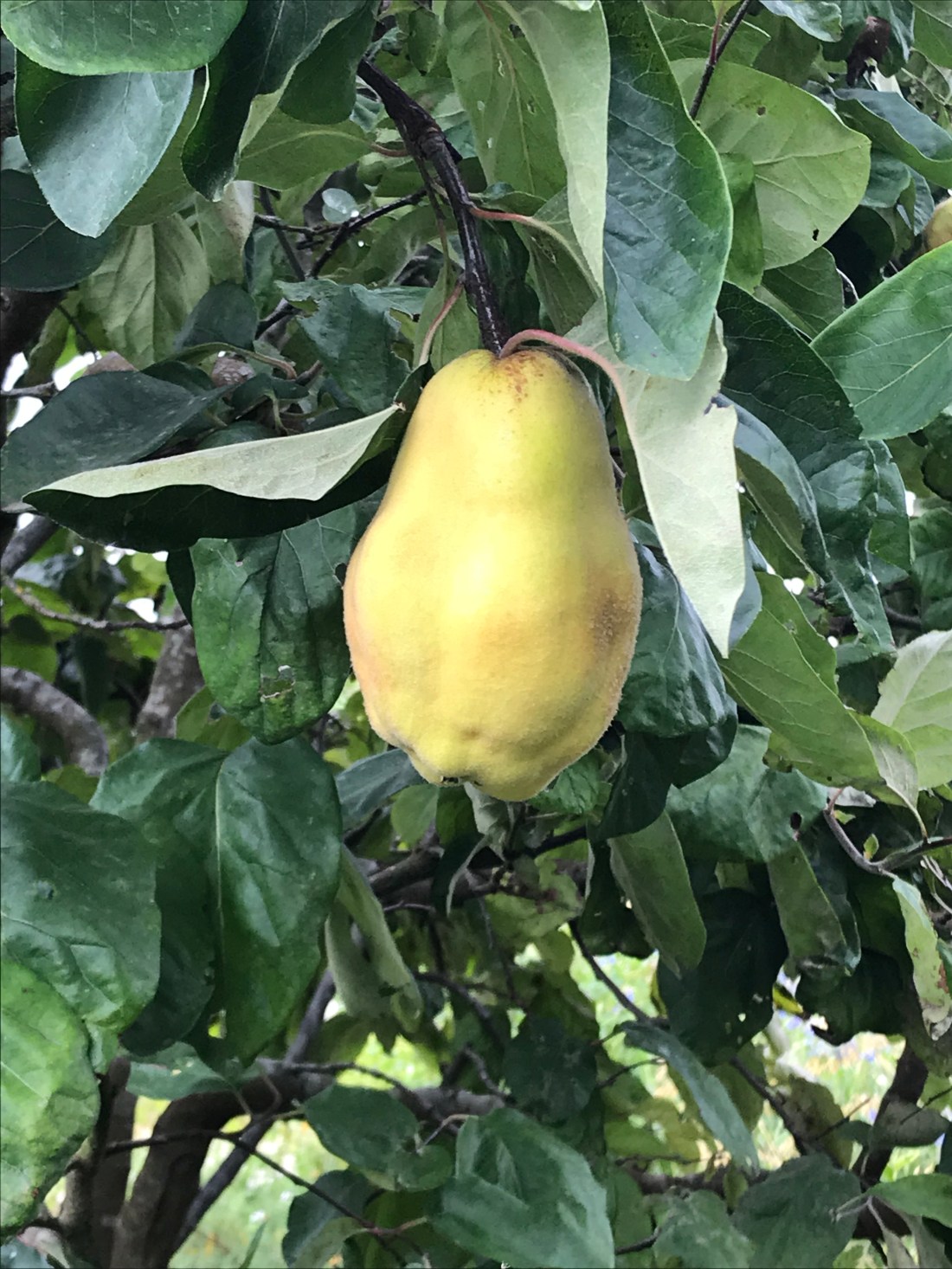
Quince is an unruly, untidy tree. It spreads outwards almost as much as it grows upwards and easily reaches 4m/14′ in both directions. Its branches crisscross and weave through each other in a most undisciplined manner. This time last year I was in the Potager du Roi at Versailles where I happened upon two quince trees which had been ‘trained’. The main trunk had been stopped at around 1m/3′ and four main branches had been directed outwards and upwards like a goblet, these in turn being stopped at 3m/10′ long. The bones of the structure were still visible, but tangled around them in a cloud of fury, the trees were growing as they pleased. Several golden pear-like fruit were hidden among the leaves. I leaned in close to smell them.

What is the smell of quince? It is green, fresh, cool, and constant at its base, then there is an elusive sweet intrigue which grows stronger as they ripen. Place some in a bowl and they scent a room pleasantly, whilst looking magnificent. It is this aromatic quality which makes quince so valuable for cooking. Constance Spry has an excellent recipe for ‘Partridges with Quince’ in her eponymous 1956 tome. Quinces are hard and bitter when raw, but transform into a soft, silky, delicately fragrant and delicately pink elixir when cooked. It is alleged that they can be bletted like medlars, but, as with medlars, I remain unconvinced.

The immature fruit are covered in a grey-ish fur which brushes off to reveal the golden skin beneath. Ancient texts are gloriously vague and at times contradictory, which leaves me free to claim that the fabled golden apples of the Hesperides were quinces. This was the prize which Aphrodite received in the divine beauty contest which sparked the Trojan War. The ancient Greeks thought the trees sprang up from her footsteps, and this association with love and fertility endures in the Balkan tradition of planting Cydonia to mark the birth of a baby.

Quince has previously enjoyed a higher cultural and culinary status in the UK than it does currently. It was an early introduction, recorded first in 1275AD when Edward I planted four at the Tower of London. It was a traditional planting in apple and pear orchards, a practice which was exported to the colonies of New England, but which fell from favour in old England. Its time may be returning given the fashion for Middle Eastern cookery and a broadening taste for exotic aromatics.

It is not a difficult tree to grow and tolerates a wide range of soils so long as they are not prone to water-logging. The simple white five-petalled flower (this is a member of the rose family), is borne early so can be prone to frost damage, and the fruit need a good summer to ripen fully, so a sheltered west or southwest aspect is probably best. The spreading habit of the quince makes it difficult to accommodate in small gardens, although there are more quinces growing in gardens than first meets the eye. Quince A and Quince B are the most common rootstocks for cultivated pears.

IMG_0635

Oenothera lindheimeri

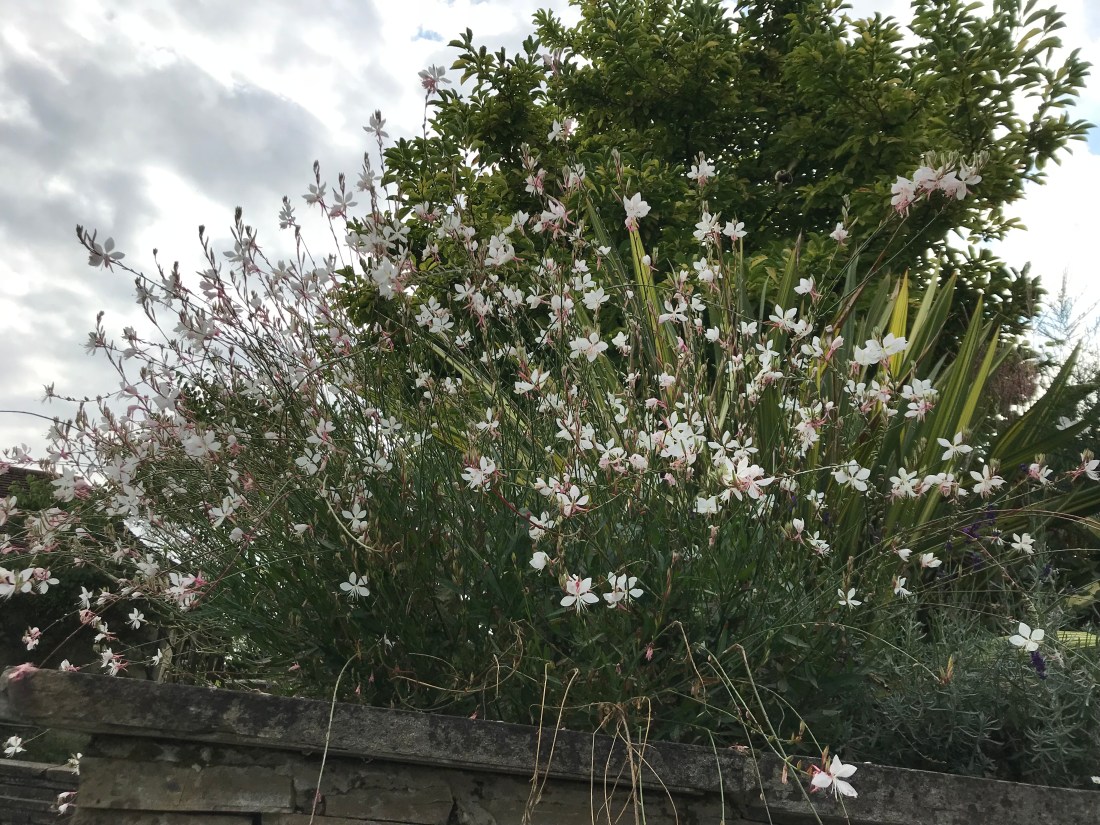
Beans may run or climb, Thymus serpyllum creeps, but Oenothera lindheimeri dances. She has been waving her long slender arms for months now and will continue to do so into October. There has been a significant drought this year, yet our heroine has flourished. In fact, I think she has excelled. She drifts through the borders, carrying her white butterfly flowers along her stems. The cultivar here is ‘Whirling Butterflies’ and the name fits. She stands at 1.2m/4′ tall, but all that growing has been since April. There was snow in April and frost throughout May and I had little hope that she would endure it: I checked her crown every few days, looking for life and not finding it. Yet here she is, beautiful and defiant. I expect, like so many other arid natives, it is not the cold which kills, but the damp island maritime winters of the British Isles.

In the English garden, this native of southern Louisiana and Texas is a natural friend with Verbena bonariensis which is common throughout South America. Their flowering period coincides and they have a similar lightness to their touch. The Verbena’s stems are also slender, but, unlike the Oenothera’s, quite rigid, so it is a useful plant which can provide support by stealth to its airier companions in the border. Aster x frikartii ‘Monch’ is another companion. Again, the fairly stiff stems help to provide support, whilst the lesser height and greater size of the flower introduces contrast. Its colouring is harmonious. ‘Monch’ will flower from mid-August until the end of the season.

When I was training, Oenothera lindheimeri was called Gaura lindheimeri. I have a strong affection for her old name, Gaura, from the Greek, meaning ‘superb’. I find Oenothera difficult to say, but it is more than that (the ‘O’ is silent and the ‘e’ is short and hard). I realise that I remember her name, in part at least, because of the rhythm of the syllables. The old rhythm has stuck, the pattern is formed, and it is difficult to break. I have the same problem with Datura which is now Brugmansia, and Crataegus pedicellata which is now C. coccinea. When I meet these old friends whilst out walking, I greet them with the name by which I first knew them and then correct myself. It is as if the world is shaped differently to how I remember it and I wonder if this is how dementia feels. Or parenthood, perhaps, as the child matures. I guess time may tell, but I expect I will have forgotten by then. And, finally, when I was training, Oenothera was, and still is, Evening Primrose, a course-foliaged plant with a hard and harsh yellow flower. Or, in other words, the antithesis of my delicate dancer.

IMG_0625

Jasminum officinale

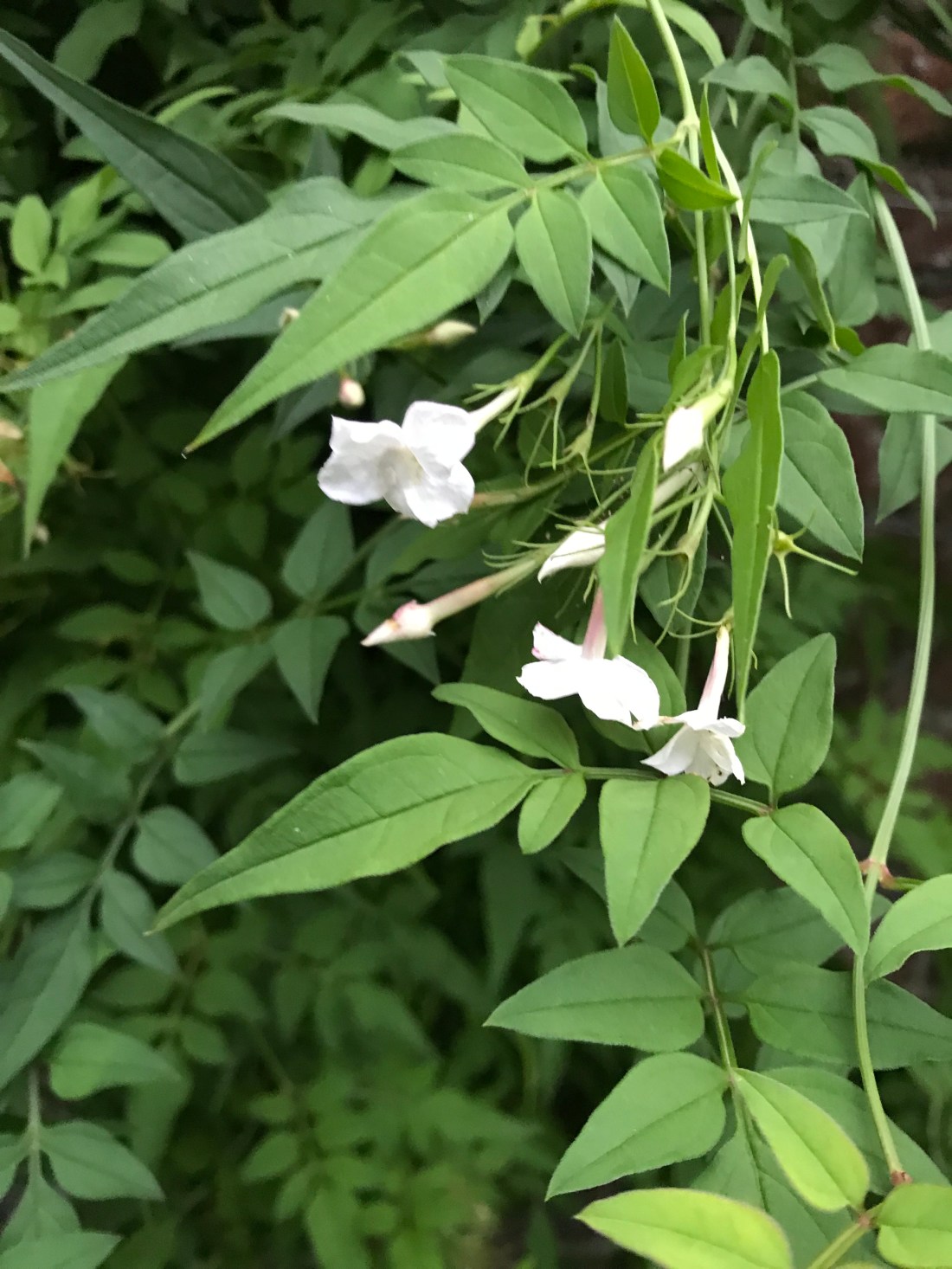
The sun was setting as I strolled around the garden one final time this evening. Beneath a west-facing wall, the Nicotiana alata ‘Grandiflora’ which I grew from seed at the start of the year and planted out in a swathe in May, was releasing its scent in waves on the cooling air. I smiled to myself – it is satisfying when a planting succeeds. The wall is covered in jasmine and the dark green foliage is the perfect foil for the large white stars of the tobacco. It is the perfect foil too for the jasmine’s smaller, more delicate white stars and my smile was in recognition that yet again, a jasmine has out-foxed me. This one has grown to the height of the wall and beyond, and it bears its flowers amidst the twining mass of stems which tumble over onto the eastern face; an aspect jasmines allegedly do not favour. Its full beauty is enjoyed outside the garden. I wandered out through the gate and found a flowering tendril within reach. I drew it down to my nose and breathed it in. Jasmine, like the tobacco, like many other white-flowered plants, releases its scent in the evening and through the night. White gardens should be planted by people who sit out late on summer’s evenings, talking into the darkness. At dusk and afterwards, the white blossoms shine, and fill the air with their musky fragrance.

Jasmine officinale has been in cultivation for so long and has become so widely naturalised that its place of origin is lost. Its name derives from Farsi though, and the old territories of Persia are a fitting place for it. It might also help to explain its early presence both in China and Byzantium. Today it can be found growing wild in the Iberian peninsula whilst also being the national flower of Pakistan. Jasmine, true jasmine, the poet’s jasmine, has a long association with love and is a reputed aphrodisiac. With no sense of contradiction, it is also recommended as a calmative remedy which quietens and soothes. As I write tonight, I am sipping from a glass of green jasmine tea and dreaming of a good night’s sleep.

Although it has found medical uses, notably as a liver tonic, its primary use beyond the garden wall has been in perfumery. Its oil, known as Jasmine Absolute, cannot be produced by steam distillation, so must instead be captured by a solvent from which it is then extracted. In the dark recesses of my memory, I have images of flowers pressed into grease between panes of glass. The volatile oils were transferred to the grease and then the grease was processed to liberate the oils. But that was a long time ago. Jasmine Absolute currently retails for around £10/ml which is expensive, but it is not the most expensive botanical. That crown is still held by saffron, a crocus with a remarkably similar geographical distribution to jasmine and with an even older recorded history of cultivation. The best saffron can cost £70/g, which is roughly three times the current price of gold.

IMG_0608

Putto with Perovskia atriplicifolia ‘Blue Spire’

Statues are such a familiar feature in a garden, that it is easy to stop asking why they are there or how they are effective. It is not simply that they are beautiful – some are brutal or Brutalist; they may have a spatial harmony, but they are disruptive and uneasy to the eye. Others, like Bernini’s Apollo and Daphne are exquisite in composition and execution, but the myth represented is one of violence and violation. The subject is as ugly as the object is beautiful. A good friend used to say, “Don’t look for hidden depths, I have only hidden shallows.” We studied philosophy together many years ago, (If presented with a choice of being a gruntled pig or a disgruntled philosopher, she always chose to be the hog). I suppose I am grasping towards the difference between figurative and abstract sculptures. Take our chubby, winged friend pictured below. Putti are highly ambiguous, at once attendees of Bacchic rites and representations of the omniscient creator; a companion of Venus-Aprodite and a messenger of divine wisdom. But, figurative sculptures do have meanings, albeit tricksy, plural, at times contradictory meanings. Their meanings have a history too, an etymology, a traceable lineage and an identity in the present. The danger with abstract sculptures is that they are only form – profound shallows signifying nothing. The British sculptor Henry Moore’s work is the most numerous in public spaces across the globe, I believe.  All statues though, even the abstract, are an external and objective condensation of energies; intellectual, cultural, physical, and chemical, perhaps even tectonic. Their presence in a garden is often ‘tonal’ – it sets a mood. The putto pictured on his ball, squeezing grapes into a goblet, is next to a swimming pool. It is a place of leisure, and licence, perhaps.

Whilst pale stone statues work well against a contrasting, darker background such as yew or bay, they can disappear in open space. Lead pieces, on the other hand, are at their best against a clear sky, or the plant substitute for such, an open-structured, blue-flowered plant such as the Russian sage. As Mary Keen observed, ‘blue is the colour of distance’. A blue-toned planting scheme is always restful and airy, whilst the hot yellows and reds are intense and enclosing. Perovskia’s common name is a good indicator of its hardiness and it is fine down to -15Celsius. It will take as much heat as the British summer can muster too, as befits its native habitat of the Steppes. In general though, silver-foliaged plants do not like too much water at any time of year, and it is often not the cold of the British winter which kills these hardy plants, just the incessant wet: their roots rot in the ground. I enjoy Perovskia for itself – like English lavender or Gaura, it moves, giving the breeze substance, making it visible. Perovskia, Lavandula, Gaura, all three would serve as backdrop to the putto – the movement and airiness is the perfect foil to its leaden density.

IMG_0576

Laurus nobilis

I have been planting a bay hedge for a client. It has three immediate purposes. Firstly, it forms one boundary of a formal garden, the rest of which is in place. The straight run of dense, dark foliage is like a word at the end of a sentence, underscored for emphasis: the garden stops here. Secondly, it hides a large plastic tank which holds domestic heating oil. It excludes it from the formal garden whilst simultaneously carving off a useful area for rubbish bins, wheelbarrows, empty flowerpots, and all the other detritus with which we clutter our lives. Thirdly, a road lies beyond it. Large thick leaves such as bay’s have better sound-dampening properties than, for example, the needles of yew. Being evergreen, it will dampen sound the year round.

Next year, it will serve other purposes. In April, bay bears small, insignificant yellow flowers which are a valuable early pollen source for bees and other insects. Birds will nest in it, enjoying the protection and privacy of the dense foliage. My clients may pick leaves for use in the kitchen. I hope that on hot sunny days the dry, spicy fragrance of the foliage will mix with the sweeter scents of the flowers in the garden, enriching the olfactory experience.

The sun was shining when I delivered the bushes, and my client came out to see them. He broke into a smile – the smell of bay had conjured memories of his childhood in the Lebanon, ‘where bay is everywhere’, and of his grandmother adding stems of it to the laundry to scent it. Clever grandmother – the essential oils in the leaves can act as an insect repellent too.

Forests of Laurus nobilis once spread across the Mediterranean basin, only retreating when the climate became hotter and drier around ten thousand years ago. Pockets linger on in Portugal and Turkey, but I have never been fortunate enough to visit one. I am pleased to bring something from my client’s homeland to his home in this corner of England. I am sure it will thrive as he has done. Bay has a reputation for being unreliable in its hardiness, but I have known bushes survive successive nights of -10 Celsius without harm and I have no fear for this planting. It is remarkably tolerant of different soils too and can be grown in Herefordshire clay or the sandy loam of Norfolk. It dislikes cold, drying winds, but it is hardly alone in that.

Like yew, the dark evergreen foliage is the perfect backdrop for a statue. Unfortunately, my perfect statue is in the Galleria Borghese in Rome. How much better it would be if it were in a garden! It is an extraordinary marble by the extravagantly talented Bernini. It captures the metamorphoses of the nymph Daphne, her raised hands already changed into laurel leaves as the rapacious Apollo reaches to grasp her. Her leaves became his victor’s wreath, and the rest, as they say, is history.

IMG_0574

Ficus carica

In a house where I lived for too long – it was never my home – there is a fig growing in front of a south-facing wall. It is planted in a rough stone bank which holds the soil away from what becomes the cellar wall as the ground falls away. We used to find its fine fibrous roots growing across the brick of the cellar floor, having somehow found their way across the trench and through the outer wall. Each year we would talk about cutting it down and removing it completely, for the sake of the house, but each year it would carry such abundant fruit that we would say, Not yet. Let’s just wait until we have enjoyed the figs. So, each year, it was reprieved. We enjoyed them from mid-July onwards, blackbirds permitting. They are wonderful with a salty cheese like Pecorino or Roquefort, and a drizzle of chestnut honey. One year, the harvest was so abundant that we made chutney and so enjoyed figs with cheese in a very different way throughout the winter.

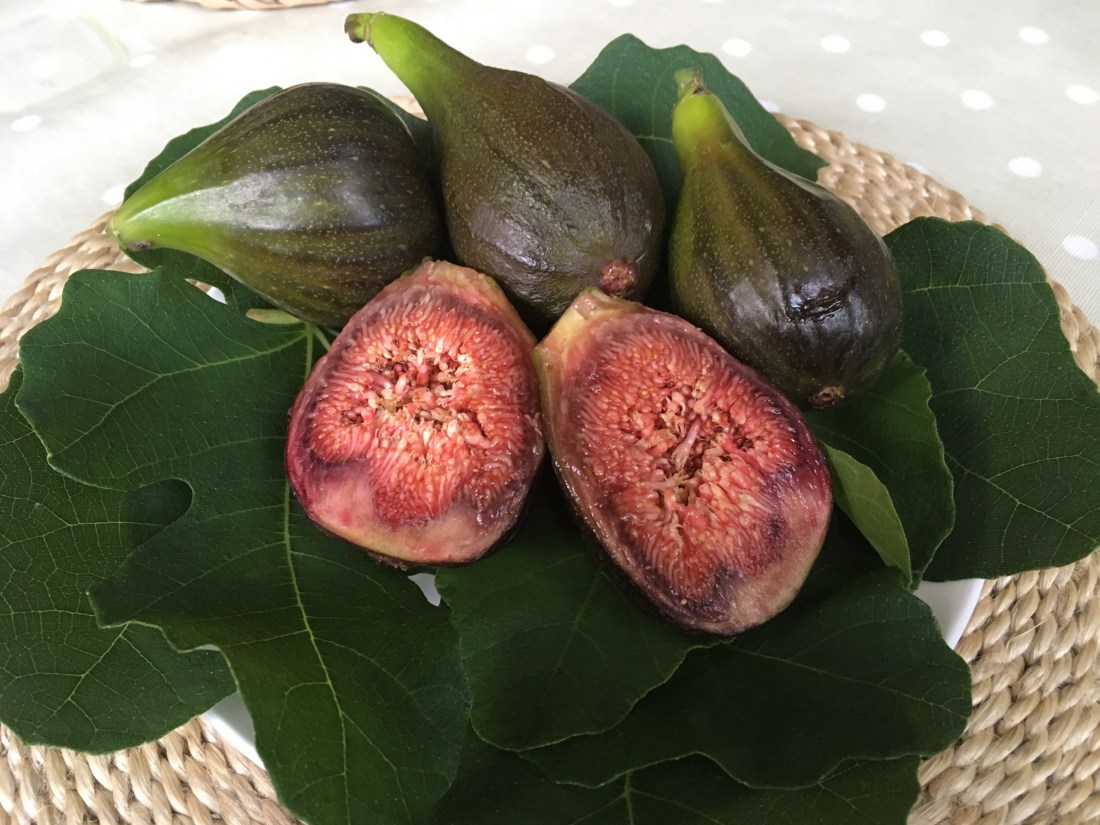
The fig I refer to is a reliable ‘Brown Turkey’ and produces large, dark figs with red, somewhat mammalian, interiors. I prefer the flavour of them to the gourmand’s ‘White Ischia’, which seems subtle to the point of blandness when compared to the meatiness of a ‘Brown Turkey’. Sometimes, I think certain plants become prized simply for their rarity or difficulty, rather than for any innate virtue. There is nothing rare or difficult about a ‘Brown Turkey’ – its vigour is almost indecent. Last September, I was at Versailles for research. I visited the Le Potager du Roi for personal interest and was deeply disappointed by its dilapidation. I wandered at leisure, being the only visitor, and nobody appeared to be working. I found a large fig tree in a southwest corner of the high walls. It had no label; it had had no care for decades. I picked a pale-skinned fig, broke it, and ate half. It tasted of honey. Perhaps it was sweeter for being stolen. Sadly, it was the only fruit within reach. I believe de La Quintinie, the garden’s first superintendent, would send 2000 figs a day to the kitchens at the palace. It was certainly one way to keep the wheels of state moving. I fantasised for an hour or perhaps a week, about having five good men, and five years, and possibly five Percheron, because the soil is terrible. What I could achieve there! Some dreams cost nothing, and can be a good way of exploring what is held and what can be let go.

Figs grow best when their roots are restricted and, in the UK, thrive when fan-trained against a wall, where they can be a handsome specimen, largely free of pests and diseases. Under glass, red spider mite can be a problem. Plant them in a box formed of paving slabs with rubble in the bottom of the hole. In Greece, on Aegina, twenty years ago, I met a fig tree growing on a south-facing slope of boulders, in conditions so arid, it must have been a desert. The tree was 10m/33′ across and abundantly figged. I picked one and broke it open. It was filled with the tiny black fig wasps which serve the fig as pollinators. The fig is a strange fruit. The skin is really an extension of the stem and the fingers within are individual flowers, each of which sets a seed. The wasps enter through the ostiole, the small orifice on the fig’s bottom. The figs and wasps have depended on each other for so long that there are almost as many thousands of species of one as of the other. I expect I may have unwittingly eaten as many wasps as I have figs, but neither I nor the fig are vegetarian. The fig excretes an enzyme, ficin, which dissolves any wasps which die inside it. The tree eats the wasps which serve its needs.

IMG_0268

Helianthus annuus

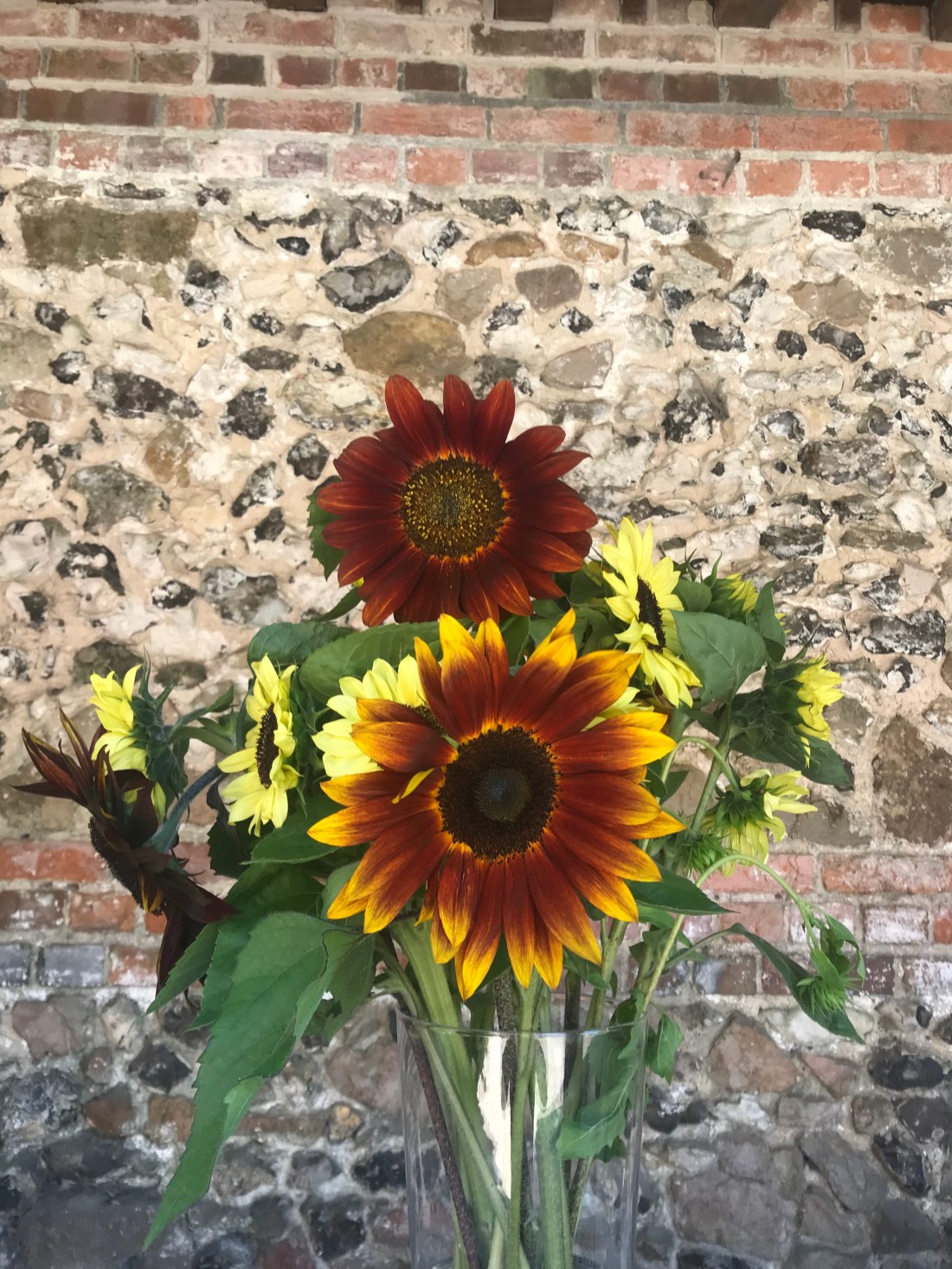
The power of plants never ceases to amaze me. I have sunflowers growing in the cutting beds which are already over 2m/6′ tall, and the solstice is barely behind us. As the annuus indicates, sunflowers are an annual, and each one has grown from the familiar seed, encased in its smart black or black and white jacket. Mine are, as yet, just infants, although they are flowering well. Sunflowers will more typically reach 3m/10′ and Guinness World Record is held by a specimen which reached an improbable 9.17m/31.1′ tall. I have cut a selection as pictured below. It is not my first attempt to recreate a famous series of pictures, but I find the flowers difficult to position in the vase to create the right effect. Perhaps this is the advantage of painting, that real-world flowers can be positioned on canvas in an ideal distribution. Van Gogh considered yellow to be the colour of happiness, allegedly. I enjoy the classic yellow sunflowers – they are joyful indeed, but I find the fiery oranges and reds thrilling, especially so early in the year. They are proving useful as a cut flower too as once the flower at the apex is removed as many as six secondary flowers are developing lower down. These are smaller and less dramatic than the primary flower, but more amenable to being placed in a vase.

Sunflowers were an early domestication around 5000 years ago in what we now call the southern United States or Mexico, where all but three of the species are native. The early European settlers recognised its value immediately and seed was in Europe by the sixteenth century. Its value was always aesthetic as well as comestible. Although Van Gogh is most famously associated with the sunflower, Van Dyck painted a self-portrait with sunflowers larger than his own head in 1633AD. Louis XIV pressed it into service, somewhat inevitably. At Versailles, down each side of the Tapis Vert, there are urns of extraordinary size set on pedestals. Some are carved with tournesols. The work is exquisite. The cut of the line is so clean that they could be fresh from the stonemason’s yard. They are one of the highlights of a walk around the garden there. Was Louis happy with the superficial association of the flower and the sun, or was he trading on the reputed heliotropism, that the flower follows the sun during the course of the day? I suspect both.

In truth, only the immature flower bud tracks the sun, something it does even on a cloudy day. The mature inflorescence is almost always fixed facing east. This means that the flower head warms quickly and early in the day, when pollinating insects are still active in hot climates. It also ensures the best ripening conditions for the tightly packed, indeed, perfectly packed, seeds which follow pollination. The flowers of the central disc are arranged in interpenetrating left and right spirals which conform to the Fibonacci series of numbers. It is the most efficient arrangement in space possible.

IMG_0543

Cynara scolymus ‘Violetta Precoce’

Few plants sound so much like an incantation as Cynara scolymus ‘Violetta Precoce’. Portals to other worlds should open at the sound; portals to past worlds, possibly. Few garden plants have the long heritage of the globe artichoke. Pliny the Elder wrote about it in his Natural History (Book XIX), observing that, ‘it was in the highest state of cultivation, and Ravenna produces heads that weigh as much as three pounds even’. Carciofi alla Romana remains a typical dish of Roman springtime cuisine. Smaller heads than Pliny’s monsters are used, braised whole bar the choke, with a section of tasty stem still attached. Other cities have their own variants. In Venice, in March, a course of whole violet artichokes arrived at our table. The heads were somewhere between a hen’s and a duck’s egg in size, and they had been braised very simply in white wine, parsley and lemon juice. Our host described them as ‘the first cutting’ and the best of the year. He lamented the artichokes found in England, artichokes ‘the size of trees’. As we had walked through the restaurant to our table, however, I had spied a different dish of artichokes which I was keen to taste. It was made from the basal plates of large ‘tree-like’ artichokes, the basal plate from which the flower develops. It is firmer, denser, and more intensely artichoke flavoured than the bud-scales. The Italians also use artichokes to make a bitter digestivo Cynar, of which I am fond. It is allegedly good for the liver.

I have planted artichokes in the flower border as often as in the kitchen garden. They, like their close relative Cynara cardunculus, the cardoon, are among those plants which attract the lazy and often spurious epiphet ‘architectural’. They have strong form, certainly. Each leaf is carried on a rigid rib and has a jagged profile. The silver-green foliage pairs well with anything pale and interesting, and contrasts nicely with the softer, blousier textures of Geranium, Knautia, or Origanum. The cultivar ‘Violetta Precoce’ has two additional virtues to the species. Its purple buds are handsome and the ‘Precoce’ indicates that it is an early season maturer, which is useful in our northern isle where summer can arrive late and leave early.

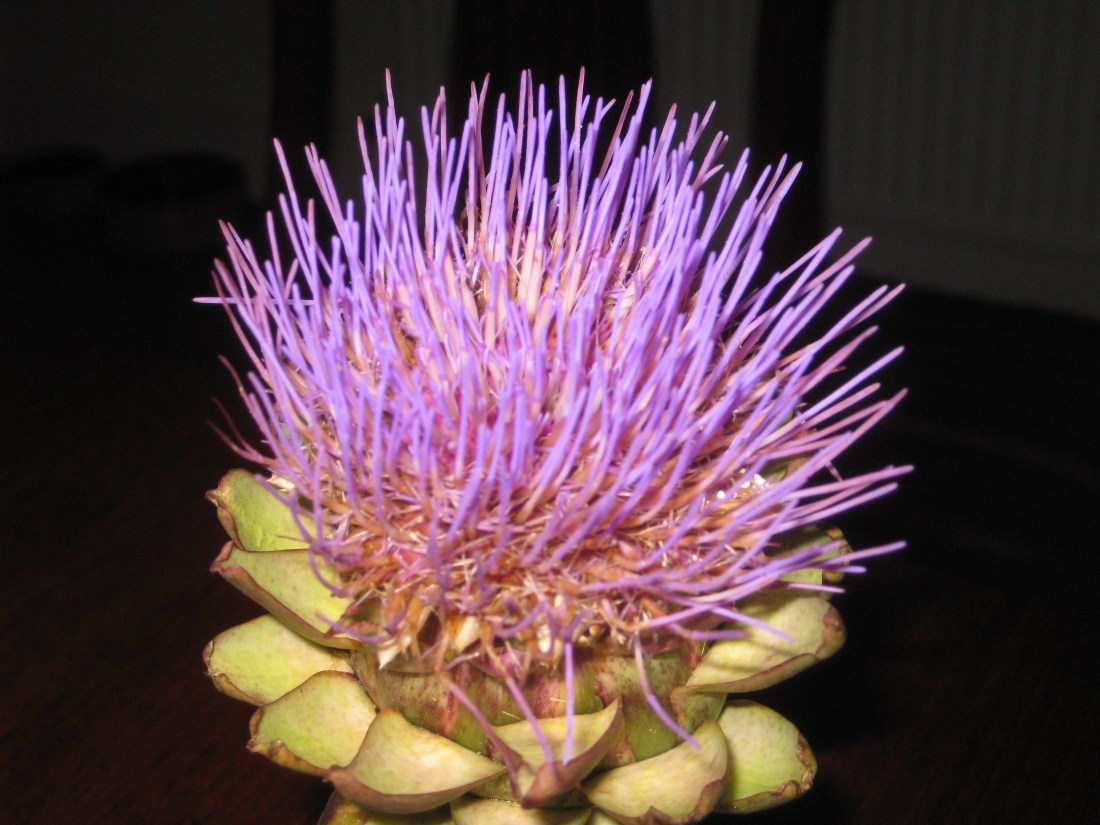
I have never found them the most predictable of plants. Of two close companions, one has died and the other thrived, and yet I can discern no difference in their situation. When they do thrive, they can be large plants, easily 1m/3′ across and 1.5m/5′ tall. I have never had the luxury of sufficient space to grow as many as I desire. I am always compromising therefore – a cardinal virtue in all successful gardening. I want to harvest buds for the table whilst they are still young and tender, and relatively choke-free, but I also want to leave some to develop into flowers. When left, the bud opens to reveal a saucer-sized cap of violet fingers. They seem to glow with their own light, and are mysterious presence in the border, like something from another world.

IMG_0412


Lavandula angustifolia

In a house where I used to live, the lavender spills out of its borders and over the path. My large dog would wait anxiously until I had opened the door, then rush through the corridor of blossom into the safety of the hall. The lavender was always alive with bees. There were honey bees, certainly, and I noted two different types, one darker and smaller than the other. And, many, many bumblebees. I sat down one day and watched them, counting six different species within seconds. There are few plants so generous with nectar, and for so long, as the English lavender.

It is generous in the garden in other ways too, being highly versatile. It works brilliantly planted in an arc, the blue stream drawing the eye along itself. The path I described is short, straight, and unremarkable really. It could be described as formal, but that implies a grandeur which it does not possess. The lavender was planted close enough together to form a low hedge. When it is trimmed, there are mounds of grey foliage which just touch each other. In flower, it is a seamless strip of blue. It suits the straight line, and it transforms it too. The rounded profile of the bushes soften the edge and make it comfortable. The flower spikes move; they stir in the breeze and are disturbed by the constant comings and goings of the insects.

Once upon a time, I cared for a garden which had a rather odd ‘feature’ wall, fully 3m/10′ high, with a planting bed on its top. I filled it with Lavandula angustifolia which I knew could tolerate the hot, dry conditions. I trimmed it less vigorously than is my usual habit, so that in flower the haze was fully 1m/3′ across, possibly even greater. From the house, the view to the garden was through the flowers, and from the garden, the house was a cliff rising from a sea of lavender blue waving in the wind.

Although movement is lovely, too much breeze steals the scent away. Lavender works well in a sunny courtyard or a sheltered sun-trap. Recently, I have been asked to rework a patio for a client. It faces west, so is in full sun from noon until dusk. It is a small area, 5m by 5m/15′ or thereabouts, and is bounded by a low wall. The sides will be planted with espaliered Malus transitoria to provide an open screen and beneath them there will be strips of lavender, cooling and restful to the eye. The wall of the house is swathed in Wisteria sinensis and, with a little luck, it and the lavender may coincide in some years. I am toying with the idea of some white lilies, something highly fragrant like Lilium candidum, which flowers in May and June. It pairs well with the lavender, both visually and fragrantly, but it may be an element too many. I prefer simple schemes in small or formal settings. They express the virtue of restraint and are a recognition of sufficiency.

My dream garden, which shape-shifts and grows in new directions as I age, will always have a space for Lavendula angustifolia. It pleases me almost as much as it pleases the bees.

IMG_0525