Syringa vulgaris

Time may be relative, but in the garden it is relational. In the British Isles it is common to sow runner beans, Phaseolus coccineus when the lilacs are in flower. Runner beans are frost-tender and although lilacs often flower when there are still frosts, by the time the beans have germinated and are poking their heads through the soil, the risk of frost is almost always over. As spring arrives with variation across the country, at different altitudes, at different times of year even, the lilac blossom is a better guide to benign conditions for beans than a fixed date on the calendar. In Oxford, the blossom is starting to brown at the edges of the petals whilst eighty miles further north in Worcestershire, it is at its fullest glory. It is a welcome flower in the garden, arriving before the roses, and occasionally over-lapping with the paeonies.

When T.S. Eliot wrote his poem The Waste Land, it had either been an exceptionally mild year, or he was writing about an experience of lilacs somewhere other than in England, or he was writing from memory and making a mistake – his lilacs flower in April. I do start to look for lilacs in the last week of April, in part prompted by the first line of the poem, but more because they are another signpost of the turning year. Along with runner beans, it signals the right time for other garden tasks and a change in expectation of the crops which can be enjoyed from the vegetable patch. In the garden, time is cyclical too, or rather, helical.

Syringa vulgaris is a member of the olive family OLEACEAE, and native throughout the Balkans. Syringa shares the same derivation as syringe, meaning a small tube, which is a reference to the sweet-smelling flowers which are born in terminal panicles, usually in pairs, but sometimes in threes. The abundant, short funnel flowers are an excellent food source for the short-tongued nectar feeding insects. The colour range of the species is from pale lilac to white, but the great French nurseryman Victor Lemoine had terrific success breeding new cultivars with deeper colours, or double flowers. I planted a pale garden a few years, quartered around a pool and fountain. It was quite small and sheltered, and I filled it with highly fragrant flowers of all types. The centre-piece of each quarter was a multi-stemmed ‘Madame Lemoine’, white-flowered and lovely.

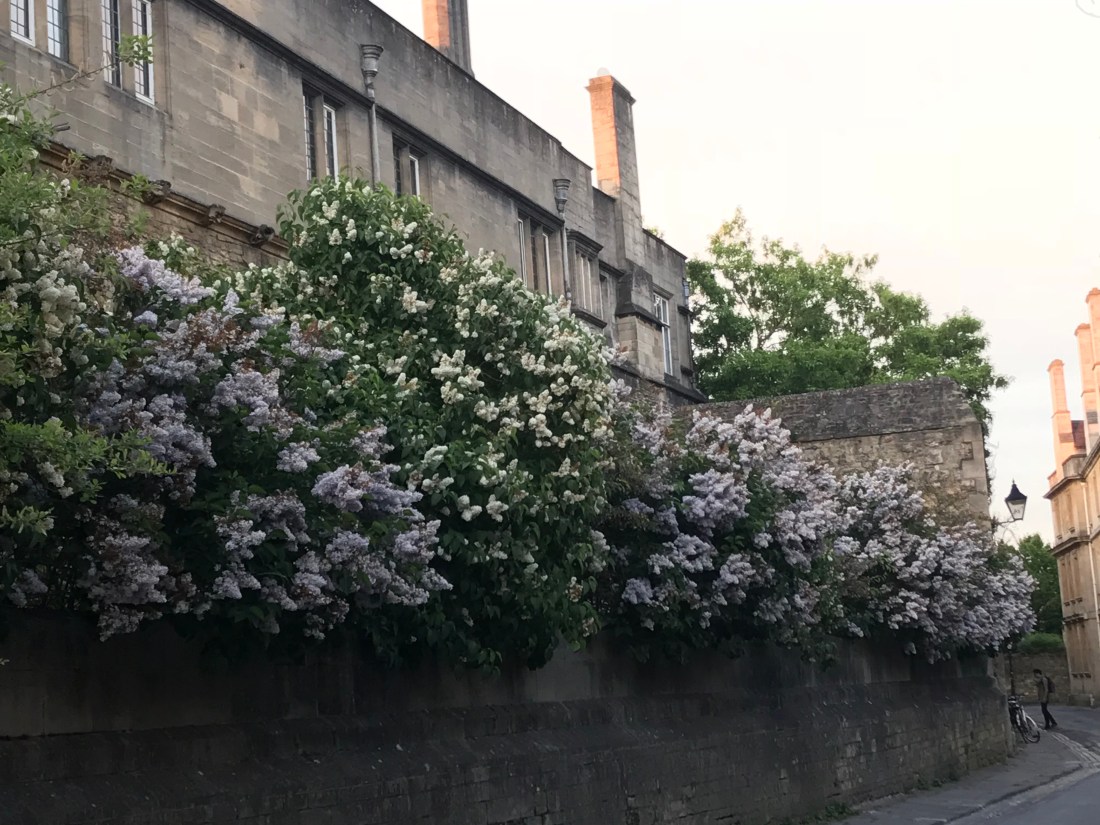
The lilac spread through the gardens of western and northern Europe in the late 16th Century, having been introduced from Ottoman gardens. They had reached North America by the 18th century and it is the state flower of New Hampshire. The tree itself is hardy down to -20 Celsius and the challenge for the North American plant breeders has been to create later-flowering cultivars so that the buds and blossom are not struck by late frosts. As a relatively late introduction to British gardens, there is little folklore or folk uses for lilac. The flowers are edible, but smell better than they taste and I cannot recommend eating them. The picture is of New College Lane, Oxford and pairs with the previous postcard of Wisteria sinensis which grows on the opposite wall.
IMG_1883

Wisteria sinensis

In early summer I try to visit Oxford. In May and June the city of dreaming spires becomes the city of hanging gardens. The walls of the colleges are draped in the lilac and white racemes of Wisteria sinensis and its scent fills the rarefied air. It is a visit which transports me in time as well as space as the memories of being in the early summer of my life, my undergraduate years and a year of graduate study, return with such clarity and presence that I almost feel young again. I spent many happy hours walking through the University Parks, the flood meadows of the Isis and Cherwell, and the college gardens, filling my eyes with beauties both built and grown, smelling the flowers whilst I could.

In Christ Church meadow a corner of the old city wall had been bridged by a wisteria escaping from a garden within. We stood beneath it, looking up at the blossom-sky above us, resting our eyes in its gentle shade and breathing it in. We kissed perhaps, before we walked on – certainly, that is how I remember it. Beyond our bower, the bright sun was glaring from the hot gravel which crunched beneath our feet, a shimmer rose over the long grass of the meadow, and the many clocks chimed again.

Wisteria does well in Oxford. It has the time and space to grow to its full glory, covering three or four storeys of the college buildings. In its native China it can reach 30m/100′, twining around a supportive tree. On walls, two thirds of that is more common. The lilac flowers and the golden cotswold stone of the walls are a serendipitous pairing. Wisteria needs care through time too. It flowers on spurs and needs careful pruning in January or February and again in July or August to help these spurs develop and to keep the vine contained within the space available.

I had two wisteria in my care for many years. Sadly, the designer who had planted them considered my beloved Wisteria sinensis vulgar and had selected a white cultivar which verged on grey and which was less fragrant than the species. They were greatly appreciated by the goldfinches though, and four or five pairs would nest in each one every year. I would leave the summer pruning as late as I dared, hoping that the last chicks would have fledged and only the empty, delicate mossy cups of the nest would be at risk from the head of my ladder.

I have known thirty year-old wisteria die suddenly from graft failure, which is when the rootstock rejects the scion. It is better to grow a new plant from a cutting and be patient. It will flower in four or five years, but what is that in the life of a plant which endures through centuries. The oldest wisteria in England was planted in 1816 at Fuller’s brewery in London and it still looks splendid. It became the mother plant for the specimen grown at Kew as theirs had failed to establish.

My favourite wisteria of all is in Oxford. Walk down New College Lane into the canyon between New and The Queen’s College. There is an old, high stone wall topped with an iron turnpike. Many years ago, the adventurous stems of a wisteria wound around and through the metal, rendering the spikes still. The black iron spikes garlanded by the soft blossom of the wisteria has always affected me deeply.

IMG_0440

Malus transitoria

Malus transitoria, the cut-leaf crabapple, is one of the tricksy members of the extended apple family. Like its sister, Malus triloba, its leaf looks more like a maple. Although the practice seems to be dying out, it used to be common for gardeners in the UK to be given a plant identification test when being interviewed for a job. This pair of crabapples were popular choices to winnow the wheat from the chaff; to test the depth of observation and knowledge. A malicious choice perhaps, designed to expose ignorance as much as strength. In common with maples, it has excellent autumn colour, and the leaves turn a very pleasing golden yellow. The picture below shows the trees in full blossom, blossom so dense that the branches are bars of white and most of the leaves are obscured. If fertilised, these flowers set into small golden fruits less than 10mm or 3/8″ across. Insignificant in size, but profuse and excellent in their abundance.

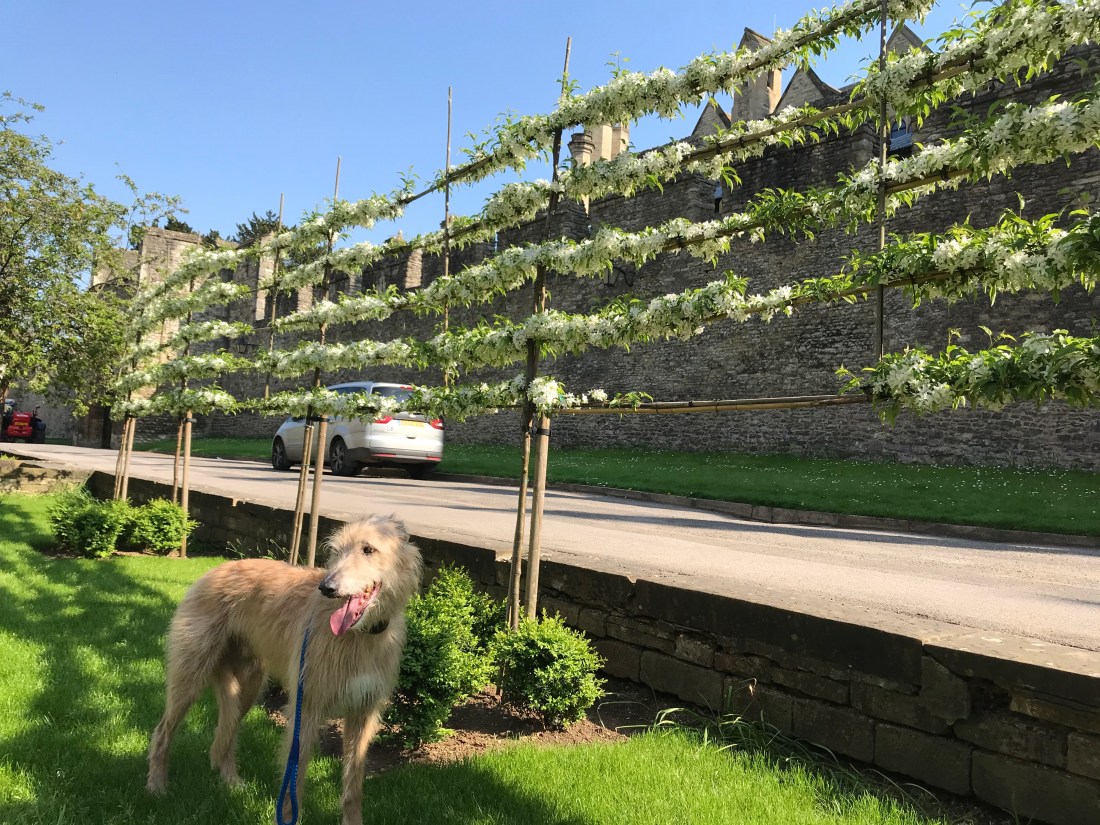
There is no etymological connection between Malus and malleability of which I am aware, but the crabapple, in common with many other members of ROSEACEAE can be formed or deformed with pressures, subtle of not. Although the Potager du Roi at Versailles has a derelict air, it still contains some magnificent examples of just how malleable apples and pears can be, and it is worth visiting  just to see these. Those pictured below in New College, Oxford, have lateral branches which have been trained out perpendicular to the trunk to a length of 2m/6′ each side and pruned so that the tree grows in a flattened plane. It raises an interesting question, I think. The tree, left alone, will find a shape determined by its nature and in response to its environment which, in the case of Malus transitoria is a fairly upright tree which all the same becomes as broad as it is tall with a range of 4-8m/14-26′. But, in the hands of a gardener, it can be shaped, and this adaptability is there in its nature also. Both possibilities are true to the nature of the tree, so long as we are considered part of the environment. The transitoria is a reference to the short-lived nature of the species, but it is a tree, and these things are relative.

The espaliered tree is highly useful when designing gardens. It provides a ‘light’ and visually permeable screen, whilst also providing a sense of enclosure. In some ways it is living equivalent of the tracery in a cloister’s arch (www.philosophergardener.com/snow), but the conceptual antithesis of the bars on a prison cell’s window. As below, it can be used to define an area – in this case a lawn – whilst not excluding a view of something desirable. The medieval city wall of Oxford can be seen through the branches. My hound and gravatar Floyd is indifferent to its virtues, but then, like all dogs, he is a cynic.


IMG_1530

Fagus sylvatica

It is the colour of joy.  The bright fresh green of beech leaves, freshly opened, thrills my heart with happiness.  I do not know at what time of day I appreciate them the most. When I walk out in the morning with my hound before breakfast, and the air is cool and the grass dewy, I fill my lungs with the verdant air and it is intoxicating. I feel chthonic. In the heat of the day, when I am tired and hungry before lunch, I rest my eyes in their gentleness and am soothed. I have walked out with the hound again just now – the sun will be setting shortly – and their quality has transformed once more. I am succoured against the coming night. There is an old church service, Compline – a remnant of the monastic tradition – the final service of day. It contains the words, ‘God grant you a quiet night and a perfect end.’ As I walk in beauty towards the night, I walk with those words within me. Like joy, the pleasure is fleeting; the leaves soon darken and dull. But, like joy, I would not be without them. The beech leaves pictured below are so new that they retain a coppery scale or two from their buds. The rest are shed in profusion, sloughed off like so many skins or carapaces, and silt up the borders and corners of the garden: even they are beautiful, in their own way.

Fagus sylvatica, common beech, ‘Queen of the Wood’ to the Oak King, will grow to 30m/100′, given time and space. It is not just a tree for a large garden though, as, when closely planted, it makes a very fine hedge. A particular virtue of the young beech is that the old leaves are not abcissed in autumn. Cutting a hedge maintains the trees in a juvenile state of marcescence and the coppery foliage is wonderful in the low winter sun. It sounds too, like an Aeolian harp when the wind blows through it, whispering softly.

Beech conceals its strength behind a delicate veil. The silvery bark is surprisingly rough and unpleasant to touch. The pale wood is dense, heavy, close-grained, and burns brightly in the hearth. It is a pleasure to cut and split, and the smell of the green wood is sweet and wonderful. Its strength endures harsh treatment, and the sawn wood can be bent with leverage and steam, and has been used traditionally to make hoop-backed chairs, most famously in the UK by Ercol. It is no accident that the Italian immigrant Ercolani established his factory in the chalk-beech heartlands of Buckinghamshire.

IMG_0412

Magnolia kobus

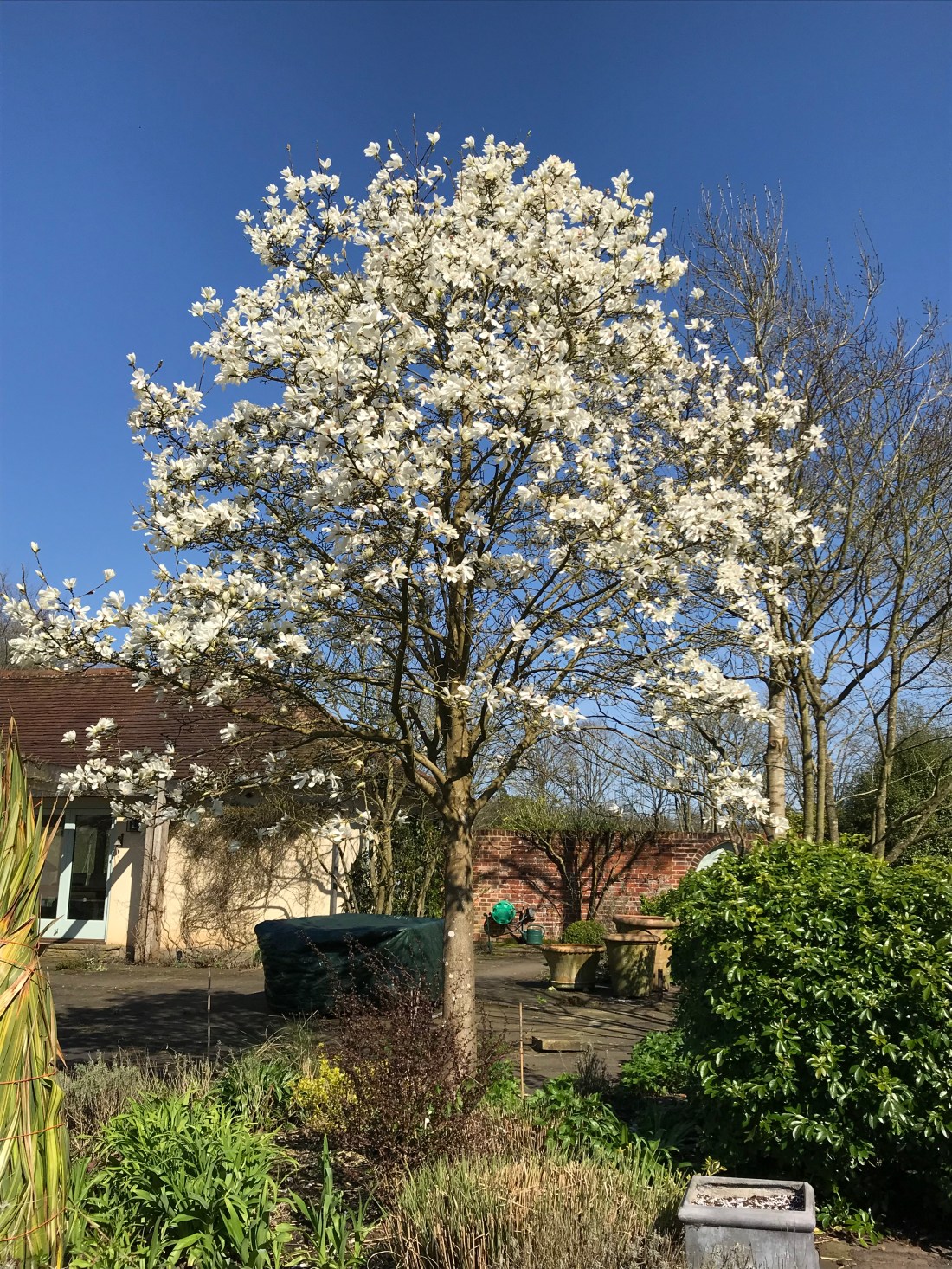
I have found the third sister to dance in my ‘Grove of Cadmus’ with Betula ermanii and Amelanchier canadensis. Magnolia kobus, the extroverted one. She has been a bright white flare in the garden all week. She carries her flowers before her leaves; six-petalled, loose blossoms of around 10cm/4″ across. They are star-formed, like her smaller cousin Magnolia stellata, and burn so brightly they start to fall within a week, strewing the ground with so many feather-like petals. In the language of the ‘goddess in triad’ she is Aphrodite (the birch is Hera, Amelanchier is Artemis), and her ephemeral, fragrant season is the perfect metaphor for the fleeting intoxication of love. The stellate flowers are fragile too, appropriately for my metaphor, in a way that the longer lasting tulip-formed or cup-shaped ones of other magnolias are not. But, just as I would always rather love and lose than never love, no matter the pain of heartache, Magnolia kobus deserves her place in the garden. My mythical grove would have a ratio of 3 Betula:2 Amelanchier:1 Magnolia. Extroverts are fun in company, but only when in the minority. The subtle birch and the gentle Amelanchier are needed for balance and stability. I am being a little unkind. The green foliage and not just the blossom is fragrant, and its dull gold in autumn adds a warm rather than fiery tone, and its subtlety is welcome.

Magnolia kobus is native to Japan and Korea and so fits the other ambition for my grove – that plants from hostile countries should be in harmony. It is named in honour of the French botanist Pierre Magnol and the English language does his name a disservice by hardening the ‘g’, making the name uglier than it need be. On the other hand, English softens the Genus named after the German botanist Leonhard Fuchs to the point of acceptability in polite company, so there are swings as well as roundabouts in the botanical playground.

The flowers of all MAGNOLIACEAE except for Liriodendron tulipifera, are pollinated by beetles because, being so ancient, they evolved before there were bees. Can any idea convey the parochial and transient nature of human concerns so well as that? There was a world before bees. And life in this world which remembers.

IMG_0400

Primula vulgaris

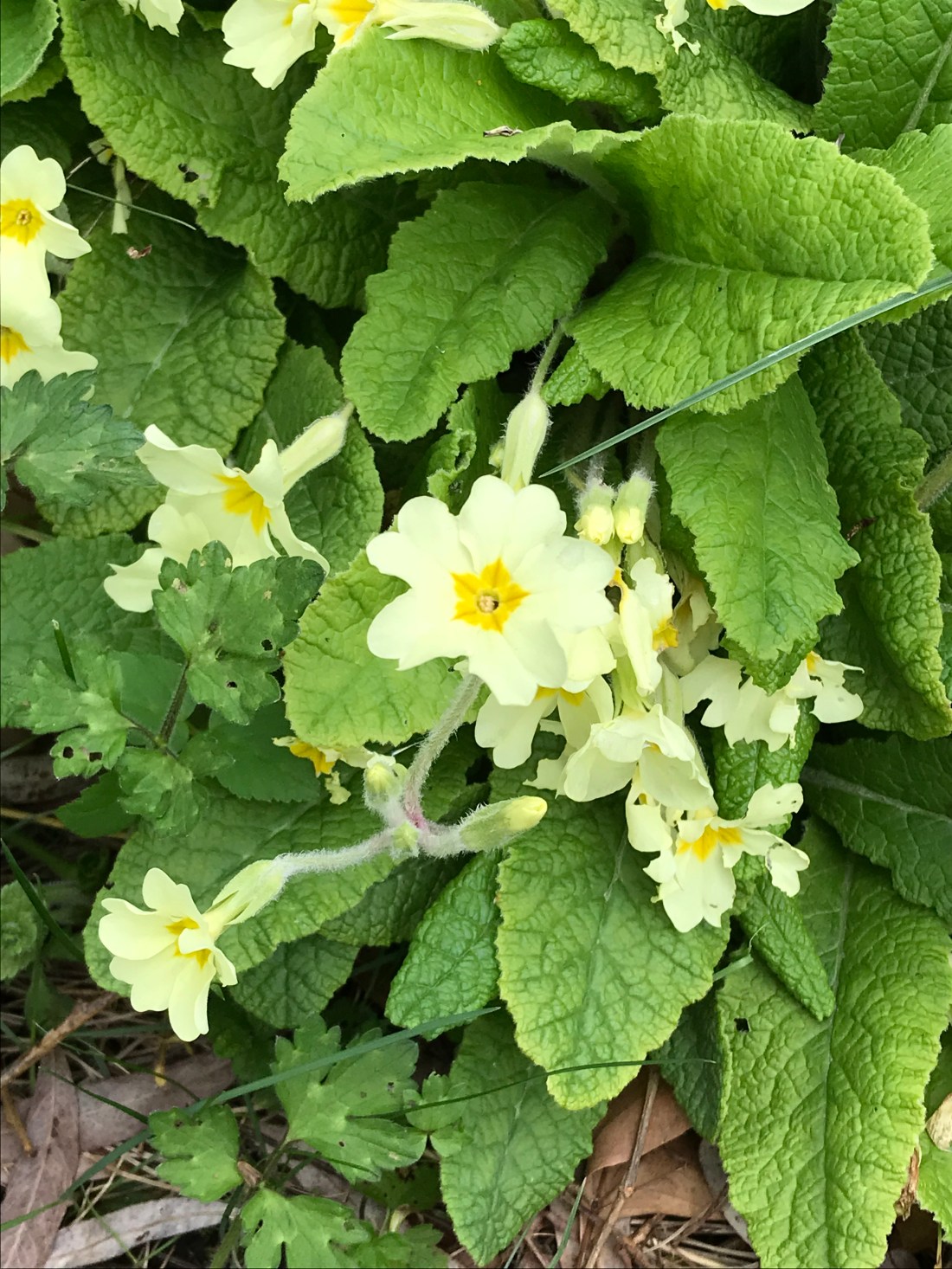
If ever a plant suffered an abusive relationship, it is the primrose. No sooner than it has been praised for being the ‘first rose of the year’, it is damned as common. It is common, when left in peace, and the world is better for it, as it is a flower of beauty and tranquillity. Primula vulgaris has an extraordinary range extending from the Faroe Islands in the far north to Iran in the southeast.  This suggest to me that it has been around for a long time and that its endurance is a function of its adaptability. It finds its niche, wherever it finds itself.

I believe it was de Girardin, Rousseau’s last pupil, who wrote that all gardens should be like woods and all woods like gardens. It is a maxim which fills my mind with images of bluebells under silver birch: I am a man of the north, after all.  I remember a walk which a friend initiated many years ago to Routing Linn in Northumberland, England. He wanted to show us the cup and ring carved stones and the waterfall there. As we walked from the carpark to his destination, we passed through the ditches and ramparts of an Iron Age fort. It had been reclaimed by the wild, and the curving banks of turf were densely carpeted with blue bells whilst the native birch rose airily above them. As a gardener, I so often look at a ‘natural’ landscape and start re-organizing it for better balance, harmony, or emotional effect. There was nothing to be done: it was the perfect composition and I was stopped in my tracks. The waterfall is unremarkable, but I may be unkind, as nothing could compete with the silver bark rising from the cerulean ground. Primroses are like that too; they are unexpected and surprising.  Yesterday, I was walking around, looking for my subject. We saw some primroses which looked lovely, massed on a bank under a hedge. As I drove home, along a road which scoured the chalk downs twenty years ago when it was made, Primula vulgaris had colonised the broken stone on each side of the carriageways, softening the violence we had forced on the earth. I took the hound Floyd out for his last pee of the day and, under the hedge, primroses. Do dogs have aesthetic appreciation? I think so; I have seen him enjoy a landscape, and he will make eye contact with me in a mirror although he doesn’t find it as fascinating as I do. He appreciated the flowers in his own way. Vive la difference!

Primroses are such a gentle yellow, but perhaps context is everything. Paint a room primrose yellow, and it will feel cold – the yellow has too much green within it. Yet outside, under the sun, it feels soothing, especially when compared to the donkey-bray of the daffodil trumpeting nearby. In the British Isles they often associate with dog violets, particularly on sunny banks under trees, and the soft violet of the one and the primrose yellow of the other are perfect companions.  Primroses, like most flowering plants, are hermaphroditic, but the primrose has an unusual strategy to discourage self-fertilisation and encourage variety. It is known as pin and thrum.  Some plants have pin flowers which hold the capita of the style prominent whilst in thrum flowered plants the stamens are uppermost. The style is the female organ whilst the stamens are male. The fertilising insect will encounter one or other of the organs first, depending on the flower. The genes mix accordingly.


IMG_0394

Chaenomeles japonica

I have been tying in a neglected Japanese quince to a wall. Blood flowers from my thorn-pricked fingers. I dislike wearing gloves and avoid doing so most of the time. Touch is essential in a garden – I learn so much about the condition of the soil when pulling weeds and feeling the resistance of the roots and the crumb of the earth through my finger tips. I was walking with a friend through the University Parks in Oxford yesterday,  and a propros nothing she said, “Your fingers always remind me of iris rhizomes.” I’ve had more flattering compliments, but there is something pleasing all the same about the image, something chthonic: my hands grasping the soil like roots and gaining strength therein. Just as I have always been healthier and happier when working the earth. My hands bear the scars of my craft, but they are better looking than my feet, which I subject to marathons.

The problem with shrubs or trees recommended for training against a wall is that they would rather not be growing against a wall. They do not grow naturally in a flattened vertical plane and their 360º nature is always trying to assert itself. Chaenomeles is particularly effusive and throws up numerous twisty stems. In some ways it is like the missing link between the blackberry and the rose – all three are ROSEACEAE – and left to its own devices it forms a tangly mound of a shrub. It is so effusive that I have encountered a successfully wall-trained Chaenomeles only once, on a house that also had magnificent Pyracantha ladders scaling its walls. But, the slightest inattention and it is out of hand. Perhaps this is why it is popular as a subject for bonsai in the Far East – it allows the expert to demonstrate excellence in the practice; a craft dedicated to breaking the will of nature.

Chaenomeles japonica is not a quince, although they are related, distantly. I once heard the first part of the name explained as ‘gape apple’ from the Greek, the meles being the apple. The hard, golden fruits are astringent at best, which will be the effect of their high levels of Vitamin C, aka Ascorbic Acid. Allegedly, they can be eaten raw once bletted, which is a term also applied to another fruit of the rose family, the medlar. It means rotted, as far as I can tell. I have always believed that the best consumer of medlars was a pig and the finest way of eating medlars was as pork. Sheep and goats would no doubt enjoy them too. The fruit of Chaenomeles is enticingly fragrant, and being high in pectin it is a fine addition to an apple or crab apple jelly, which can then be enjoyed with a medium hard cheese. Or a nice salty ham.

UKiREUjFSdS37oVO6vjRZg

Anser anser

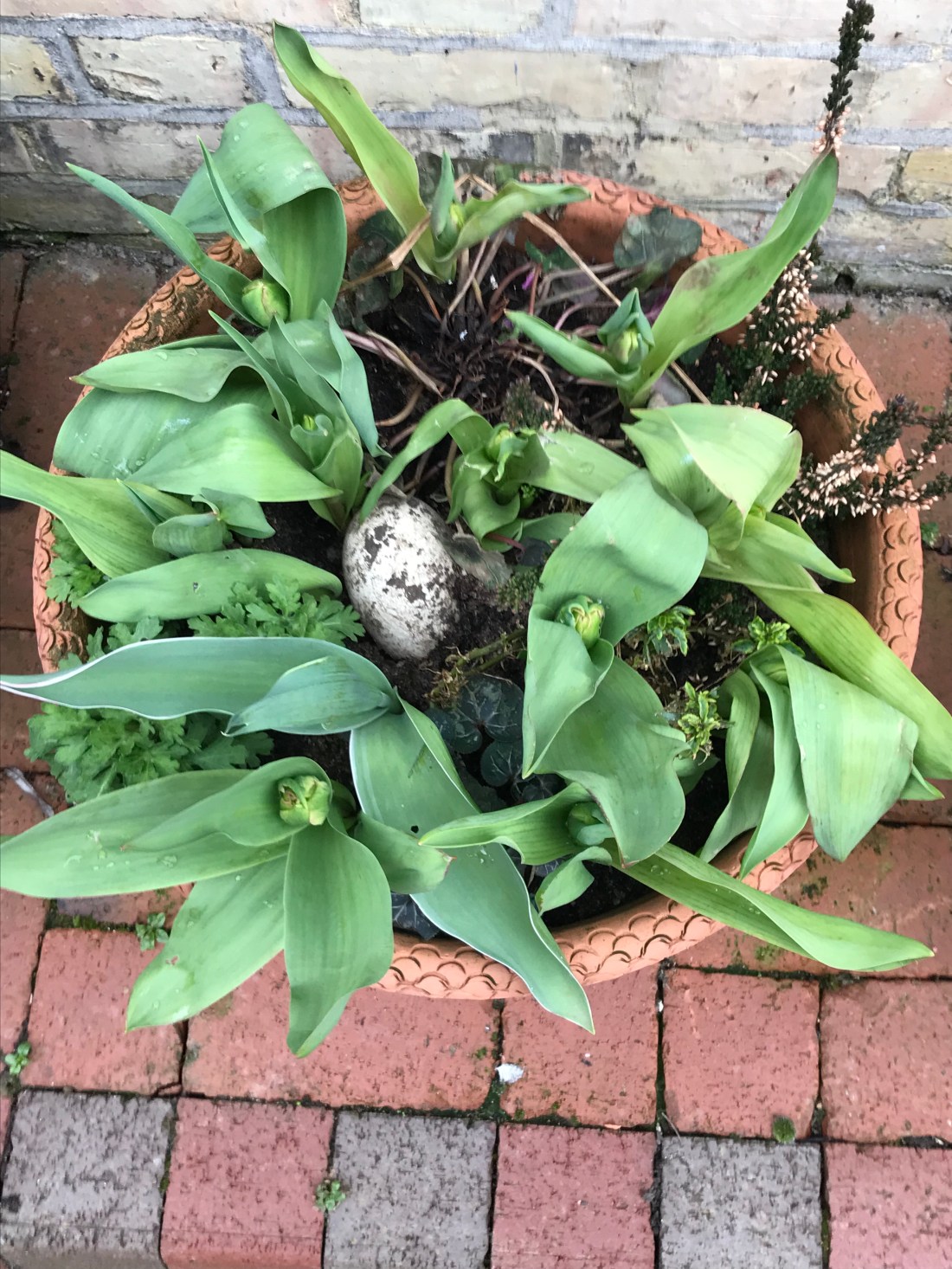
In a pot by the door, a pot only a little larger than a goose, a greylag goose, Anser anser has laid an egg. She must have been balanced precariously, then, mission accomplished, took time to tuck the egg into the compost, arranging the leaves of the tulip over it. We puzzle at the strangeness of the choice. The river runs on the other side of the house and there are fields and rushy channels which provide abundant nesting sites. Perhaps she was “caught short”, but that too seems unlikely. There is something too deliberate about the placing of the egg and the arrangement of cover. It looks as if the pot was chosen. It is a timely reminder that we can garden for others and not just for ourselves. That every arrangement we make of plants and hard materials, can be used by different species for their advantage. I have spent many a happy time watching mason bees exploiting the porosity of old lime mortar in a south-facing garden wall, tunnelling in to the wall’s very core and exploiting its protection and warmth. Or the blackbirds which would visit the rill on a hot summer’s afternoon, bathing in the shallow water before retreating refreshed to a perch, invariably to sing. And my hound, Floyd, who over the course of the day will migrate between sunlight and shade as the temperature waxes, following the best conditions for sleeping. The trees and shrubs which form his bower were not chosen with him in mind, but he finds them perfectly amenable.

It is timely too, because it is Easter, and eggs signify new life in many traditions, not only the Christian. In a museum in Newcastle-upon Tyne, there is a Roman era stone relief recovered from Housesteads Fort on Hadrian’s Wall. It depicts Mithras, being born from a cosmic egg. I find it fascinating that a Persian deity adopted by the Romans should be carved in local sandstone at the most northerly point of the empire. But then, worshipping a lord of light probably helped preserve the memories and dreams of the Mediterranean sun. As March turns to April and half the country is still gripped with snow and the remaining half with constant rain, summer seems like an elusive dream.

IMG_0385

Dryopteris affinis

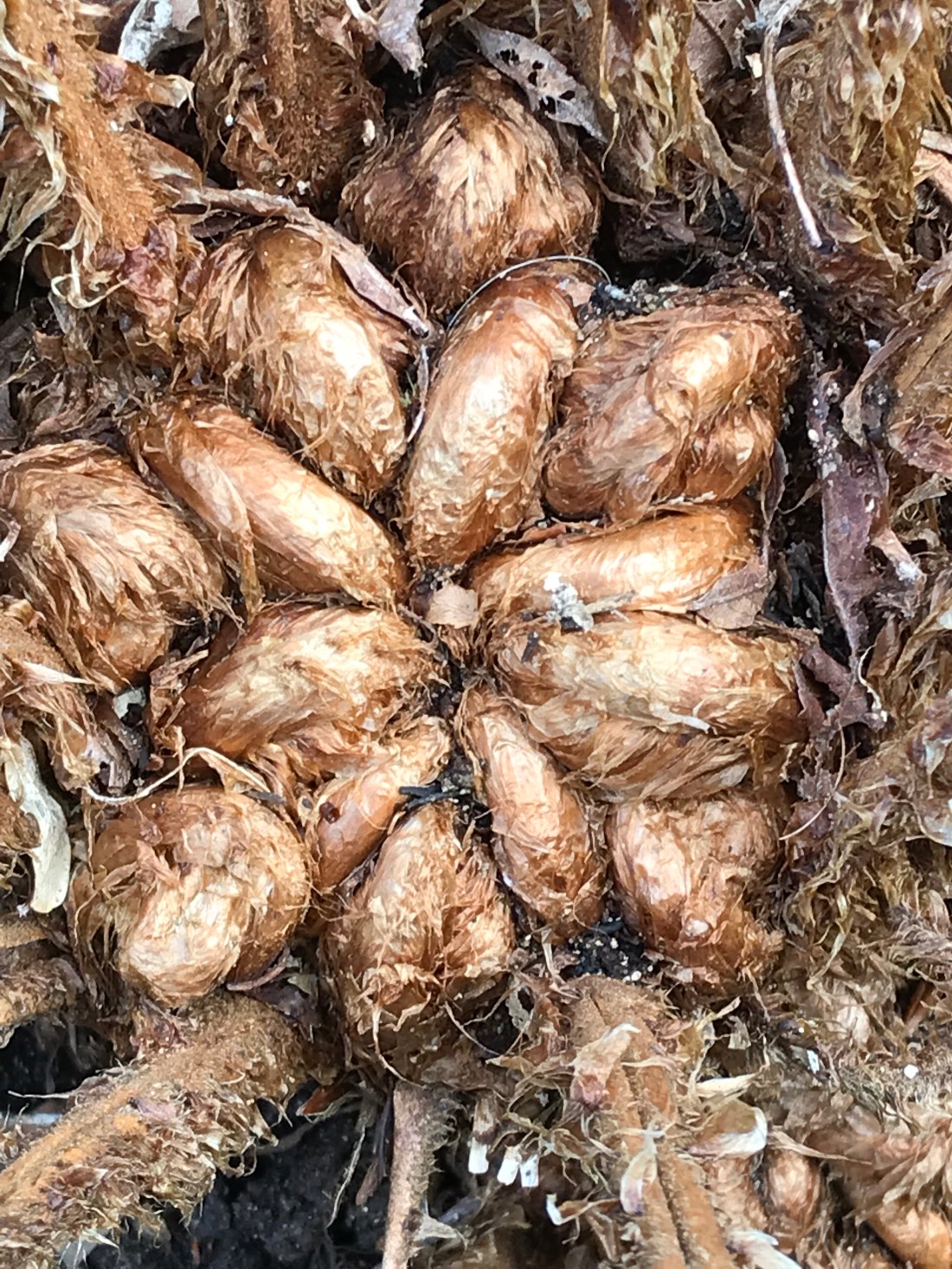
The male fern populates my nightmares. They cluster together in corners and under shrubs like nests of massive spiders, with their legs pulled tightly into their bodies ready to pounce. The rachis, the ‘spine’ of the frond is covered with hairy brown scales or ramenta near the base which only adds to their arachnid character. Although it is not carnivorous like a Venus fly trap, it is easy to imagine it catching frogs and mice, grabbing them with its fronds, closing over them, embracing them in a slow proteolytic death.

Dryopteris affinis is semi-evergreen, but  in the garden it is best to cut the fronds down in autumn as they grow tatty with age and break in the winter storms. This reveals the coppery crowns which look so spider-like. It also prepares one of the great anticipations of the gardening year. In spring, the rising turgor unfurls the crozier fronds with all the beauty of a flower slowly opening over a fortnight. As the fronds grow around a central rhizome, the fern in summer is a handsome ‘shuttlecock’ standing proudly to as much as 1.5m/5′ tall.

Dryopteris affinis is an unusual edition of these postcards as it is native to the British Isles. It grows in the wetter parts of western France too and even down into the Caucasus region, but the further south it goes and the drier it gets, the higher is climbs up the hillsides. Moisture, both in the ground and in the air, is its determining factor. With plenty of water it will grow in all soils and in full sun, although in the wild it is most frequently found in deciduous woodland. It is useful in the garden to bring height and texture to that difficult damp, shady corner. It can be a useful foil behind Helleborus niger or Cyclamen coum too.

The male fern is not male, of course. It is hermaphrodite like most other ferns. Its gendered common name is a reflection of historic social attitudes. It is a male fern with sturdy, upright fronds, coarse pinnae, and a hairy bottom. The ‘lady ferns’ of genus Athyrium are more delicately constituted and less hirsute.

Dryopteris

Pulmonaria officinalis

I returned to Oxford after a week in the north. Spring had arrived in my absence. In the hedgerows of Port Meadow the blackthorns were clouds of white blossom, whilst in the University Parks, carpets of purple crocus lined the paths. I went in search of my Pulmonaria and I found it at last, hiding under the skirts of shrubs in the borders, like shy chicks beneath a hen.

Pulmonaria officinalis, or common lungwort, is so named  because the spotted leaves were said to resemble diseased lungs. In the era of sympathetic magic or the Doctrine of Signatures, depending on which side of the theological divide you found yourself, plants were believed to carry signs indicative of their usefulness. The cemeteries of Europe and beyond are littered with the results of this belief, but like many beliefs, it is highly resistant to contra-indications. It is still possible to buy a tincture of Pulmonaria officinalis for chest complaints. I pass no judgment on its efficacy.

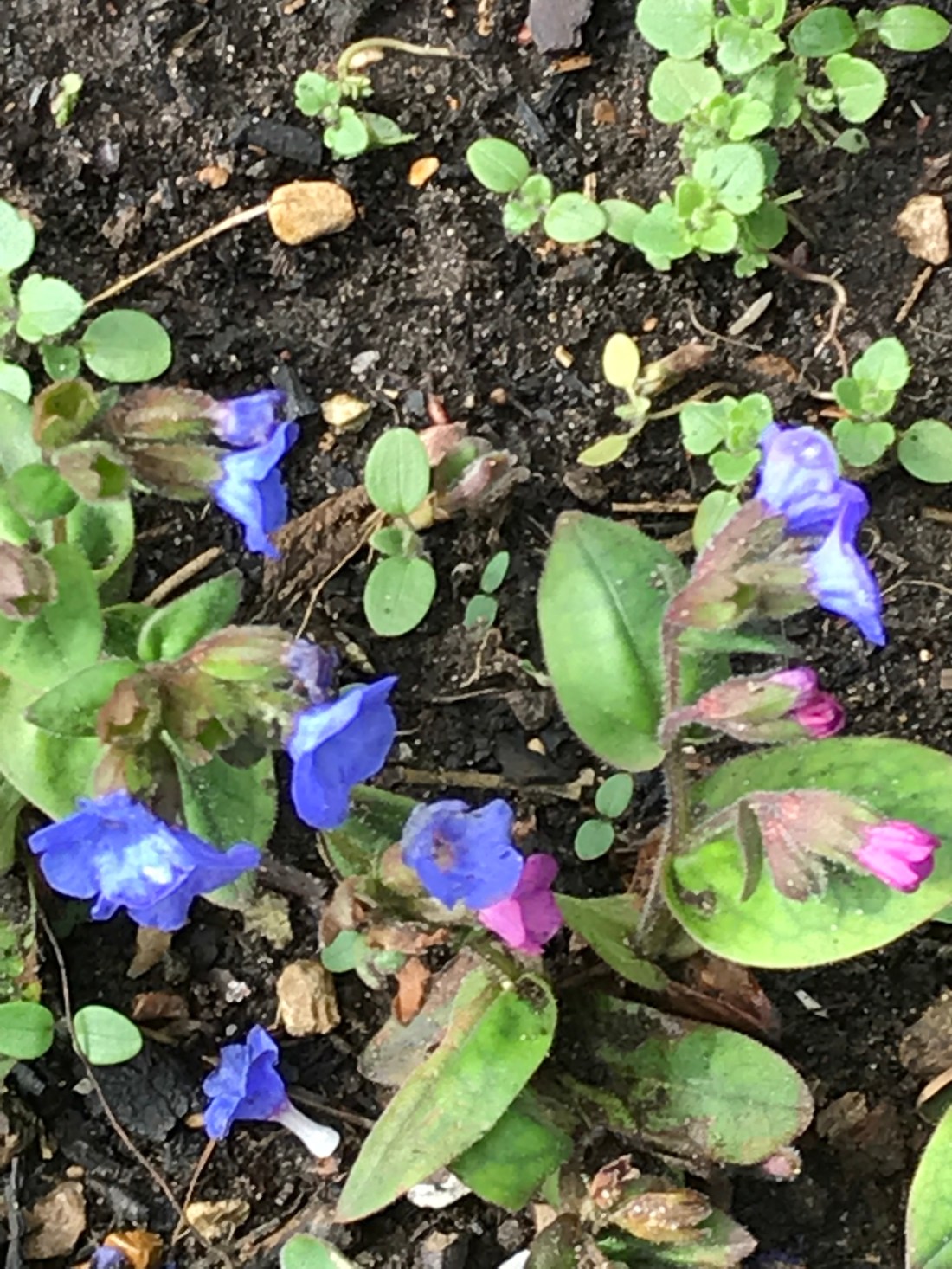
Pulmonaria officinalis is a plant with an unusually large number of common names. Some, like Adam and Eve or Soldiers and Sailors seem to refer to the different coloured flowers borne on the same plant. I believe this is an expression of a pH change within the maturing flower from alkaline (pink) to acidic (blue), although this charming characteristic has been bred out in cultivars such as Sissinghurst White and Blue Ensign. Spotted Dog refers to the leaves, whilst most of the others have Christian associations, which I assume is indicative of its importance to the medieval monastic herbalists – note the officinalis again. An incomplete list includes, Jerusalem Sage, Bedlam (Bethlehem) Cowslip, Jerusalem Cowslip, Sage of Bethlehem, Mary’s Honeysuckle, Mary’s Tears, Lady’s Cowslip, and Lady’s Milk.

By whichever name it is known, it is most useful in the garden. It covers the ground nicely in shade and semi-shade and is hardy down to -20 Celsius. The lovely flowers in pink and blue, are a valuable early food-source for bees which start to fly once the thermometer rises above 6 degrees. The spotted leaves are pretty enough if one is not thinking of diseased lungs, although they are prone to powdery mildew in dry conditions. No matter, just cut them off and give the plant a good water, and new fresh leaves will grow.

Pulmonaria officinalis