
Conditions are perfect for digging. It is cold, the air is 3 Celsius, but not frosty. The sun is gaining strength in a cloudless sky. I can work in short sleeves as is my preference. The moisture level of the soil is optimal – neither too dry nor too wet and I can dig without damaging its structure.
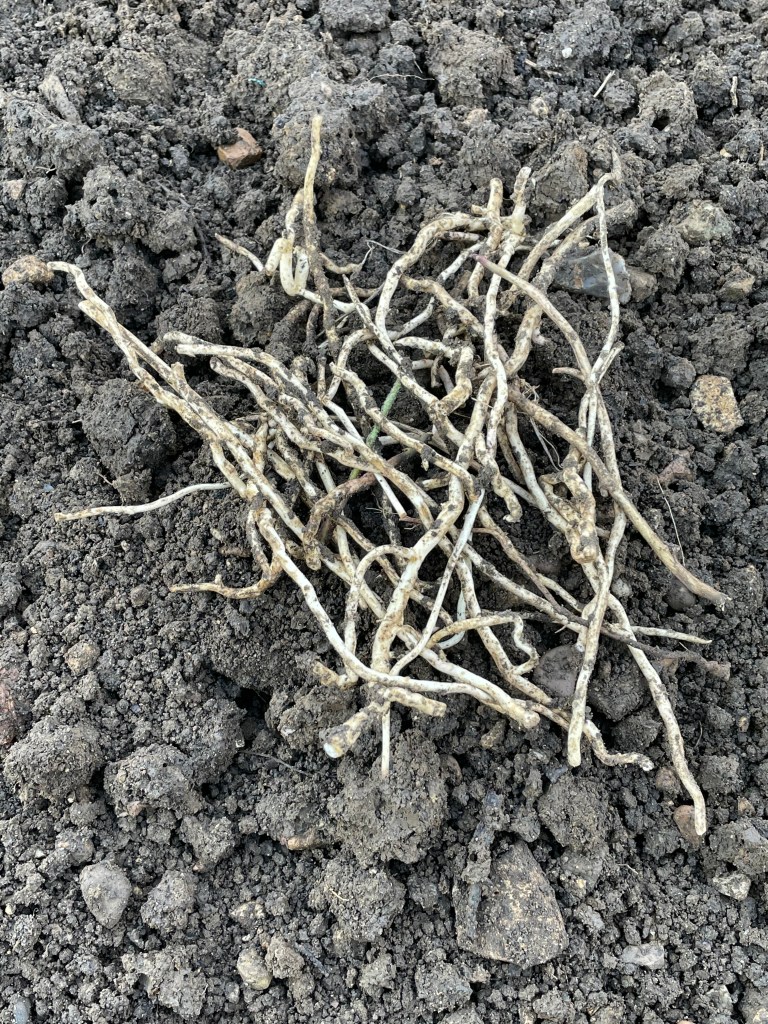
I am preparing a border for re-planting. Yesterday, I lifted all the plants which were not required and disposed of them. Today, I lifted a Magnolia stellata and a Viburnum opulus ‘Rosea’ which will be replanted in the garden but elsewhere. Replanted once I have washed their roots thoroughly as they, in common with the waste plants are riddled with the roots of another plant, Calystegia sepium, common bindweed. As I dig the now bare border, I can feel the thongs of it break on the tines of my fork. I become avian, stooping to pick out the smallest worms of the long white roots. I have seen it re-grow from a piece as small as 1cm or 3/8″ from as deep as 30cm/12″, such is its vigour. It is not a huge border, 1.2m/4′ wide, 12m/38′ long, but I fill two large buckets with these roots.
I suppose most gardeners have their favourite plants and their least favourite weeds. I always tend to have a shortlist. It is not that I am indecisive, I just appreciate context. Setting aside the Victorian monsters – the Japanese knotweed, the Rose Bay Willowherb, the Giant Hogweed (I bear the scar of this one), I think my two least favourite weeds are creeping thistle and common bindweed. They share vices. Both reproduce sexually, via seed and asexually by the roots. I know that as I dig and break the roots that every piece I create and leave behind will grow into a new plant. The border has a brick path on one side and a lawn on the other. The roots disappear beneath each. I can bury a membrane on the path side which might stop regrowth, but that isn’t viable on the lawn side. And then there are the seeds.
Like so much of gardening, this digging is a tuition in humility and reasonableness. I know I will not extract every single piece of root and yet I must try to remove as much as I possibly can. Some might call it futile, but I guess you understand why Sisyphus pushes the rock up the hill, or you don’t.
We have a plan. The border will be replanted with espalier apple trees, centrally placed. After that until autumn, any re-growth of bindweed will be dug out or treated with a translocating herbicide – one which is taken in through the leaves and stems, then moves around the plant even into the roots. Only then will we plant spring-flowering bulbs and something herbaceous for summer. As the border is long and narrow simplicity will be best. I’m recommending Narcissus ‘Thalia’ for the first and a Hemerocallis such as ‘Gentle Shepherd’ for the second. It should be lovely.

 thephilosophergardener