
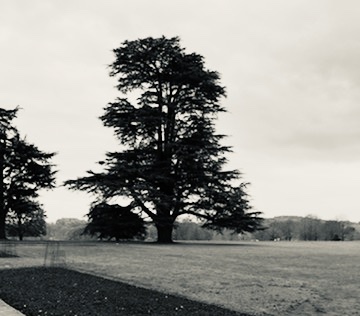
Winter is the season of the evergreen, carrying life and hope through the darkest months of the year. The Cedar of Lebanon I have in mind, the one which is pictured, stands on the west lawn of Cornbury House, the property of the Lord Rotherwick in Oxfordshire. It is a suitably aristocratic association. Having first been mentioned as present in England by John Evelyn in his magnificent ‘Sylva’ (1664) they became the ‘must have’ tree on English estates especially from the 1770s onwards. I caught sight of my tree yesterday whilst driving. Its crown rose above the deciduous trees in front of it in a way which is not noticeable when they are in leaf. Perhaps it was a trick of the winter light as it seemed to tower over the adjacent mansion too. It is home to a pair of ravens who fill the garden with their calls. Last year I watched them carry a nestling crow to feed their own brood. It’s a dog eat dog world.
Cedars of Lebanon are suited to an extensive lawn as although not a giant of the arboreal world (130’/40m being their limit), they do throw out their arms widely; thick arms of immense weight which join the trunk close to the horizontal. I am often amazed by the strength of trees. It is not a tree for a town garden, but then, few trees are, sadly. Or perhaps it is the opposite – few town gardens are suitable for trees.
Although Lebanon names the tree, in part due to long association – it appears in the Bible and the Epic of Gilgamesh, they are native to Cyprus, Syria, and southern Turkey also. They were so highly prized in the ancient world that the Roman Emperor Hadrian (ruled AD117-138) established a reserve to protect them. As cedars can live for over two thousand years, it is possible that saplings of Hadrian’s time are still with us today. They were valued as a building timber and for furnishing. The wood was burnt in rituals of purification and the Egyptians used an oil derived from it for embalming.
I have a tabletop and benches made from barn-seasoned planks which were gifted to me by friends – one of their cedars came down in a storm many years previously. When the table was delivered, the whole house filled with the essence of the tree and remained fragrant for a month. I have left the surface untreated except for a light oil and intend it to be a repository for memories – every red wine stain a testimony to friendship and hospitality, of dinners enjoyed with glasses of Chateau Musar form the Bekaa Valley in Lebanon: a perfect convergence. Once a year I will sand it lightly, certainly not enough to erase the memories, just sufficient to raise the scent of the tree.


 thephilosophergardener